Appliances & Heat
Moka Pot
A stovetop coffee maker that forces steam-pressured water up through ground coffee for a strong brew.
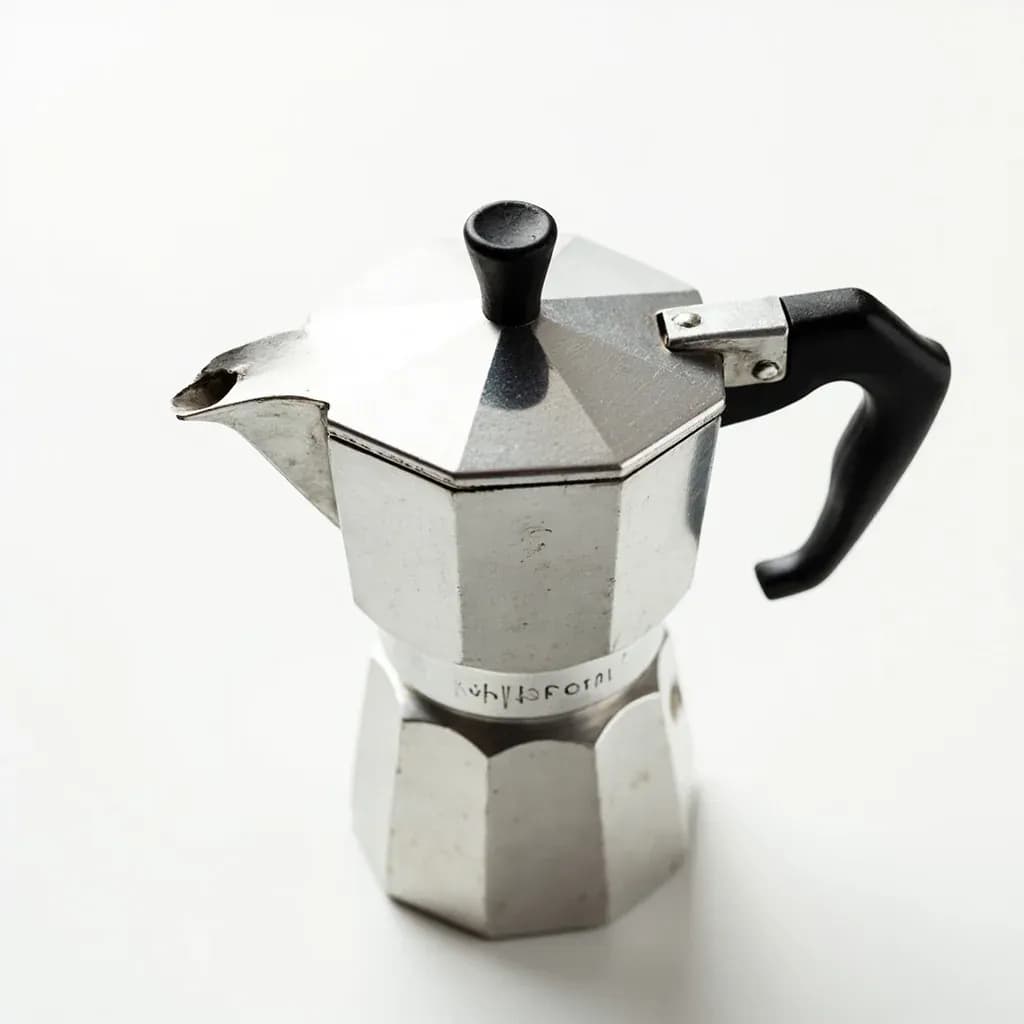
A moka pot is a screw-together metal pot with a water chamber, a coffee basket, and an upper collecting chamber. Heated on the stove, steam pressure pushes hot water up through the grounds and into the top, yielding a concentrated espresso-style coffee. The classic aluminum octagonal design is an Italian icon; pulling it off the heat as soon as it gurgles keeps the brew from scorching.
The moka pot is a stovetop coffee brewer that uses steam pressure to push hot water up through a bed of ground coffee, producing a strong, dense cup that has been a fixture in Italian kitchens since 1933. It sits between drip coffee and true espresso — far more concentrated than a pour-over, but reaching only about a third of espresso's pressure — so the result is best understood as a distinct style of coffee rather than a homemade espresso. Its three-chamber construction (lower boiler, middle filter basket, upper collector) is simple, durable, and works on any heat source that can boil water, which is why it remains the dominant home-brewing method in Italy and has spread into nearly every coffee-drinking country.
What makes the moka pot worth understanding is that the quality of the cup is almost entirely in the operator's hands. Grind size, water temperature, burner level, and the exact moment you pull the pot off the heat all shape the final flavor in ways the device itself does not control. A few small habits — hot water in the boiler, level but untamped grounds, the lid open, off the heat the moment the spurt turns pale — push the result from harsh and metallic toward rich and balanced. Master those, and a modest aluminum pot outperforms a careless user on a far more expensive espresso machine.
Alternatives
Types & varieties
The 1933 octagonal cast-aluminum original; the visual archetype of the moka pot.
Modified design with a weighted, spring-loaded opening lid that forces a thin crema-like foam into the upper chamber.
Rounded stainless-steel body, induction-ready; updated aesthetic introduced in the 2000s.
Stainless-steel, induction-ready, dishwasher-safe; rounded silhouette similar to Musa.
Compact stainless version designed for small stovetops and travel.
Slim cylindrical stainless-steel body for induction.
Designer model by Richard Sapper (1979); tall conical silhouette, induction-compatible stainless.
Stainless-steel induction model; a popular alternative to Bialetti.
Budget aluminum versions common in Latin America and the US; basic but functional.
Umbrella term for non-Bialetti octagonal aluminum pots in the same form factor.
Anatomy of a Moka Pot
Every moka pot, regardless of brand or finish, is built from the same three parts stacked and screwed together. Knowing what each does makes both brewing and troubleshooting much easier.
- Lower chamber (boiler): holds the water. The water level should sit just below the safety valve — never above it — so pressure can vent safely if the filter clogs.
- Middle filter basket: a small metal basket that holds the coffee grounds. It sits on the central column rising from the lower chamber; steam pressure pushes water up through the column, through the coffee bed, and out through the spout in the upper chamber's lid.
- Upper chamber (collector): receives the brewed coffee. The spout inside the lid is what produces the visible 'spurt' as the pot finishes brewing.
- Safety valve: a small spring-loaded valve set into the lower chamber wall. It releases pressure if the filter becomes blocked, which is why the water must always stay below it.
- Gasket and filter plate: the rubber gasket seals the upper and lower chambers; the metal filter plate sits above the basket. Both wear out and need periodic replacement.
Moka vs. Espresso: A Useful Distinction
The phrase 'stovetop espresso' is technically a misnomer, and the difference matters for how you brew and how you taste the cup. Real espresso machines use a pump to push water through the grounds at roughly 9 bar. A moka pot relies on steam pressure that tops out near 1.5 bar — enough to force water through the bed, but not enough to emulsify oils the way a pump does. The moka cup is therefore strong and dense, with a heavier body and little or no crema, and is served in a demitasse rather than a straight shot glass. Treating it as 'espresso at home' usually leads to disappointment; treating it as its own style of strong coffee is the more useful frame, and it explains why Italians drink it as a default morning brew rather than as a special-occasion drink. The same brew also works beautifully as the base for milk drinks, where its body and slight bitterness hold up well against a lot of milk.
Common uses
Tips & pitfalls
- Fill the lower chamber with hot, pre-boiled water instead of cold. Cold water lengthens the contact time and produces a metallic, bitter cup.
- Grind medium-fine, the texture of table salt. Espresso-fine grounds clog the filter plate and over-extract; drip-coarse grounds let water rush through weak and sour.
- Fill the filter basket level and leave it. Do not tamp — moka pots brew by gravity packing and steam pressure, not by compression, and tamping chokes the flow.
- Use medium-low heat. High heat scorches the bottom of the boiler and turns the last part of the spurt acrid.
- Leave the lid open and watch the spout. Pull the pot off the heat the moment the stream turns pale yellow or starts to sputter — what comes out after that point is over-extracted.
- Set the bottom of the pot on a cold, wet towel the moment you pull it off the burner. The thermal shock halts extraction and noticeably reduces any metallic taste.
- Never fill water above the safety valve in the lower chamber; the valve must stay clear of water so it can release pressure safely if the filter clogs.
- Replace the rubber gasket and the metal filter plate every 6–12 months. Worn parts cause leaks, slow flow, and weak brews — most 'broken' moka pots are simply a gasket away from working like new.
Good to know
- Inventor
- Alfonso Bialetti, in Omegna, Italy
- Year introduced
- 1933
- Brewing pressure
- Approximately 1.5 bar — about one-third of true espresso (9 bar)
- Cup size
- Roughly 60 ml (2 fl oz), close to a single espresso shot, not a US 8-oz cup
- Construction
- Three chambers: lower water boiler, middle filter basket, upper collector
- Brew time
- About 4–6 minutes on medium-low heat for a 6-cup pot
- Grind size
- Medium-fine, similar in texture to table salt — coarser than espresso, finer than drip
- Heat sources
- Gas and electric for aluminum; stainless-steel models also work on induction and ceramic
Also called
Moka Pot / Espresso Maker · Stovetop Espresso Maker · Moka Pot (Kotyogós Kávéfőző) · Stovetop Coffee Maker · Napoletana Coffee Pot · Caffettiera
Related

Stovetop
The everyday burners where most cooking actually happens

Oven
Enclosed dry heat for roasting, baking, and braising

Grill
Live-fire or gas grates for char, smoke, and high heat

Smoker
Low, slow heat and wood smoke for barbecue and brisket

Air Fryer
Countertop convection that crisps with little or no oil

Slow Cooker
Set-and-forget low heat for stews, beans, and braises

Pressure Cooker
Sealed steam pressure that cooks tough food in a fraction of the time

Rice Cooker
Foolproof, perfectly steamed rice every single time