Appliances & Heat
Offset Smoker (Stick Burner)
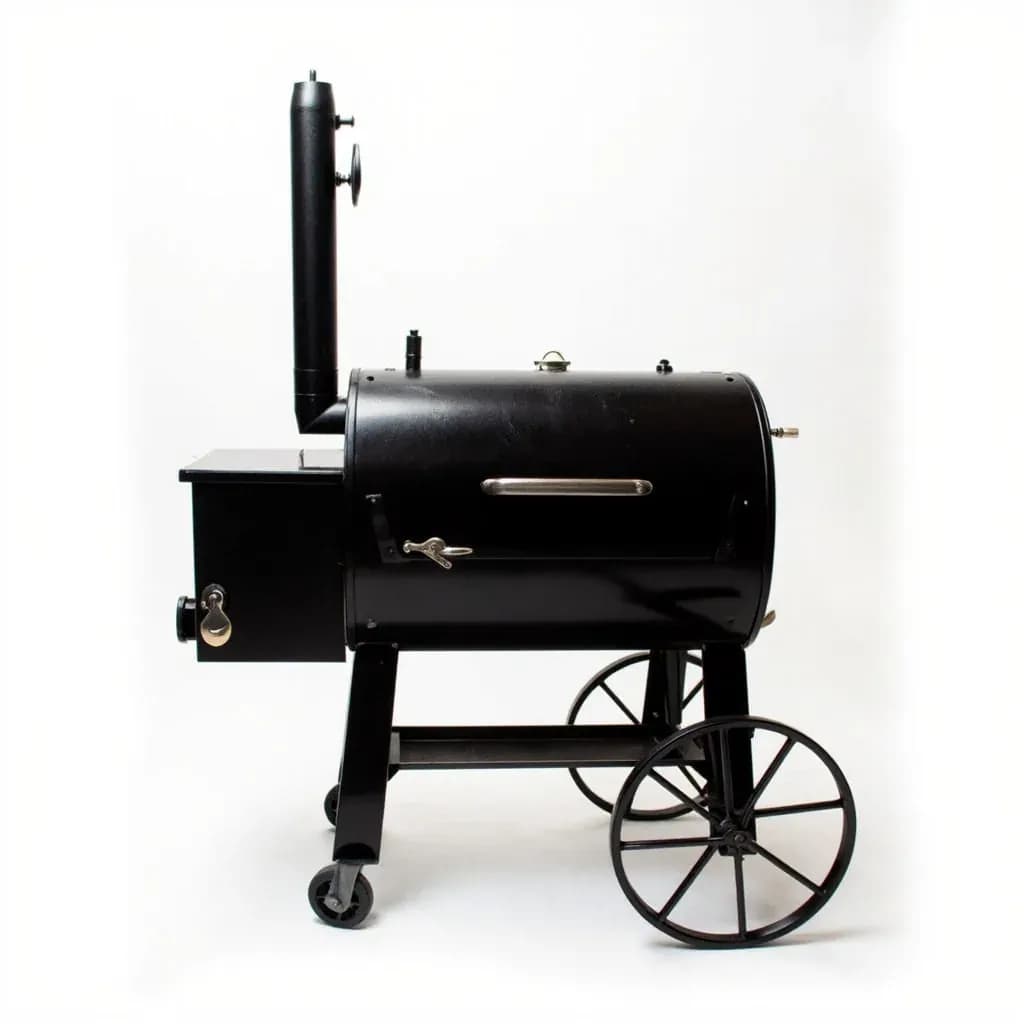
A barbecue smoker with a separate side firebox that draws wood smoke across meat in the main chamber.
An offset smoker burns wood or charcoal in a firebox attached to the side of a large cooking chamber, pulling heat and smoke horizontally across the meat before it exits the chimney. The indirect, low-and-slow heat is the backbone of American barbecue brisket, ribs, and pulled pork. Pitmasters call it a stick burner because it runs on split logs, and managing the fire for steady temperature is a skill in itself.
An offset smoker — also called a stick burner, pipe smoker, or horizontal offset — is the barrel-style barbecue cooker with a side firebox that defines traditional American low-and-slow barbecue. Hardwood splits burn in the firebox; the heat and smoke are drawn across a separate cook chamber and out a smokestack on the far end. The meat never sees flame. What it does see, for many hours at a time, is a steady stream of convective heat and wood smoke that dries the surface, builds a dark mahogany bark, and renders fat slowly. This is the cooker behind Texas brisket, Carolina and Memphis pulled pork, and most of what the competition barbecue circuit produces.
Pitmasters reach for an offset over a pellet grill or electric cabinet smoker because the flavor of split-wood combustion is fuller, sharper, and more dimensional than what processed fuels deliver. They accept the trade-offs: pronounced hot spots from firebox to stack, sensitivity to wind and weather, and a learning curve measured in dozens of cooks rather than hours. Operating one is, in practice, a fire-management discipline. Draft is governed by the intake damper on the firebox door and the exhaust damper or stack cap; temperature is held in the 225–275 °F range by feeding splits on a schedule, not by turning a dial. That hands-on character is exactly what the format's devotees love about it.
The defining engineering variable is thermal mass, set by steel thickness, chamber length, and whether the walls are insulated. A 1/4-inch-plate, 60-inch competition cooker holds temperature through a windy afternoon far better than a 1/8-inch, 36-inch entry model. Reverse-flow and insulated designs are modern answers to the chief complaints about the traditional direct-flow layout: hot zones near the firebox and inefficient fuel use. None of those refinements change the basic equation, though: a stick burner rewards a cook who learns to read smoke, judge fire, and leave the lid alone.
Alternatives
Types & varieties
Smoke travels straight from the firebox through the cook chamber and out the chimney. Stronger smoke profile near the firebox, tapering toward the stack end.
Adds a steel baffle plate and tuning plate that force smoke to the far end, under a lower shelf, and back toward the chimney. More even heat across the grates and a milder, more uniform smoke profile.
Double-walled construction, often with an air gap or ceramic blanket. Holds temperature more steadily in cold or windy weather, burns less fuel, and reduces hot spots.
A longer, shallower cook chamber popular on the competition circuit for laying out long racks of ribs in a single row.
Smaller, lighter units (often 24–30″) intended for tailgating or home use. Lower thermal mass means more temperature swings and tighter fuel management.
Reading the Smoke
Smoke color is the most honest feedback a stick burner gives you. Aim for a thin, almost-invisible blue plume exiting the stack — that is clean combustion of well-seasoned hardwood at the right oxygen-to-fuel ratio. Thick, white, billowing smoke means the fire is starved of air, the wood is too wet, or you have just opened the firebox and a fresh split is smoldering against cold coals. White smoke deposits creosote on cold meat surfaces and leaves a bitter, acrid bite that no rub or sauce can hide. If you see white, open the intake damper a touch and let the fire breathe; do not compensate by adding more wood, which usually makes the problem worse.
The Three Variables: Draft, Fuel, Oxygen
An offset smoker has no thermostat. Chamber temperature is the byproduct of three things you control: how much air enters the firebox (intake damper), how fast that air is pulled through the chamber (exhaust damper or stack cap), and what is burning (split size, wood species, charcoal). The most common mistake new pit cooks make is treating a stick burner like an oven — opening the door to check on things. Every peek dumps heat, prolongs cook time, and rewards you with a rush of white smoke.
- When temperatures run high, close the intake a quarter-turn first, then trim the exhaust. Do not open the lid.
- When temperatures run low, add a single fully developed split — one that has burned down to a glowing bed of coals — and give it ten minutes before judging.
- Build a small, hot fire rather than a large smoldering one. Smoldering wood makes dirty smoke; clean fire makes clean smoke.
- Clean ash from the firebox on long burns. Accumulated ash smothers airflow and pushes the fire toward incomplete combustion.
Wood by Region and Meat
Wood choice is regional dialect in American barbecue. The right wood for the cook depends on cook time, meat, and how assertive you want the smoke to read. As a rule, long, low cooks (whole brisket, whole hog) want a neutral, steady-burning wood; shorter cooks (chicken, ribs) can take something more assertive.
- Post oak — the Texas standard for brisket. Clean, neutral, assertive without being sharp; burns long and steady.
- Hickory — the Carolinas and the Ozarks default for ribs and pork shoulder. Strong; turns acrid fast if over-applied, so blend or use sparingly.
- Pecan — common across the Southeast. Sits between hickory and fruit wood: a touch sweet, a touch nutty, burns evenly.
- Mesquite — West Texas. Hot, fast, resinous. Use sparingly and often blend with oak; pure mesquite can dominate a long cook.
- Fruit woods (apple, cherry) — reserved for pork and poultry where a lighter, slightly sweet smoke is welcome.
Common uses
Tips & pitfalls
- Cure the smoker before first use: run several empty burns at 300 °F+ with a thin coat of oil wiped on the interior to burn off manufacturing residues and lay down a protective patina.
- Aim for thin blue smoke — almost invisible against the sky. Thick white smoke means incomplete combustion and will leave a bitter, creosote-laden crust on the meat.
- Use only fully seasoned (kiln-dried) hardwood. Softwoods (pine, fir, cedar) and green wood deposit heavy creosote and taint the food.
- Plan your fuel: a typical brisket cook uses 8–14 splits. Pre-stage them in a dry area so they ignite predictably and you are not running to the woodpile at 2 a.m.
- Place a water pan between the firebox opening and the meat. It stabilizes chamber temperature, adds humidity for better smoke adhesion, and catches drippings that would otherwise burn on the firebox side.
- Open the cook chamber only when you have to. Every peek can drop grate temperature 20–40 °F and add fifteen minutes or more to recovery time.
- Rotate and shuffle cuts during the cook to compensate for the hot zone nearest the firebox; expect a 25–50 °F difference from firebox end to chimney end on a direct-flow unit.
- Use two thermometers: a chamber probe at grate level for ambient air and a leave-in probe for each piece of meat. The pit-mounted gauges that come on most offsets are notoriously inaccurate.
- If temperature spikes, close the intake damper slightly or add a split and shut the lid. Do not spray water on the fire — it produces a heavy white smoke that will coat the meat in creosote.
- Rest large cuts (brisket, pork butt) in a dry cooler for 1–4 hours after pulling. The carryover heat and gentle steam redistribute juices and finish the bark.
Good to know
- Origin
- Evolved in mid-20th century Texas from simple pit smoking; commercial versions proliferated from the 1970s onward
- Also called
- Stick burner, pipe smoker, horizontal offset, side-firebox smoker
- Fuel
- Hardwood splits (oak, hickory, mesquite, pecan, post oak) and/or lump charcoal; never softwoods or green wood
- Cooking temperature
- 225–275 °F (107–135 °C) is the working range; some pit cooks push to 300 °F for poultry and sausage
- Cook time range
- Roughly 4 hours (ribs) to 18+ hours (whole brisket or whole hog on a large unit)
- Common barrel lengths
- 36″, 48″, 60″ standard; custom 72″ and up for competition and catering
- Draft control
- Intake damper on the firebox door and an exhaust damper or stack valve on the smokestack
- Chamber material
- Steel plate, generally 1/8″ on budget units to 1/4″ on premium builds; some are double-walled or insulated
- Capacity (48″ model)
- Roughly 6–10 full briskets, 10–14 racks of ribs, or 6–8 pork butts per load
- Skill level
- High; requires hands-on fire management throughout the cook, not a set-and-forget appliance
Also called
stick burner · barrel smoker · horizontal offset smoker
Related

Stovetop
The everyday burners where most cooking actually happens

Oven
Enclosed dry heat for roasting, baking, and braising

Grill
Live-fire or gas grates for char, smoke, and high heat

Smoker
Low, slow heat and wood smoke for barbecue and brisket

Air Fryer
Countertop convection that crisps with little or no oil

Slow Cooker
Set-and-forget low heat for stews, beans, and braises

Pressure Cooker
Sealed steam pressure that cooks tough food in a fraction of the time

Rice Cooker
Foolproof, perfectly steamed rice every single time