Appliances & Heat
Oven Toaster
A small countertop electric oven for toasting, reheating and baking modest portions.
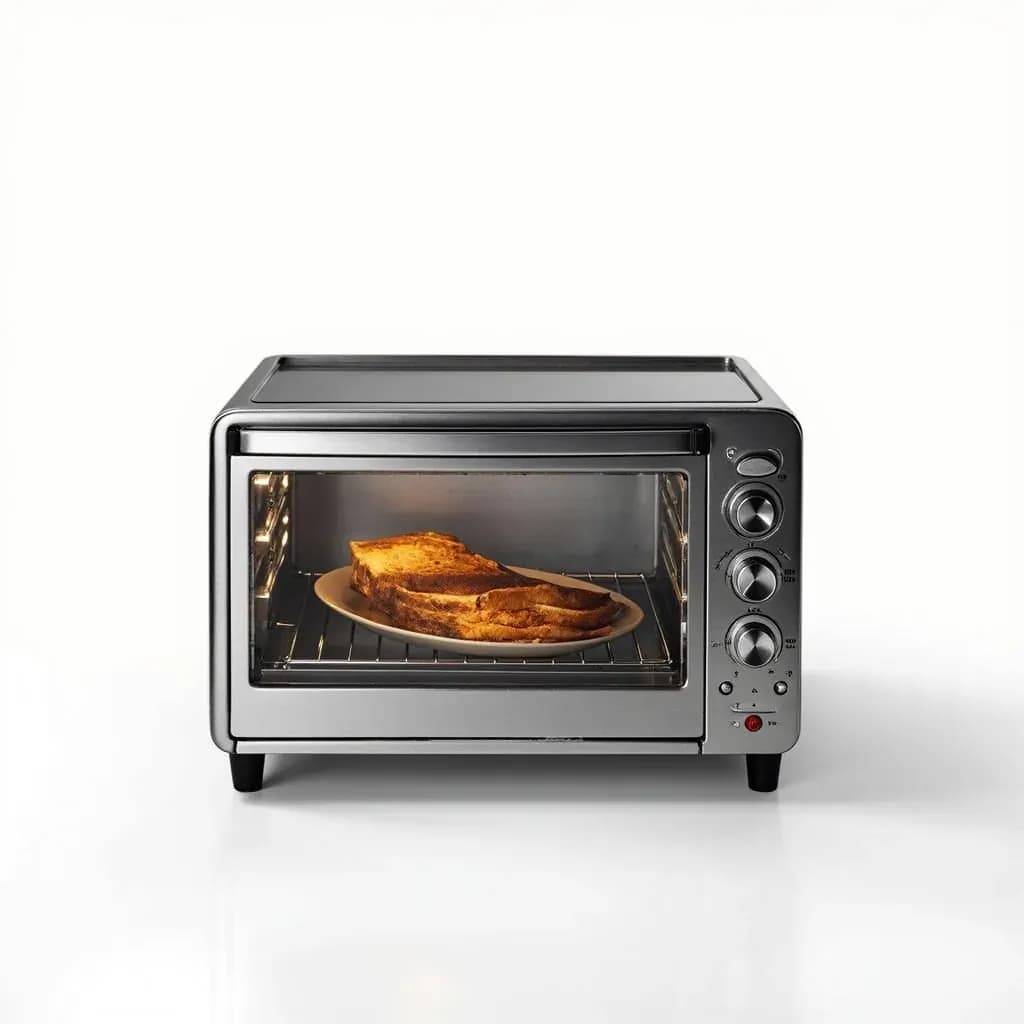
An oven toaster, or toaster oven, is a compact countertop appliance with heating elements above and below a small rack for toasting bread, melting cheese, reheating and baking small dishes. It heats up faster and uses less energy than a full oven for single servings. Most include a crumb tray and a basic temperature and timer dial.
An oven toaster — also called a toaster oven — is a small, front-loading countertop electric oven built around two heating elements, one above and one below the food. Unlike a slot toaster, it bakes, broils, toasts, and reheats in a shallow cavity about the size of a microwave, giving it the versatility of a full oven in roughly a third of the space. Because the cavity is small and the elements sit close to the food, it preheats in 3 to 5 minutes and runs at lower wattage than a wall oven.
The appliance earns its place in a working kitchen by handling high-frequency tasks — toast, reheated pizza, open-faced sandwiches, frozen snacks, a small tray of roasted vegetables, a half-dozen cookies — faster and more crisply than either a microwave or a full oven. Modern convection and air-fry models blur the line with wall ovens, circulating hot air so aggressively that they brown frozen fries and roast chicken pieces with near-wall-oven results. The trade-off is capacity: a standard compact unit will not accommodate a tall cake, a whole loaf of bread, or a full sheet pan, so it complements rather than replaces a full oven in most homes.
Alternatives
Types & varieties
Two-element bake/broil with no fan; the cheapest option, with more pronounced hot spots and longer cook times.
Internal fan circulates hot air for more even browning and roughly 25 % faster cooking, often at 15 °C / 25 °F lower temperature.
High-velocity fan paired with a top heating element crisps frozen fries, wings, and breaded foods without a separate basket.
PID temperature control, preset programs, and sometimes a probe thermometer; brands like Breville, Cuisinart, and KitchenAid dominate this category.
Combines convection baking with a microwave for speed reheating and browning in one unit; heavier and pricier.
Fits 2–4 slices of toast or a 9 in pizza; dorm-room or office size, limited baking.
Accepts a 12 in pizza, a quarter-sheet pan, a 9 × 13 in casserole set diagonally, and a 4–6 lb chicken.
Choosing the Right Size
Buy to the pan you cook in most often, not to the wattage or the preset list. A 9 in pie plate, quarter-sheet pan, or 9 × 13 in casserole dish is the practical yardstick — measure the listed interior dimensions and check that your most-used pan fits with at least 1 in / 2.5 cm of clearance on every side. Compact 9 L units are honest about being toast-and-reheat machines; large 20 L+ convection models can stand in for a wall oven on small-batch baking, roasting, and broiling. Wattage matters mainly for how fast the cavity recovers when you open the door — anything above about 1,500 watts handles that well.
- Toast and reheat only → 9–12 L standard model.
- Bake cookies, rolls, small casseroles, and roast vegetables → 20 L+ convection.
- Want frozen-snack crisp without a separate air fryer → air-fry toaster oven in the 22–25 L range.
- Counter space is tight → look at exterior footprint, not just interior volume.
Converting Recipes from a Wall Oven
Because the cavity is small and the elements sit close to the food, recipes almost always cook faster and brown more aggressively in a toaster oven. The two adjustments that matter most are temperature and rack position; pan choice comes next. Expect to check on food several minutes earlier than the wall-oven recipe suggests.
- Convection mode: drop the listed temperature by 15 °C / 25 °F and start checking 3–5 minutes early.
- Bake mode: keep the temperature, but check 5–10 minutes early — most things finish faster.
- Use the middle rack for baking, the upper slot for broiling and browning, and the lower slot for slow-roasting or crisping the underside of pizza.
- Light-colored aluminum bakeware is the safest match; dark pans over-brown against the lower element.
Care, Cleaning, and Safety
Toaster ovens stay useful for years when treated like a small appliance that gets cleaned often. The crumb tray exists because crumbs on the lower element are the leading fire cause; a 30-second wipe after each use prevents the problem and keeps odors down. The interior walls, racks, and tray can be hand-washed with warm soapy water, and many modern units have removable, dishwasher-safe parts.
- Pull and empty the crumb tray after every use, once the unit has cooled.
- Never line the floor of the oven with foil against the lower element — it traps heat and can ignite.
- Cover splatter-prone food (bacon, chicken thighs, stuffed peppers) loosely with foil to keep the interior clean.
- Wipe the interior walls between heavy uses; baked-on grease smokes and flavors the next dish.
- Keep 1–2 in / 2.5–5 cm clearance on all sides of the food for airflow, especially in convection units.
- Unplug before washing, and never submerge the housing or the heating elements.
Common uses
Tips & pitfalls
- Always preheat for at least 3–5 minutes — the small cavity recovers quickly but starts cold and uneven.
- Use light-colored aluminum bakeware; dark pans over-brown the bottom against the close-set lower element.
- Drop the recipe temperature by 15 °C / 25 °F when switching to convection, and start checking several minutes early.
- Empty the crumb tray after every use — accumulated crumbs are the single biggest fire risk.
- Never line the bottom with foil against the lower element; the trapped heat can melt or ignite the foil.
- Cut food to fit the cavity: tall items like layer cakes and whole loaves won't clear the upper element.
- For cheese melts, finish under the broiler element for 30–60 seconds — cheese burns fast under direct heat, so watch it closely.
- On units without auto-centering racks, flip or rotate bread halfway through to toast evenly.
Good to know
- Category
- Small countertop electric oven
- Power Draw
- 1,200–1,800 watts (roughly half a wall oven)
- Interior Capacity
- 9–25 L; compact fits a 9 in/23 cm pizza, large fits a 12 in/30 cm pizza or quarter-sheet pan
- Max Temperature
- 230–260 °C / 450–500 °F on most units; air-fry models reach the top of that range
- Preheat Time
- 3–5 minutes vs. 10–15 minutes for a full oven
- Heating Elements
- Top (broil) and bottom (bake), often both on during bake; quartz halogen on some premium units
- Controls
- Analog dials, digital touchpad, or a mix; timers from 30 minutes to 12 hours on extended models
- Safety Standard
- UL 923 in the US; crumb buildup is the leading cause of toaster-oven fires
Also called
Toaster Oven · Countertop Oven
Related

Stovetop
The everyday burners where most cooking actually happens

Oven
Enclosed dry heat for roasting, baking, and braising

Grill
Live-fire or gas grates for char, smoke, and high heat

Smoker
Low, slow heat and wood smoke for barbecue and brisket

Air Fryer
Countertop convection that crisps with little or no oil

Slow Cooker
Set-and-forget low heat for stews, beans, and braises

Pressure Cooker
Sealed steam pressure that cooks tough food in a fraction of the time

Rice Cooker
Foolproof, perfectly steamed rice every single time