Appliances & Heat
Pacojet
A pro machine that micro-purees frozen blocks into ultra-smooth ice creams, sorbets and savory pastes.
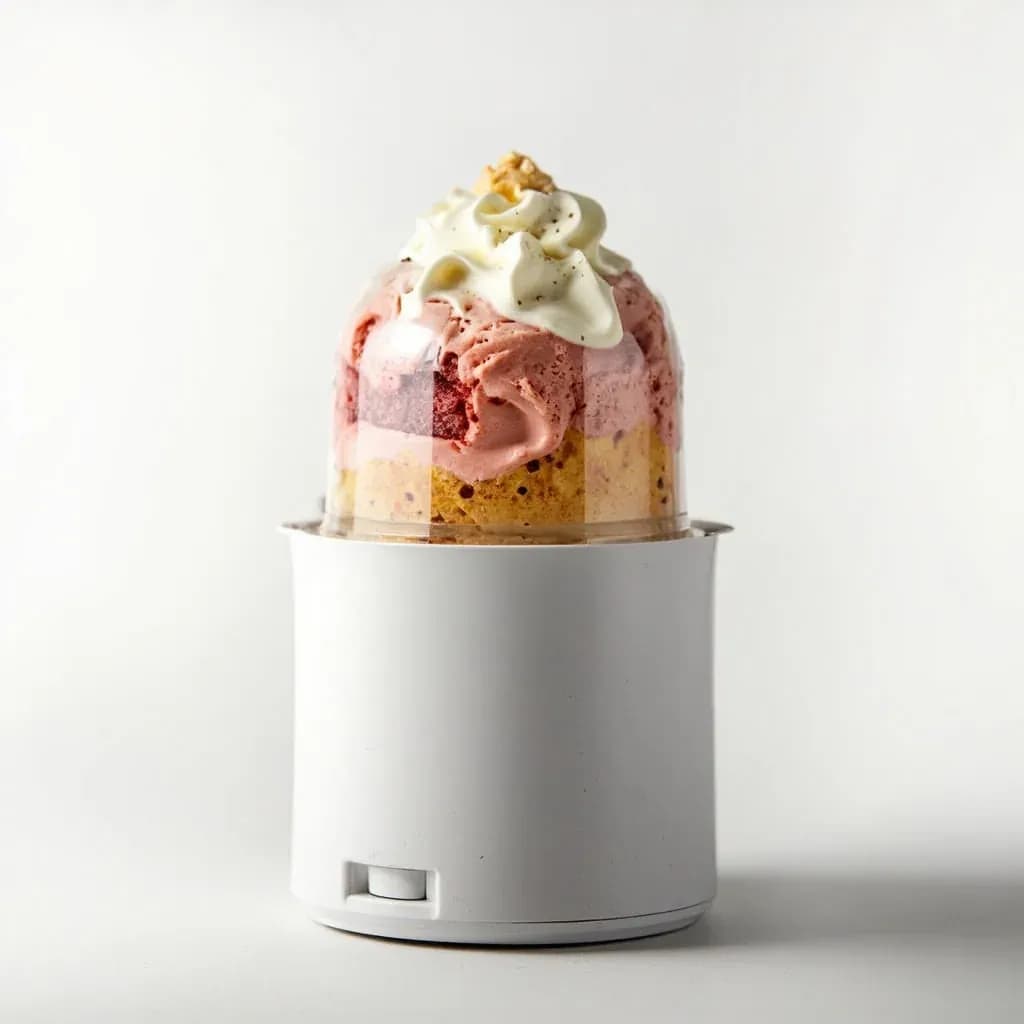
A Pacojet shaves a deep-frozen block of ingredients in fine micro-layers, producing exceptionally smooth ice creams, sorbets, mousses and savory purees without thawing the whole batch. Chefs portion only what they need and keep the rest frozen, so flavors stay fresh. Because it works from a solid frozen state, it makes intensely flavored bases impossible to achieve in a churn.
The Pacojet is a professional countertop appliance that shaves and purees food that has been frozen solid inside a sealed stainless beaker. Instead of churning or blending, it uses a high-speed spinning blade (roughly 2,000 rpm) to micro-plane a one-to-two-millimeter layer off the top of a frozen block while the beaker slowly rotates, releasing an instantly smooth, dense, ice-crystal-free puree in seconds. The result is finer than any batch freezer or high-power blender can achieve, because the ice structure is being cut away at the moment of service rather than ground up or whipped into a frozen custard.
What sets the machine apart is texture. A Pacojet product has almost no overrun — very little air is incorporated — so ice creams and sorbets come out dense and silky in the style of Italian gelato, and savory purees retain vivid color because no external heat is applied. The trade-off is throughput: each beaker produces only a handful of portions per minute, and every recipe must be pre-formulated as a liquid that can be frozen, which makes the Pacojet a finishing and signature tool rather than a high-volume producer.
Originally developed in Switzerland in the early 1990s, the Pacojet has become a fixture in fine-dining pastry kitchens, Michelin-starred savory stations and progressive bar programs. Home versions do not exist at a practical price, but the machine has profoundly shaped modern restaurant menus — frozen foie gras terrine, parsnip "ice cream," and bright green herb oils owe much of their identity to the texture the device makes possible.
Alternatives
Types & varieties
Current flagship with 4-beaker capacity, touchscreen controls, adjustable portion size, automatic repeat function and a refined motor.
Previous-generation professional unit with push-button operation and 4-beaker capacity; still the workhorse in many restaurant kitchens.
Compact single-beaker model aimed at smaller kitchens and pâtissiers; lower price, slightly less powerful motor.
Default blade for ice cream, sorbet, sauces and purees.
Accessory blade designed for especially hard or fibrous frozen blocks.
Stainless beakers in three volumes so recipes can be scaled without rebalancing ratios.
How it works
A Pacojet is essentially a precision micro-plane aimed at frozen food. The base is blended smooth in a conventional blender, poured into a sealed stainless beaker and frozen solid. When the beaker is loaded and the cycle is started, an internal blade descends while spinning at roughly 2,000 rpm and shaves a hair-thin layer from the top of the block; the beaker slowly rotates beneath the blade so the cut is even. The shavings are pushed through a discharge port as a finished puree. Because the food is being cut, not blended, ice crystals never have a chance to form or survive the pass, and there is only minimal friction heating — the puree emerges at essentially the same temperature it went in.
- The blade shaves; it does not homogenize. A grainy or lumpy base will produce a grainy finished product.
- Each pass adds a small amount of overrun, so multiple passes yield a lighter, airier texture.
- Minimal heat is generated during processing, which helps preserve color in herbs, vegetables and lean proteins.
Working with the machine
Think of the Pacojet as a finishing tool and a recipe-development tool, not a production line. Most of the work happens in advance: formulating a stable emulsion, freezing it properly, and planning how many beakers you will need for service. The actual time at the machine is measured in seconds per portion.
- Freeze beakers flat and for a full 24 hours; an under-frozen block shaves into a coarse, icy slush.
- Leave at least 1 cm of headspace in the beaker — expansion on freezing can crack the beaker or pop the lid seal.
- Wipe the rim of the beaker dry before fitting the blade. A single frozen sugar or salt crystal will break the seal and the beaker will not lock into the machine.
- Season savory bases slightly under your target; freezing dulls salt and a few sweet spices.
- Rinse the blade under hot water the instant you finish a batch — dried-on food ruins the cutting edge and contaminates the next product.
Common uses
Tips & pitfalls
- Blend the base completely smooth before freezing — the blade shaves, it does not homogenize.
- Run multiple 'Jet' passes for lighter, airier textures; each pass adds a small amount of overrun.
- Never run the machine with an empty beaker; the blade needs frozen product to cut against.
- Store beakers upright in the freezer with lids on to prevent freezer burn and odor pickup.
- Label beakers with date and contents — frozen bases keep best quality for about 2–3 months.
Good to know
- Origin
- Switzerland; developed in the early 1990s by Paco Jet AG.
- Type
- Professional micro-pureeing appliance, countertop.
- How it works
- A blade spinning at roughly 2,000 rpm shaves a 1–2 mm layer off a frozen block while the beaker rotates, releasing an instant puree.
- Required food state
- Liquid or fully blended base, sealed in a Pacojet beaker, frozen solid at about −20 °C / −4 °F for at least 24 hours.
- Standard beaker
- ≈1 L (about 1 quart); 0.8 L and 1.6 L sizes are also available.
- Capacity
- Current flagship models process up to 4 beakers in sequence without re-freezing.
- Output per pass
- One shaving yields roughly one portion, about 50–80 g of finished puree.
- Texture
- Very fine, dense, low-overrun products with no detectable ice crystals.
- Power
- Standard commercial unit draws roughly 950–1,300 W depending on model.
- Voltage
- 230 V in Europe; 120 V versions are produced for North America.
- Approx. price
- New units run from about USD 4,000–5,000 (Junior) to USD 6,000–9,000+ (Pacojet 2/4).
- Weight
- Roughly 16–23 kg (35–50 lb) depending on model.
- Cleaning
- Beakers and blades are dishwasher-safe; the blade should be rinsed immediately after use.
Also called
Paco Jet · Pacotizer
Related

Stovetop
The everyday burners where most cooking actually happens

Oven
Enclosed dry heat for roasting, baking, and braising

Grill
Live-fire or gas grates for char, smoke, and high heat

Smoker
Low, slow heat and wood smoke for barbecue and brisket

Air Fryer
Countertop convection that crisps with little or no oil

Slow Cooker
Set-and-forget low heat for stews, beans, and braises

Pressure Cooker
Sealed steam pressure that cooks tough food in a fraction of the time

Rice Cooker
Foolproof, perfectly steamed rice every single time