Appliances & Heat
Pasta Extruder
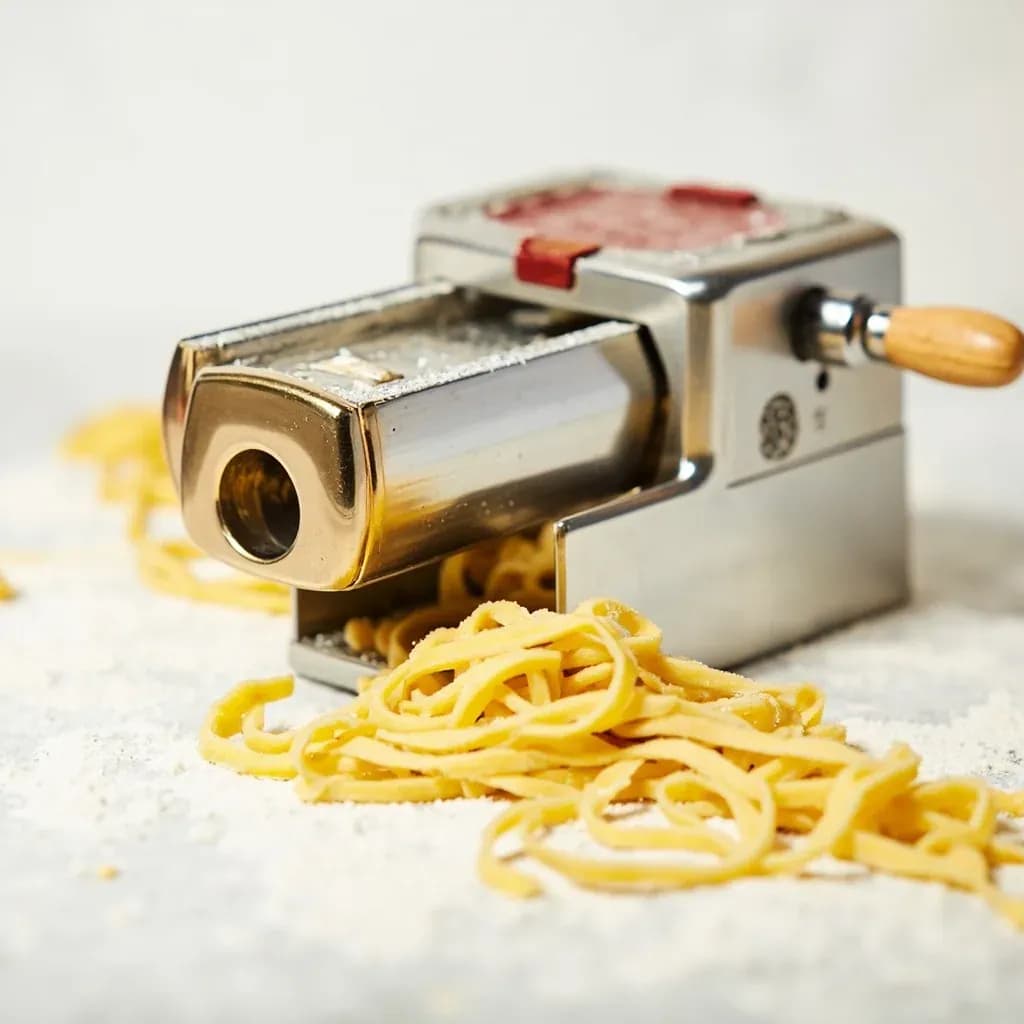
A machine that forces dough through shaped dies to form macaroni, bucatini and other tube pastas.
A pasta extruder mixes and pushes stiff dough through interchangeable bronze or steel dies to produce shapes that cannot be rolled and cut, such as rigatoni, bucatini and fusilli. Home and bench-top electric models automate the kneading and forming in one pass. Bronze dies give a rough, porous surface that grips sauce better than smooth Teflon ones.
A pasta extruder is a machine that uses a rotating auger to push hydrated semolina dough through a shaped die, producing continuous strands or hollow tubes that are then cut to length. Unlike a pasta roller, which flattens dough into sheets that you cut by hand, an extruder forms three-dimensional shapes — most importantly the hollow tubes (penne, rigatoni, macaroni, bucatini) that simply cannot be made any other way at home. The pressure of the auger against the die is what gives extruded pasta its dense, springy texture and, with a bronze die, its faintly rough, sauce-grabbing surface.
The tool matters because it bridges the gap between home cooking and authentic Italian pasta-making traditions. Industrial pasta production has used extrusion for over a century, and the same principle scaled down — a screw, a die, a cutter — drives every domestic machine on the market. For a cook who wants penne lisce with the snap of a factory-dried piece, or bucatini with a true hollow core, an extruder is the only practical path. It also opens the door to non-wheat doughs (chickpea, lentil, rice) and colored pastas that hold their shape far better when forced through a die than when rolled and cut.
In practice, an extruder rewards a different dough than a roller. The dough must be more hydrated, well rested, and based on coarse durum semolina so it flows smoothly rather than fracturing under pressure. Treat it less like bread dough and more like a thick, crumbly paste that coheres when compressed — the machine does the kneading and shaping in a single pass.
Alternatives
Types & varieties
Manual countertop press with a side handle; small batches, good for occasional use and full control over extrusion speed.
Self-contained unit that mixes, kneads, and extrudes in one chamber; simplest workflow with the least hands-on attention.
Mounts to a stand mixer (e.g., KitchenAid KPEXTA) and uses the mixer motor to drive the auger; saves counter space and leverages an existing tool.
Standard industrial design with one auger conveying dough through the die; used for most dried pasta production worldwide.
Two intermeshing screws for high-pressure or specialty doughs such as legume-based, gluten-free, or strongly colored pastas.
Bronze for artisan texture — rougher surface, better sauce adhesion; Teflon for a smoother finish and easier release and cleaning.
Extruder vs. Pasta Roller
The two tools are not interchangeable, and buying the wrong one is a common home-cook mistake. A roller (Atlas 150, Imperia, Marcato Atlas) takes a stiff, low-hydration dough, compresses it into thin sheets, and lets you cut tagliatelle, pappardelle, lasagna, or stuffed shapes like ravioli. An extruder takes a wetter, more granular dough and pushes it through a die to make shapes with real three-dimensional structure — hollow tubes, spirals, shells, and short cuts. If you only want sheets and ribbons, save the money and counter space for a roller. If you want rigatoni, bucatini, or authentic penne, you need an extruder.
Bronze Dies vs. Teflon Dies
The die is the soul of the extruder, and its material shapes the final character of the pasta far more than any other variable. Bronze dies (traditional, used in most artisan Italian production) score the dough's surface as it exits, leaving micro-grooves that sauce clings to. The trade-off is friction: bronze dough requires more pressure, the machine works harder, and cleanup is more demanding — water and a small brush, then immediate drying to prevent the bronze from tarnishing. A light wipe of food-grade mineral oil before storage keeps the die bright. Teflon-coated dies release dough with less resistance, run cooler, and rinse clean in seconds, but the pasta comes out smoother and slicker, with noticeably less sauce adhesion. For everyday cooking, Teflon is forgiving. For serious pasta work, bronze is worth the extra care.
Dough for Extrusion
Extruder dough is wetter and grittier than roller dough, and that trips up a lot of first-time users. A workable ratio is roughly 100 g durum semolina to 45–55 g liquid — water for plain dough, whole eggs plus a splash of water for egg dough. The mixture should look like damp sand at first; it will come together under the auger's pressure. Rest it, wrapped, for at least 30 minutes so the semolina fully hydrates; under-rested dough cracks and shreds as it exits the die. If the dough sticks to your fingers, work in another tablespoon of semolina. If it crumbles into dry pebbles, mist it with water and knead briefly. The texture you want is one that holds together when squeezed but breaks apart cleanly when crumbled.
Cutting, Drying, and Storing Extruded Pasta
Cut the pasta as it emerges, before it has time to bend and deform. For short shapes (penne, rigatoni, macaroni), a dough scraper held at a slight angle works well; for long strands (bucatini, spaghetti), let the pasta lay in loose nests on a semolina-dusted tray and cut to roughly 10–12 inch lengths. Always dust with semolina, not flour — all-purpose flour turns gummy on the surface and clouds the cooking water. Fresh extruded pasta can be cooked immediately (2–4 minutes in boiling salted water) or dried 12–24 hours at room temperature on a single layer for longer storage; under-dried pasta cracks open in the pot. Fully dried pasta keeps in an airtight container for several months; frozen, it keeps well for many months when sealed airtight.
Common uses
Tips & pitfalls
- Use durum semolina flour, or a 50/50 blend with tipo 00, for the cleanest extrusion and the firmest al dente bite after cooking.
- Hydrate dough more than you would for a roller — about 45–55 g liquid per 100 g semolina — and let it rest at least 30 minutes before extruding so the flour fully absorbs the moisture.
- Aim for a dough that holds together when squeezed but crumbles when pressed; sticky dough needs more semolina, crumbly dough needs a light misting of water and a brief re-knead.
- Discard the first few inches of pasta that comes out of the die — they often contain air pockets or under-pressurized dough that will cook unevenly.
- Cut extruded pasta to length as soon as it exits the die; long strands left to coil will kink, deform, and stick to themselves.
- Dust cut pasta with semolina, never with all-purpose flour, which turns gummy on the surface and clouds the cooking water.
- Dry extruded pasta 12–24 hours at room temperature before boiling; under-dried pieces will crack and burst open in the pot.
- Don't try to make filled or stuffed pasta (ravioli, tortellini) in an extruder — those shapes require rolled sheets and hand forming.
- After washing a bronze die, dry it immediately and rub lightly with food-grade mineral oil to prevent tarnish; Teflon dies can simply be towel-dried.
- Run a small amount of plain dough through the machine between batches (especially when switching colors or flavors) to clear residual bits and keep the next pasta's color clean.
Good to know
- Origin
- Mechanical extruders developed in Italy in the late 19th century; industrial models replaced hand-rolled methods for tube and shaped pasta.
- Mechanism
- An internal auger (screw) forces hydrated semolina dough through a shaped die under pressure, forming pasta continuously as it exits the cutting plate.
- Die material
- Bronze dies give a rougher, more porous surface that holds sauce; Teflon-coated dies are smoother, easier to clean, and release dough more readily.
- Typical die shapes
- Industrial extruders support 50–200 die shapes; domestic machines usually include 6–13 (penne, rigatoni, macaroni, bucatini, fusilli, spaghetti, capellini, and others).
- Throughput (domestic)
- Countertop extruders typically produce 1–1.5 lb (450–700 g) of fresh pasta in about 10–15 minutes.
- Operating pressure
- Industrial extruders run at several hundred psi; domestic machines use far lower pressure and need softer, more hydrated doughs to flow cleanly.
- Key brands (domestic)
- KitchenAid 3-Piece Pasta Press (KPEXTA), Philips/Avence Pasta Maker, Marcato attachments, Imperia, Weston, and Cucina Pro.
- Cleaning
- Dies and auger must be cleared of starchy residue and thoroughly dried to prevent mold; bronze dies need immediate drying to avoid oxidation.
Also called
Extruder Pasta Machine · Bronze Die Extruder
Related

Stovetop
The everyday burners where most cooking actually happens

Oven
Enclosed dry heat for roasting, baking, and braising

Grill
Live-fire or gas grates for char, smoke, and high heat

Smoker
Low, slow heat and wood smoke for barbecue and brisket

Air Fryer
Countertop convection that crisps with little or no oil

Slow Cooker
Set-and-forget low heat for stews, beans, and braises

Pressure Cooker
Sealed steam pressure that cooks tough food in a fraction of the time

Rice Cooker
Foolproof, perfectly steamed rice every single time