Appliances & Heat
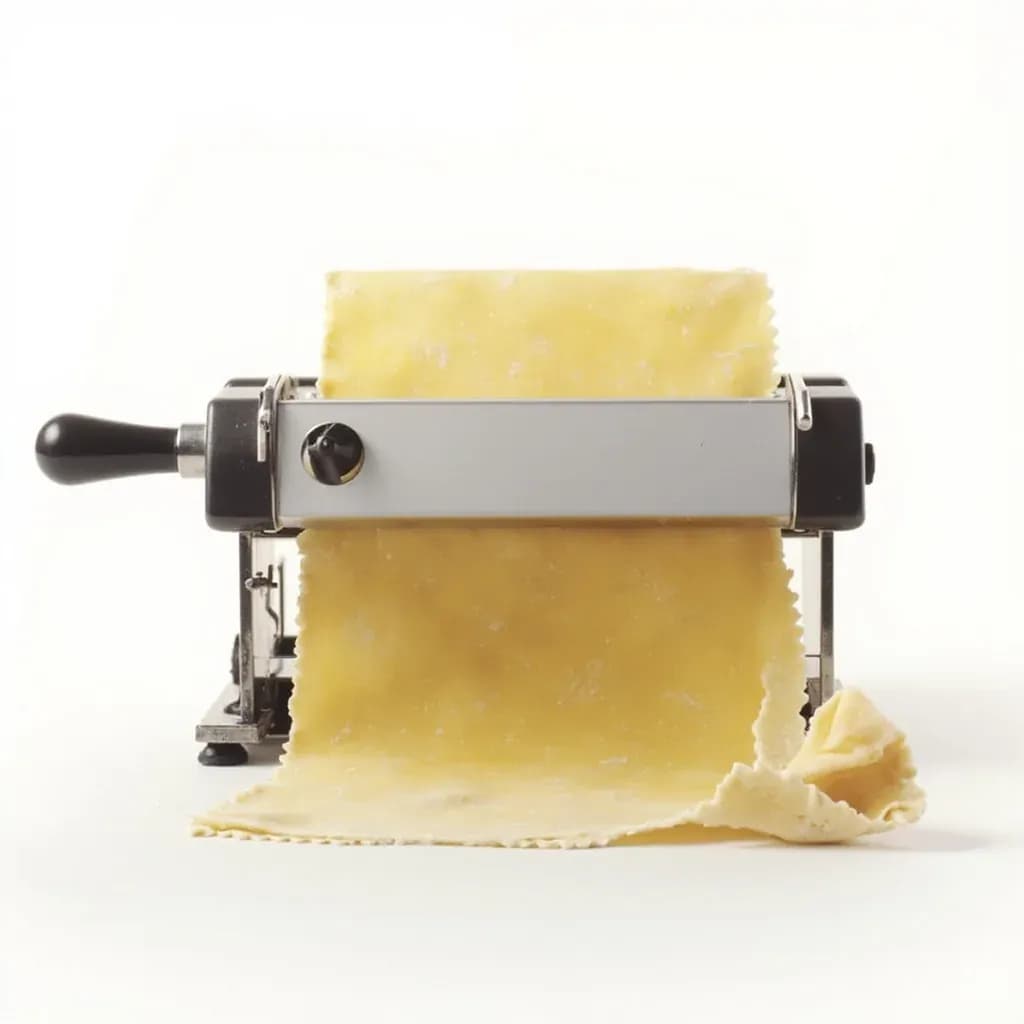
Electric Pasta Sheeter/Roller
A motorized roller that flattens pasta dough into even sheets and cuts it into noodles.
An electric pasta sheeter feeds dough between motorized rollers set to progressively thinner gaps, producing smooth, even sheets for lasagna, ravioli, and tagliatelle. A cutting attachment then slices the sheet into ribbons of various widths. The motor frees both hands to guide the dough, making it faster and more consistent than hand-cranked models for volume work.
The electric pasta sheeter is a small motor bolted to the same roller mechanism that has defined home pasta-making since Marcato introduced the Atlas 150 in 1930. The chrome-plated steel rollers, the stepped thickness dial, the snap-on cutters for tagliatelle and spaghetti — none of it is new. What the electric motor replaces is the hand crank, and that single substitution changes pasta-making in three concrete ways. Both hands are free to guide the dough into the rollers and support the sheet as it exits, the sheet never tears from an uneven cranking rhythm, and a batch that would take twenty minutes of elbow grease by hand finishes in five. For anyone rolling pasta more than two or three times a year, the upgrade is the difference between a project and a Tuesday-night dinner.
The machine works on a simple principle: two parallel rollers turn at a set gap, and dough fed into the gap is compressed to that exact thickness. The dial steps the rollers closer together, from a starting gap of about 4.5 mm down to a final setting of roughly 0.5 mm for sheets destined to be cut or filled. Stand-alone units such as the Marcato PastaMatic, Imperia, and Cucina Pro plug into a wall outlet; stand-mixer attachments like the KitchenAid KPRA draw power from the mixer's hub. Home models share a 150 mm (about 6-inch) roller width and handle 250–500 g of dough comfortably per session; the motor is rated for roughly 15-minute continuous cycles and benefits from a few minutes' rest between batches. Commercial sheeters from Hobart, Globe, and Italgi run 250–500 mm wide with faster throughput and sturdier gearboxes for restaurant and pasta-shop work.
The single most important thing to know before buying is what a sheeter does not do: it makes flat sheets and strips, nothing more. Penne, rigatoni, fusilli, and macaroni are extruded — forced through a die by an auger — and require a different machine entirely. Confusing a sheeter with an extruder is the most common shopping mistake in home pasta equipment.
Alternatives
Types & varieties
Italian-made stand-alone electric roller with nine thickness settings, designed to match the Atlas 150
Larger 150 mm electric roller in the Marcato lineup, aimed at frequent home users
Older Marcato bundle pairing the hand-cranked Atlas with a clip-on motor drive
Driven by the KitchenAid stand-mixer hub; includes roller, fettuccine cutter, and spaghetti cutter
Italian competitor to Marcato, available in 150 mm and 180 mm widths
Entry-level 150 mm stand-alone sheeter sold widely in North America
Floor or counter-standing rollers (250–500 mm) used in pasta shops and serious restaurant kitchens
Sheeter vs. Pasta Extruder
These are two different machines, and the distinction matters at the shopping stage. A sheeter compresses dough between two rollers into a flat sheet, which is then cut into strips (tagliatelle, fettuccine, pappardelle, spaghetti, capellini) or used whole (lasagna, cannelloni, ravioli). An automatic pasta extruder, by contrast, forces a stiffer, more hydrated dough through a bronze or Teflon die by means of an auger, producing hollow or solid shapes with a defined cross-section: penne, rigatoni, fusilli, macaroni, casarecce. The doughs are not interchangeable — extruded dough needs more water (often 35–45%) and is kneaded longer to develop a smooth, plastic consistency that will flow through a die. If your menu is mostly stuffed pastas and long noodles, a sheeter is what you want. If you want short, sauce-catching tubes, you need an extruder. Combination machines exist but are compromises on both fronts.
- Sheeter: two rollers, flat output, cuts into strips. For tagliatelle, fettuccine, spaghetti, lasagna, ravioli.
- Extruder: auger and die, shaped output. For penne, rigatoni, fusilli, macaroni, casarecce.
- Stand-alone extruders (Philips Avance, Lello 3000, Gourmia) are sold separately from sheeters and cost roughly the same.
- Dough hydration differs: ~30–35% for sheeting, ~35–45% for extruding.
Choosing Between Stand-Alone and Stand-Mixer Attachment
The practical decision after deciding on a sheeter is whether to buy a plug-in stand-alone unit or a stand-mixer attachment. Stand-alones (Marcato PastaMatic, Imperia, Cucina Pro) are dedicated machines: they roll pasta, then sit on the counter or in a cupboard. Roller attachments for stand mixers (KitchenAid KPRA) cost a bit less, store in the mixer bowl, and are a natural choice for a cook who already owns a KitchenAid. The trade-off is that the mixer is occupied for 20–40 minutes during a pasta session, and the mixer's motor runs hotter and louder than the small gear motor in a dedicated unit. For a household that makes pasta weekly, the stand-alone is the more comfortable long-term tool.
Common uses
Tips & pitfalls
- Rest the dough wrapped in plastic for at least 30 minutes at room temperature before rolling — gluten must relax or the sheet snaps back every time it exits the rollers.
- Dust with semolina rather than soft flour to prevent sticking; the coarse grains also add a pleasant bite to the cooked pasta and brush off cleanly after drying.
- Start at the widest setting, fold the dough into thirds, and feed it through two or three times to build an even rectangle before stepping the thickness down.
- Step the thickness dial down one notch at a time — jumping two settings cracks the sheet and forces you to start over.
- Hold the dough lightly at the entry and support the sheet as it exits with a flat palm; never pull, which stretches and tears.
- If sheets come out ragged at the edges, the dough is too dry; if they gum up and fold over on themselves, it is too wet — adjust by kneading in flour or a few drops of water respectively.
- For very sticky egg dough, lightly oil the rollers before the first pass.
- Cut sheets into 25–30 cm lengths and dust well with semolina before running them through the cutter, or the strands will fuse into a solid mat.
- Hang or rack-dry freshly cut noodles for 15–60 minutes before cooking so they hold their shape.
- Clean the rollers immediately after use with a dry brush or wooden skewer; never run water through the machine or submerge any part of it.
- Avoid running the motor continuously for more than about 15 minutes on home units — let the gearbox cool down.
- For laminated doughs, chill for 10–15 minutes between each pass to keep the butter cold.
Good to know
- Roller width
- 150 mm (about 6 in) on home units; commercial sheeters run 250–500 mm
- Thickness settings
- 9 stepped positions on Marcato and KitchenAid units, roughly 0.5 mm to 4.5 mm
- Roller material
- Chrome-plated steel rollers with food-grade polymer or metal gears
- Compatible cutters
- Snap-on tagliatelle (~6–7 mm) and spaghetti/capellini (~1.5–2 mm) attachments
- Ideal dough hydration
- 30–35% water-to-flour by weight for sheet pasta; higher for extruded shapes
- Capacity
- Home units comfortably handle 250–500 g of dough per batch
- Continuous run
- Home motors rated for roughly 15-minute cycles; give a few minutes' rest between
- Cleaning
- Dry brush or wooden skewer only; never submerge the motor housing or rinse the gears
Also called
Noodle Cutting Attachment · Pasta Machine · Pasta Sheeter · Electric Pasta Roller
Related

Stovetop
The everyday burners where most cooking actually happens

Oven
Enclosed dry heat for roasting, baking, and braising

Grill
Live-fire or gas grates for char, smoke, and high heat

Smoker
Low, slow heat and wood smoke for barbecue and brisket

Air Fryer
Countertop convection that crisps with little or no oil

Slow Cooker
Set-and-forget low heat for stews, beans, and braises

Pressure Cooker
Sealed steam pressure that cooks tough food in a fraction of the time

Rice Cooker
Foolproof, perfectly steamed rice every single time