Appliances & Heat
Pellet Grill
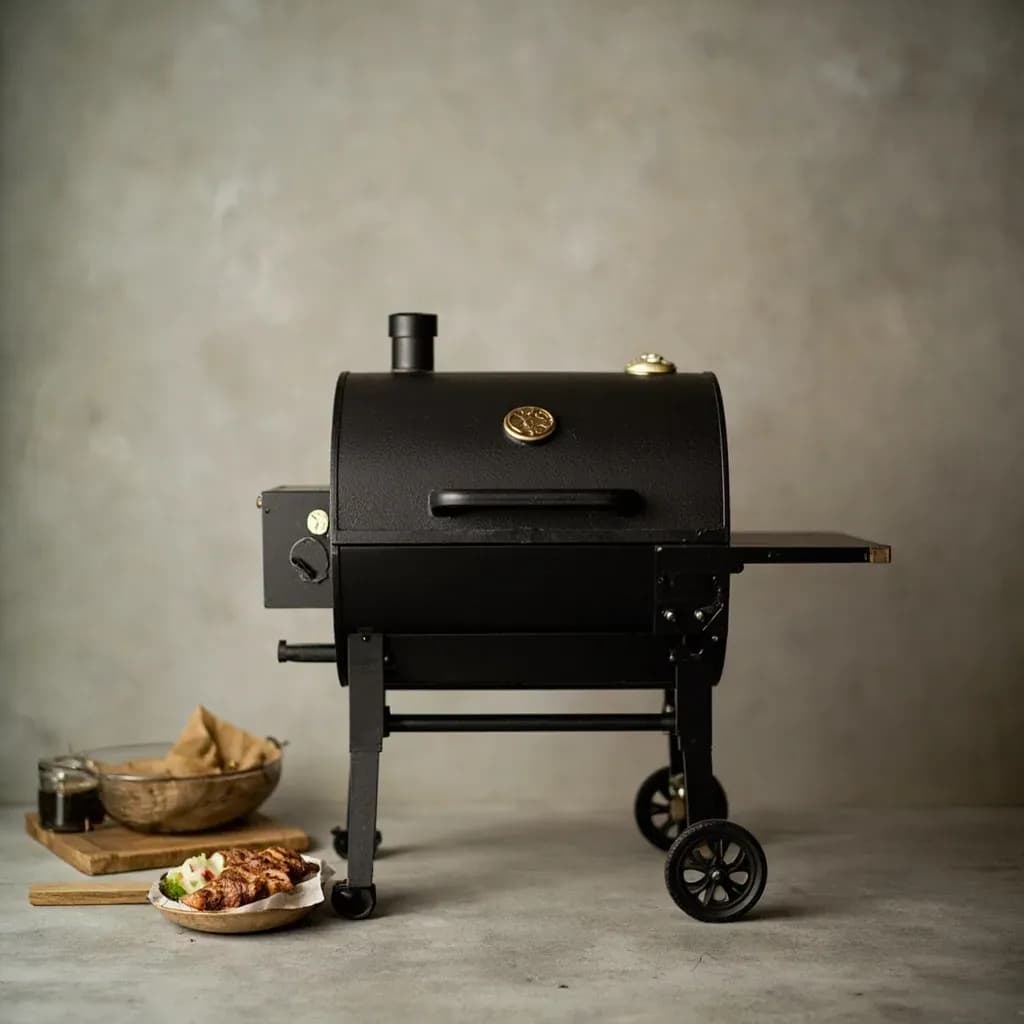
A grill-smoker that auger-feeds wood pellets to a firepot for thermostat-controlled wood cooking.
A pellet grill burns compressed hardwood pellets fed automatically by a motorized auger into an ignited firepot, with a fan circulating smoky heat through the chamber. A digital controller holds a set temperature, so it can low-and-slow smoke or grill hotter with hands-off consistency. It gives wood-smoke flavor with the convenience of a thermostat.
A pellet grill is a thermostat-controlled outdoor cooker that burns small, compressed hardwood pellets fed by a motorized steel auger into a cast-iron or steel firepot. Invented by Joe Traeger in 1985 in Mount Angel, Oregon, it sits between the set-and-forget ease of a gas grill and the genuine wood-fired character of a stick-burning offset smoker: an electric controller drives the auger, fires pellets with a hot rod, and meters the fan to hold a setpoint anywhere from about 180 °F to 500 °F on most residential models. The cook sets a number, closes the lid, and the machine behaves more like an outdoor convection oven than a live fire.
What separates a pellet grill from an offset or kettle is the smoke profile and the temperature stability. Pellets smolder thin, blue smoke the way a clean fire should, and the controller largely eliminates the swings and flare-ups that demand a stick-burner's attention. The trade-off is recovery: open the lid and a pellet grill can take several minutes to climb back to setpoint, and smoke output drops off as the controller trims the auger at higher temperatures. For low-and-slow barbecue at 225 °F, where the lid stays shut and the fire idles, this is the lowest-effort route to legitimate wood-fired flavor you can buy. For 700 °F+ sear work, the same grill needs a direct-flame accessory or a separate cast-iron plancha.
Choose a pellet grill if your weeknight schedule rewards an unattended long cook and your weekends reward brisket and ribs you didn't have to babysit. Skip it if you want the heavy white-billowing smoke and crackling bark of a true offset pit, or if you need the 1,200 °F radiant heat of a steakhouse broiler — neither is what this machine does well. Treat it as a smoker-oven first and a grill second.
Alternatives
Types & varieties
Non-PID thermostat cycles the auger on and off; expect 20–30 °F swings. Common on entry-level Traeger Pro, Pit Boss, and most budget Camp Chef models.
Proportional-integral-derivative thermostat holds setpoint within roughly 5 °F; found on Traeger Ironwood and Timberline, Camp Chef Woodwind Pro, Yoder, and Rec Tec.
Removable heat deflector exposes the firepot for true open-flame grilling; examples include Traeger Timberline, Weber SmokeFire with Sear-Grate, and Memphis Pro.
Compact 8 lb hopper, folding legs, and lower price; Traeger Tailgater, Z Grills 200A, and Pit Boss 1067.
Drop-in units for outdoor kitchens; Memphis Grills and Blaze offer stainless cabinet-mount versions.
Add a gas side burner or charcoal tray; Camp Chef Woodwind pairs with the Sidekick accessory.
Pellet fuel: species, blends, and storage
Pellet choice is the single biggest flavor lever on a pellet grill, because the smoke is the only seasoning the food receives from the machine itself. The first ingredient on the bag should be a named hardwood or a declared blend — oak, hickory, mesquite, pecan, cherry, apple, maple, or a labeled 'competition' mix.
- Hickory and mesquite are the boldest woods; reserve them for beef and pork shoulder where their intensity won't overpower.
- Post oak and pecan are the classic barbecue backbone — neutral, clean, and forgiving on long cooks.
- Fruit woods (cherry, apple, peach) and maple add sweetness and a reddish smoke color; they shine on poultry, pork ribs, and salmon.
- Avoid generic 'grilling' blends that list softwood, filler, or a flavorless base wood as the first ingredient — they don't smoke well and can leave a chemical aftertaste.
- Buy pellets by the bag, not the ton, if you live in a humid climate. A single wet bag will swell, jam the auger, and refuse to light.
- Store opened bags in a sealed metal or heavy plastic bin; the controller, auger motor, and pellets themselves are all moisture-sensitive.
Reading the smoke and the fire
A pellet grill produces thin blue smoke — almost invisible against a blue sky — not the heavy white billow of an offset stick burner. Learning to read the difference between a clean burn and a starved fire is the most useful skill on this machine.
- Thin, blue, almost-invisible smoke with a sharp pleasant aroma = a clean, properly fed firepot.
- Thick, white, acrid, eye-stinging smoke = the firepot is starving for air or choked with ash. Stop, scrape the firepot, and check the auger.
- Smoke output drops naturally as you climb above 300 °F because the controller throttles the auger; this is normal, not a malfunction.
- Open the lid for more than 30 seconds and plan on a 3–5 minute recovery before the controller catches back up to setpoint.
- Wind across the firepot is the pellet grill's worst enemy — even a moderate crosswind can cause chamber-temp swings that the controller struggles to correct. Park the grill with the firepot sheltered or build a simple wind screen.
- For deeper smoke profile at high temps, add a smoke tube or a foil pouch of pellets on the grate; the grill's own smoke output is genuinely thin above 350 °F.
Common uses
Tips & pitfalls
- Never let the hopper run completely empty mid-cook — the auger can jam, and pellets smoldering in an empty firepot can flare dangerously when fresh pellets drop in.
- Buy pellets by the bag in humid climates; moisture-swollen pellets won't feed reliably and may not light at all.
- Read the bag's ingredient list: the first ingredient should be a single named hardwood or a declared blend. Pass on anything listing softwood, 'grilling base,' or unnamed filler.
- Season a brand-new grill by running it empty at 350 °F for 30–40 minutes with a full hopper to burn off manufacturing oils and residue.
- Scrape the firepot every two to four cooks. Ash buildup insulates the firepot, the controller over-feeds pellets trying to compensate, and temp swings get worse.
- Calibrate the lid thermometer on budget grills — built-in gauges routinely read 50 °F or more low, which silently ruins low-and-slow cooks. Trust a leave-in probe at grate level instead.
- Wind is the pellet grill's biggest enemy; position the firepot out of the prevailing breeze or build a wind block, or expect frustrating temperature swings.
- Don't expect steakhouse sear marks from a stock pellet grill. For a real crust, finish on a cast-iron plancha, a griddle plate, or a torch — or buy a direct-flame model.
Good to know
- Invented
- 1985 by Joe Traeger in Mount Angel, Oregon; Traeger remains the original and largest pellet grill brand.
- Fuel
- Food-grade compressed hardwood pellets, ~1/4" (6 mm) diameter, yielding roughly 8,000–10,000 BTU per pound by species.
- Power source
- Electric — 110 V on most residential units, 220 V on some commercial — needed to run the auger, hot-rod igniter, and combustion fan.
- Temperature range
- About 180–500 °F (82–260 °C) on standard residential units; sear-equipped and direct-flame models reach 700 °F.
- Hopper capacity
- Common sizes 8 lb (portable), 18 lb, 22 lb, 36 lb, and 40+ lb on full-size carts.
- Pellet consumption
- Roughly 1–3 lb per hour depending on set temperature, ambient weather, and wind.
- Startup and preheat
- Allow 10–15 minutes for the rod igniter to light pellets and the controller to reach setpoint, then preheat 15 more minutes before cooking.
- Cleanup
- Empty the firepot of ash every 2–4 cooks; vacuum the grease drip tray and clean the vent yearly.
Also called
Pellet Smoker · Wood Pellet Grill
Related

Stovetop
The everyday burners where most cooking actually happens

Oven
Enclosed dry heat for roasting, baking, and braising

Grill
Live-fire or gas grates for char, smoke, and high heat

Smoker
Low, slow heat and wood smoke for barbecue and brisket

Air Fryer
Countertop convection that crisps with little or no oil

Slow Cooker
Set-and-forget low heat for stews, beans, and braises

Pressure Cooker
Sealed steam pressure that cooks tough food in a fraction of the time

Rice Cooker
Foolproof, perfectly steamed rice every single time