Appliances & Heat
Reach-In Refrigerator
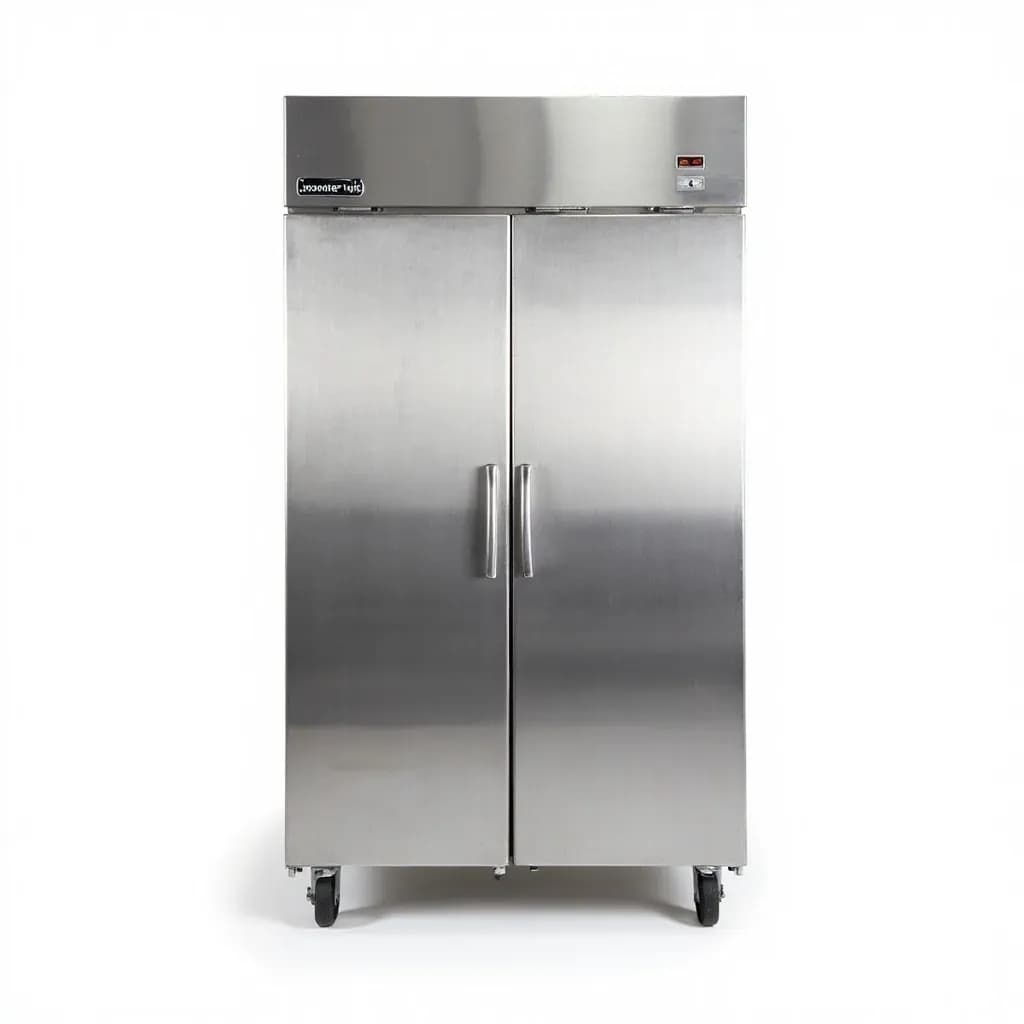
An upright commercial fridge with full-height doors for shelved cold storage in busy kitchens.
A reach-in refrigerator is an upright commercial unit, usually stainless steel with one to three full-height doors, that holds shelved ingredients at safe cold temperatures during service. Cooks reach straight in for prepped pans, dairy and proteins without bending into a cooler. Its heavy-duty compressor recovers temperature quickly as doors open repeatedly during a rush.
A reach-in is the upright, full-height commercial refrigerator that stands against the kitchen wall, usually one to four doors wide, with three or four adjustable shelves behind a hinged solid or glass door. It is the everyday working cold-storage of a restaurant line: closer than a walk-in, faster to open, and organized for the cook rather than the receiver. Most reach-ins hold 33–41 °F (1–5 °C), with 36–38 °F the working target for general product, and the freezer version holds 0 to −10 °F (−18 to −23 °C). The cabinet is stainless inside and out, runs on a bottom- or top-mounted compressor, and depends on free airflow over the evaporator coil — which is why clearance around the box, gasket condition, and how tightly you pack it matter as much as the name on the door.
A reach-in is not a smaller walk-in. A walk-in is a room you walk into; a reach-in is a cabinet you open, and that single difference shapes how it is used. A reach-in lives at the line for active production — pre-portioned proteins, sauces, garnishes, and pans of mise en place — while the walk-in handles bulk receiving, par stock, and longer holds. Most professional kitchens run both side by side. When floor space, budget, or volume does not justify a walk-in, a two- or three-section reach-in becomes the entire cold-storage plan, and how it is loaded and maintained decides whether the kitchen holds temperature during a Saturday rush or doesn't.
The unit behaves like a heat exchanger, not an icebox. Every opening pulls room-temperature air across the evaporator, condensing moisture and raising the cabinet temperature until the compressor catches up. Stack pans so air can move between them, leave a couple of inches of clearance at the rear and top, and never load a hot hotel pan straight from the stove — the temperature spike can run several degrees in a packed single section and endanger everything else inside.
Alternatives
Types & varieties
Standard 33–41 °F cold storage; the workhorse of most commercial kitchens.
Same cabinet form factor but holds 0 to −10 °F; heavier-duty insulation, stronger compressor, and longer recovery time after door openings.
A two-section body with one side refrigerator and one side freezer; useful where wall space is tight.
Doors on both front and rear so cooks and servers can access product from either side; standard behind banquet and buffet lines.
Reach-in with glass doors for retail display — beverages, grab-and-go items, prepackaged food. Higher thermal loss than solid doors.
Two half-height doors stacked per section; opening the top half loses roughly half as much cold air as a full door.
All-stainless construction, more powerful compressors, longer warranties (e.g. True SPEC, Continental Designer Line, Traulsen G-Series) for high-volume operations.
Shorter (≈ 30–36 in tall) versions that double as a prep surface; a different class from full-height reach-ins and worth noting only to avoid confusion.
Reach-in vs. walk-in vs. roll-in
All three are commercial cold storage, but they answer different problems. Knowing which one is which is half the battle when sizing a kitchen.
- Walk-in: a refrigerated room for bulk receiving, par stock, and items you'll hold for days. You walk into it; everything lives on rolling racks or stationary shelving.
- Reach-in: a full-height upright cabinet for active line production. You stand in front of it; pans of prep live one shelf away from the pass.
- Roll-in refrigerator: a tall cabinet built to accept a full sheet-pan rack on casters. The rack rolls in and out; the cabinet itself rarely gets opened. Common in banqueting and central-production kitchens.
- Most mid-size operations run a walk-in for storage plus one or two reach-ins on the line. Small operations often run only reach-ins and accept the discipline that comes with tighter space.
How to load and organize a reach-in
A reach-in is small enough that organization has to be deliberate. Treat it as the most-used shelf in the kitchen and stock it like one.
- Top shelf: ready-to-eat items, garnishes, sauces — anything you'll grab in the next ten minutes.
- Middle shelves: portioned proteins, cooked grains, vegetable prep, dairy, eggs.
- Bottom shelf: raw proteins in sealed containers, well below ready-to-eat food. Health inspectors will check this.
- Label and date every container; the FIFO rule is non-negotiable in a cabinet this size.
- Leave a finger-width of space between pans so cold air can move; tight stacking creates warm pockets the thermostat cannot see.
Common uses
Tips & pitfalls
- Leave 2–3 inches of clearance on the sides, rear, and top of the cabinet. Blocked airflow is the leading cause of compressor failure, and it usually isn't covered by warranty.
- Do not overstock. Cold air has to circulate around every pan, and a packed reach-in runs constantly, runs hot, and shortens compressor life.
- Cool hot food to 70 °F or below before putting it inside. A 140 °F hotel pan (the FDA hot-holding threshold) will spike the cabinet and endanger everything else — this is one of the most common and most expensive mistakes on a busy line.
- Check door gaskets weekly. A torn or warped gasket is the single biggest energy waste in cold storage, and a sanitarian will flag it on inspection.
- Clean condenser coils every 90 days — monthly in a greasy kitchen. Dusty coils can cut efficiency in half and are behind a large share of 'broken' reach-in service calls.
- Set the thermostat to 36–38 °F for refrigerators and 0 °F for freezers. Cranking it lower wastes energy without meaningfully extending shelf life.
- Do not place a reach-in next to grills, fryers, dishwashers, or ovens. Ambient heat forces the compressor to overwork and shortens its life.
- Use only NSF-approved food-grade shelving. Residential shelves and wooden boards are not designed for commercial cold storage and can fail under load or harbor moisture.
- If a unit stops cooling, check the door-ajar alarm, condenser coil, evaporator fan, and refrigerant level before calling service — many 'broken' reach-ins are simply clogged with dust or packed too tight.
Good to know
- Operating range
- 33–41 °F (1–5 °C) for refrigerators; 0 to −10 °F (−18 to −23 °C) for freezers; target 36–38 °F / 0 °F for daily use.
- Cabinet sizes
- Single ≈ 23–25 cu ft; two-section ≈ 46–50 cu ft; three-section ≈ 70–72 cu ft. Width runs about 27–30 in per section.
- Standard height
- Roughly 6'6"–7' (78–84 in) to clear overhead hoods and doorframes.
- Shelving
- 3–4 adjustable epoxy-coated or stainless wire shelves per section, full cabinet depth.
- Construction
- Stainless exterior and interior standard; anodized aluminum interior on economy models; 2 in CFC-free polyurethane foam insulation.
- Compressor placement
- Bottom-mounted (easier service, slightly warmer top shelf) or top-mounted (cooler interior, less heat radiating to the floor).
- Refrigerant
- R-290 (propane) in newer units; R-134a still common; older units used R-404A.
- Certification
- NSF/ANSI 7 for commercial food equipment; ENERGY STAR® models available and typically save 10–40 % over standard units.
Also called
Reach-In Cooler · Upright Refrigerator · Commercial Fridge
Related

Stovetop
The everyday burners where most cooking actually happens

Oven
Enclosed dry heat for roasting, baking, and braising

Grill
Live-fire or gas grates for char, smoke, and high heat

Smoker
Low, slow heat and wood smoke for barbecue and brisket

Air Fryer
Countertop convection that crisps with little or no oil

Slow Cooker
Set-and-forget low heat for stews, beans, and braises

Pressure Cooker
Sealed steam pressure that cooks tough food in a fraction of the time

Rice Cooker
Foolproof, perfectly steamed rice every single time