Appliances & Heat
Refrigerated Prep Table
A chilled work counter with insert pans for assembling sandwiches, pizzas and salads.
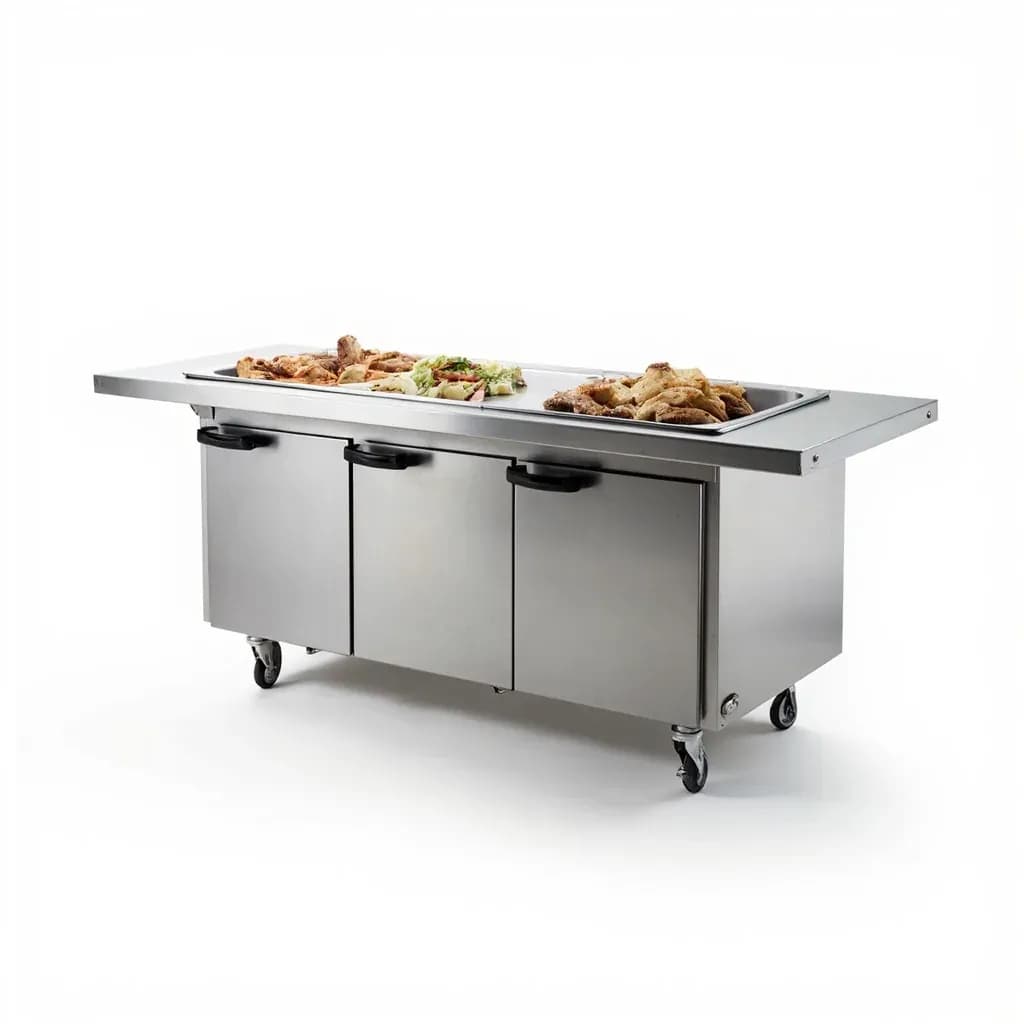
A refrigerated prep table combines a refrigerated base with a top rail of chilled insert pans, keeping toppings and fillings cold and within reach while a cook assembles food on the cutting surface in front. Sandwich and pizza make-lines rely on it to speed assembly during service. The cold base below stores backup product for restocking the rail.
A refrigerated prep table is the workhorse of any cold-line service: a stainless-steel cabinet topped with a recessed cold well that holds a row of hotel pans at 33–41°F (1–5°C) and a removable cutting-board surface where the actual assembly happens. Conceptually it is two pieces of equipment fused into one — a reach-in refrigerator for backup stock in the base, and a cold-food holding table (the pan rail) on top — which is why it eliminates so much of the back-and-forth that slows down sandwich, salad, and pizza stations.
The advantage is not just convenience. The cold well is engineered to NSF/ANSI 7 food-zone standards, meaning the pans are held in a sealed, refrigerated envelope rather than sitting on an open ice bath or being shuttled to a walk-in. Ingredients stay at safe holding temperature through an entire lunch rush, and the cook works from a single, organized station. For delis, cafés, pizzerias, and any high-volume cold-line operation, the prep table is the single biggest labor-saver on the floor.
Alternatives
Types & varieties
12-in.-deep cutting board with a shallow pan rail; the standard configuration for delis, cafés, and cold-line stations.
19–24-in.-deep cutting board to assemble dough, sauce, and toppings; often accepts 6-in.-deep pans in the rail.
Deeper refrigerated rail that holds 4- to 6-in.-deep pans, doubling ingredient capacity in the same footprint.
Replaces hinged-door storage with a stack of refrigerated drawers for portioned proteins or pre-portioned mise en place.
Sized by the number of full-size GN cabinet sections in the base; door count tracks with overall width.
34-in. working surface for accessibility compliance; sacrifices a small amount of under-counter storage.
Compressor is mounted remotely (often on the roof) for quieter line service and less heat dumped into the kitchen.
Shorter unit that pairs with a standard 36-in. counter, with a smaller pan rail on top.
Anatomy of the Unit
Three zones define every prep table. The cold well (or pan rail) is the refrigerated trough at the back, sized to accept 1/6-size pans about 4 in. deep; the evaporator coil runs along the bottom of this trough and chills the pan contents directly. The cutting-board deck sits in front of the rail, removable for cleaning and typically made of 1/2-in. HDPE. Below the deck is the refrigerated base — a reach-in cabinet with hinged or sliding doors, or drawers — that stores backup stock at the same 33–41°F range. The compressor is almost always bottom-mounted for serviceability and to keep the food zone free of mechanical heat.
- Cold well: sealed refrigerated trough; 1/6-size hotel pans; adapter bars allow 1/3- and 1/9-size pans.
- Cutting board: 12 in. for sandwich/salad, 19–24 in. for pizza; lifts out for sanitation.
- Base cabinet: hinged doors, sliding doors, or drawers; sized by overall width and door count (one to four).
- Compressor: typically 1/4 to 1/2 HP, bottom-mounted, often R-290 refrigerant on new models.
Choosing the Right Configuration
Match the unit to the menu, not the other way around. A sandwich or salad line needs a 12-in. board and shallow 4-in. pans; a pizza station cannot work on a sandwich-depth board because the dough and finished pie will not fit. Count your toppings: a standard rail holds roughly seven to eight 1/6-size pans per 48-in. unit. If you run more than that — or hold proteins in 6-in. deep pans — step up to a mega-top. Drawer bases are worth the premium for portioned proteins and prepped vegetables, since the drawer dividers double as a labeling system.
Common uses
Tips & pitfalls
- Pre-chill every ingredient before loading it into the rail — dropping room-temperature product into the pan well spikes holding temperatures for hours and can push food above 41°F.
- Use first-in, first-out rotation: refill from the back and pull pans from the front, so older product never hides at the rear of the well and loses temperature.
- Verify the food zone with a calibrated probe thermometer at startup and weekly during service; the built-in gauge reads the air, not the food, and is not reliable for compliance.
- Clean the condenser coil every 60–90 days — a clogged coil is the number-one cause of temperature failure in commercial refrigeration.
- Inspect door and drawer gaskets monthly; a torn gasket can let warm air leak in and climb the pan-rail temperature above the safe zone during a rush.
- Use only NSF-listed 1/6-size pans (or proper adapter bars) so the evaporator can actually chill the food zone — ill-fitting pans create dead spots.
- Do not use the cutting board as a permanent landing zone for hotel pans; deep gouges harbor bacteria and force early replacement.
- Let the unit stand upright for several hours before plugging in after delivery, especially if it was transported on its side, to let compressor oil settle.
Good to know
- Also called
- Sandwich prep table, salad prep table, pizza prep table, make table, cold prep table
- Pan-rail temperature
- 33–41°F (1–5°C), meeting NSF/ANSI 7 food-zone cold-hold standards
- Pan capacity
- 1/6-size hotel pans (or 1/3- and 1/9-size with adapter bars) on a refrigerated cold well
- Common widths
- 27, 36, 48, 60, and 72 in., scaling from one to four sections
- Working height
- 36 in. standard; 34 in. for ADA-compliant models
- Cutting board
- Removable high-density polyethylene (HDPE); 12 in. deep for sandwich/salad, 19–24 in. for pizza
- Refrigerant
- Most new units use R-290 (propane), a low-GWP natural refrigerant
- Power
- 120V/60Hz, 1-phase, on a dedicated 15- or 20-amp circuit
Also called
Refrigerated Prep Table (Sandwich Station) · Pizza Make-Line · Prep Table Refrigerator · Sandwich Prep Table
Related

Stovetop
The everyday burners where most cooking actually happens

Oven
Enclosed dry heat for roasting, baking, and braising

Grill
Live-fire or gas grates for char, smoke, and high heat

Smoker
Low, slow heat and wood smoke for barbecue and brisket

Air Fryer
Countertop convection that crisps with little or no oil

Slow Cooker
Set-and-forget low heat for stews, beans, and braises

Pressure Cooker
Sealed steam pressure that cooks tough food in a fraction of the time

Rice Cooker
Foolproof, perfectly steamed rice every single time