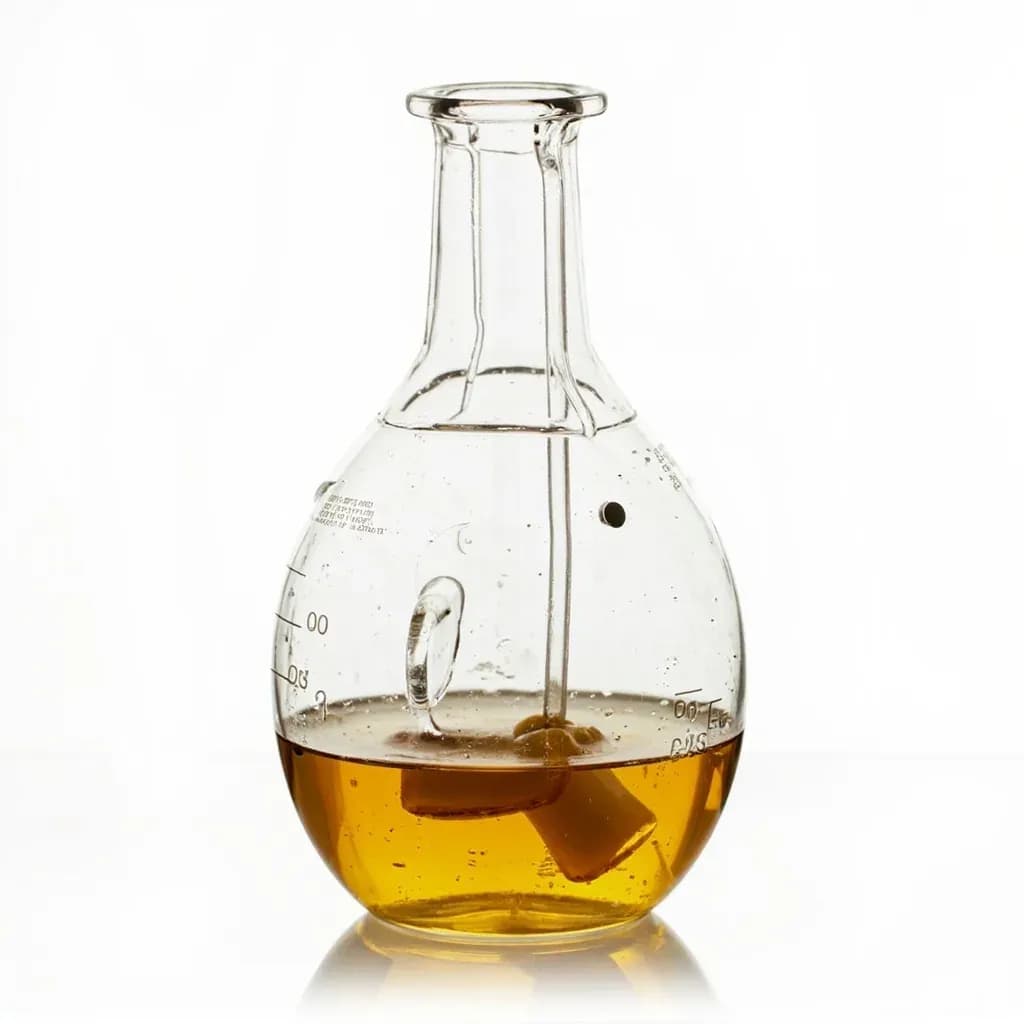
Appliances & Heat
Rotary Evaporator (Rotovap)
A lab-style distiller that gently concentrates and captures aromas under vacuum at low heat.
A rotary evaporator spins a flask under vacuum in a warm water bath, lowering the boiling point so volatile aromas distill off without scorching. Modernist cooks use it to make clear, intensely flavored distillates and to concentrate juices, stocks and infusions while preserving delicate notes. The condenser recaptures the evaporated liquid for a pure aromatic essence.
The rotary evaporator — almost always shortened to rotovap — is a piece of laboratory glassware adapted for the kitchen that concentrates liquids and captures their volatile aromatics at temperatures far below 100 °C. It does this by pulling a partial vacuum inside a spinning flask, which lowers the boiling point of the liquid: water that would normally boil at 100 °C can be coaxed to evaporate at 30 °C or even cooler, and ethanol boils well below room temperature under hard vacuum. Because the heating bath stays gentle and the solvent leaves as vapor rather than through prolonged simmering, fragile compounds that would otherwise cook off — the bright top notes of basil, the green pepper character of fresh coriander, the floral lift of orange blossom — end up condensed and recovered intact in a separate flask.
For cooks, the practical consequence is access to flavors that are usually destroyed the moment a pot touches a burner. A rotovap can pull alcohol out of a bitter infusion without the harsh bite that heat extraction leaves behind, reduce a chicken jus to a glossy concentrate without dulling its color, or split a strawberry purée into a clear aromatic water and a richly colored residue. The instrument was invented in 1950 by Lyman C. Craig at the Rockefeller Institute for solvent recovery in pharmaceutical chemistry; it migrated into restaurant kitchens in the early-to-mid 2000s, when chefs like Ferran Adrià, Heston Blumenthal, and Grant Achatz began using it to chase the volatile chemistry that traditional cooking could not reach.
A rotovap is not a still in the distillery sense, and it is not a fancy reduction pot. It is a precision tool for separating volatile and non-volatile fractions of a liquid under controlled temperature and pressure. Once a cook understands the three dials — bath temperature, vacuum level, and rotation speed — the instrument becomes predictable and reproducible, which is the whole reason a serious kitchen reaches for it in the first place.
Alternatives
Types & varieties
The standard form factor (Büchi, Heidolph, IKA, Yamato, Steroglass); most reliable for serious kitchen work but expensive and glassware-heavy.
Smaller, simplified units aimed at chefs with 1–2 L flasks and a friendlier footprint.
10–20 L flasks for production kitchens or small distilleries; require higher-capacity chillers and pumps.
Standard evaporating and receiving flasks sheathed in plastic to contain implosion — strongly recommended in any food kitchen.
Manual-lift units use a hand jack to raise the bath; motor-lift automates the bath and is standard on most modern units.
Vertical condensers save bench space; diagonal/V-shaped condensers offer better separation for low-boiling solvents.
Oil-free vacuum pumps suited to food use; quieter, cleaner, and lower maintenance than rotary vane pumps.
Reading the three controls
Every rotovap run comes down to the relationship between bath temperature, vacuum, and rotation speed. Rather than setting them independently, think of them as a triangle: the goal is to evaporate solvent steadily, condense it cleanly, and avoid bumping. The bath should sit roughly 20 °C above the boiling point of your solvent at your working pressure — bumping the bath to maximum is rarely an improvement, it just scorches residue. Vacuum should be lowered gradually; a sudden drop in pressure is the single most common cause of violent boil-over into the receiving flask. Rotation spreads the liquid into a thin film on the flask wall, increasing surface area and dampening the kind of bumping that ruins a run. As a working rule: small flasks (≤1 L) spin fast (200–280 rpm), large flasks (≥5 L) spin slow (50–100 rpm) to keep the film balanced.
- If the distillate smells flat or cooked and the residue is bright: the bath is too hot for the chosen pressure — drop temperature or raise pressure slightly.
- If the distillate smells of nothing and all the flavor is in the residue: the condenser is too warm — check chiller temperature and coolant flow.
- If solvent floods into the receiving flask: the vacuum dropped too fast, the flask was overfilled, or there is no bump trap in line.
- If the run stalls and nothing is condensing: vacuum is too weak, the condenser is warm, or the seal has failed — listen for the pump and feel for cold at the condenser outlet.
Setting up a kitchen station
The instrument itself is the smallest part of the cost. A working kitchen rotovap station needs the rotovap, a vacuum pump (a diaphragm pump is the practical choice for food use), a condenser cooling source, plastic-coated glassware, and — depending on the solvents — a fume hood or strong local exhaust. A recirculating chiller set to 0–5 °C is ideal for ethanol; for very low-boiling fractions like hexane or pure essential oils, a dry-ice/acetone bath at roughly –78 °C will hold what a water-cooled condenser cannot. Budget bench space for a chiller and pump beside the rotovap, plan a power circuit that can handle a 1–3 kW bath heater, and keep the unit away from any open flame.
- Entry cost: a used lab unit plus pump and chiller can be assembled for roughly $1,500–$3,000; a new small-scale kitchen unit with pump runs $2,500–$5,000; full lab-grade systems reach $5,000–$20,000+.
- Never distill near a gas burner or hot plate — ethanol vapor is heavier than air and will travel along a bench before igniting.
- Label every run with bath temperature, vacuum pressure, and rotation speed; reproducibility is the entire reason to use a rotovap over a stovetop reduction.
- Clean glassware the same day you use it; resinous botanicals (pine, citrus, vanilla) polymerize onto hot glass and can ruin the next batch.
Common uses
Tips & pitfalls
- Never fill the evaporating flask more than one-third full — overfilling causes bumping and loss of product into the receiving flask.
- Set the bath roughly 20 °C above the boiling point of your solvent at your working pressure; this is a safer default than maxing out heat.
- Lower the vacuum gradually — a sudden drop in pressure is the single most common cause of violent bumping.
- Use a bump trap (anti-splash adapter) between the evaporating flask and the vapor duct; it is cheap insurance against losing a batch.
- Keep the condenser cold enough: a recirculating chiller at 0–5 °C for ethanol; dry-ice/acetone (~ –78 °C) for very low-boiling solvents.
- Do not distill to complete dryness — concentrated residue in a hot flask scorches, and bumping risk rises as volume shrinks.
- Use plastic-coated (safety-coated) glassware in any kitchen; bare borosilicate can and occasionally does implode under vacuum.
- Match rotation speed to flask size: small flasks (≤1 L) around 200–280 rpm, large flasks (≥5 L) closer to 50–100 rpm to balance the film.
Good to know
- Inventor
- Lyman C. Craig, Rockefeller Institute for Medical Research, 1950
- Original use
- Pharmaceutical and chemistry laboratory solvent recovery
- Adapted to kitchens
- Early-to-mid 2000s, by modernist restaurants including El Bulli, The Fat Duck, and Alinea
- Principle
- Reduces pressure inside the flask, lowering the liquid's boiling point so it evaporates at gentle temperatures
- Typical bath temperature
- 30–60 °C for water baths; oil baths can run to ~180 °C for heavier fractions
- Vacuum range
- Roughly 1 mbar at the deep end, more commonly a few to a few hundred mbar for kitchen work
- Rotation speed
- 20–280 rpm; spinning thins the liquid into a film that increases surface area and prevents bumping
- Common flask sizes (kitchen use)
- 500 mL to 5 L; lab units extend to 20 L and beyond
- Build material
- Borosilicate 3.3 glassware with PTFE seals; plastic-coated glassware is strongly recommended for kitchen use
- Safety
- Glassware can implode under vacuum; never distill to dryness, and always work under a fume hood or strong exhaust
Also called
Rotovap · Rotary Evaporator · Rotavap
Related

Stovetop
The everyday burners where most cooking actually happens

Oven
Enclosed dry heat for roasting, baking, and braising

Grill
Live-fire or gas grates for char, smoke, and high heat

Smoker
Low, slow heat and wood smoke for barbecue and brisket

Air Fryer
Countertop convection that crisps with little or no oil

Slow Cooker
Set-and-forget low heat for stews, beans, and braises

Pressure Cooker
Sealed steam pressure that cooks tough food in a fraction of the time

Rice Cooker
Foolproof, perfectly steamed rice every single time