Appliances & Heat
Rotary Rack Oven
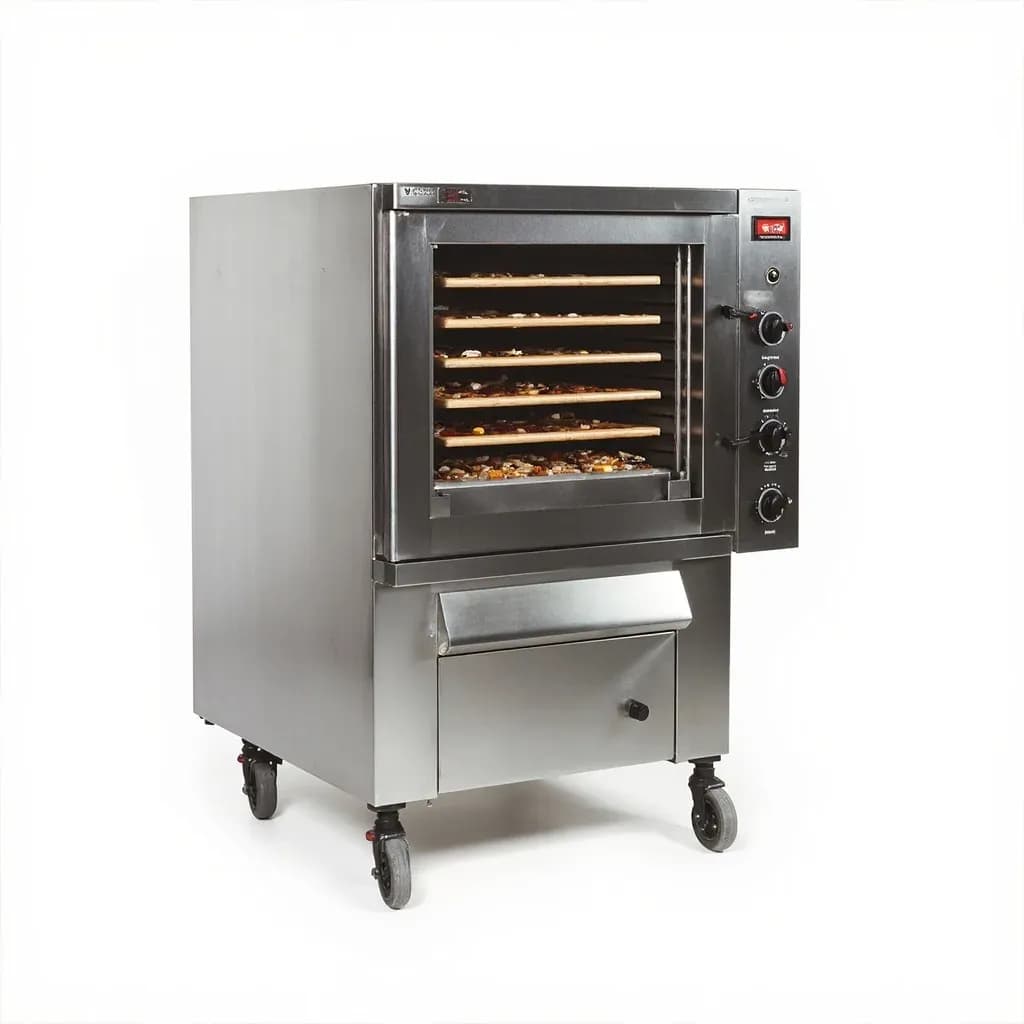
A large commercial oven that bakes a full wheeled rack of trays while rotating it for even results.
A rotary rack oven is a tall, industrial baking oven into which a whole rolling rack loaded with sheet pans is wheeled. Inside, the rack slowly rotates as hot air circulates, so every tray bakes uniformly regardless of position, eliminating hot spots across a big batch. Bakeries rely on it to produce large, consistent runs of bread, rolls, and pastries.
A rotary rack oven is a large commercial oven built around a single idea: load an entire wheeled rack of sheet pans in the bakery, wheel it into the oven, lock it onto a motorized turntable, and let continuous rotation plus high-velocity convection airflow do the rest. That mechanical simplicity is the whole point — before rack ovens became common, bakers loaded pans one at a time into deck or reel ovens, a slow, hot, and inconsistent process. The rotating rack eliminates the edge-versus-center hot spots that plague any large chamber, so a tray on the front of the rack bakes the same as one on the back.
What makes the format genuinely useful is the combination of capacity and control. A single full-size rack holds 16–20 sheet pans, a double-rack model pushes that to 30–40, and the oven's controls usually separate top heat, bottom heat, fan speed, rotation, steam injection, and exhaust damper. That means the same oven can be tuned for crusty hearth loaves that need aggressive steam at the start, a dry finish on the crust, and even color on a sheet of delicate shortbread — provided the baker understands what each control actually does.
In practice the rack oven behaves as both a heat source and a workflow hub. Dough is mixed, divided, shaped, and often proofed on the same rack, which is then rolled directly into the oven with no transferring of pans. For medium- and large-volume bakeries, hotels, catering operations, and supermarket in-store bakeries, that ergonomic loop is what makes the format indispensable.
Alternatives
Types & varieties
The classic format: one full bakery rack rotates inside one chamber. The standard for medium-volume bakeries.
Two independent rotating racks stacked in one oven footprint; high-capacity production bakeries and wholesale operations.
Smaller chamber that accepts a half-size or 8–12-pan rack; used by small bakeries, cafés, and supermarket in-store operations.
The most common commercial format — fast heat-up, higher peak temperatures, lower operating cost where gas service is available.
Uses electric heating elements rather than gas; favored where gas service is unavailable or for cleaner indoor installations.
Built-in boiler or steam generator for injected steam; essentially required for crusty breads, rolls, and bagels.
Tuned for high-velocity, low-moisture airflow; best suited to cookies, biscuits, scones, and pastry work.
Floor-loader: rack lifts up into the chamber from below, common in European designs such as MIWE and Wiesheu. Front-loader: rack rolls in at floor level on a track, common in North American installations.
Steam and crust development
Steam is the single most misunderstood control on a rack oven, and it is what separates a good crust from a pale, brittle one. The goal in crusty breads, rolls, and bagels is to saturate the chamber with steam in the first phase of the bake so the surface of the dough stays plastic long enough for maximum oven spring and a glossy, blistered crust to form. After that window closes — usually once the crust has set and started to color — the damper must open and the steam must vent, otherwise the crust will never dry and crisp.
- Inject steam immediately after loading, not partway through the bake; delay cancels out the benefit.
- Vent the damper and stop steam injection at roughly one-third to halfway through the bake for breads, depending on size and weight.
- Rolls and bagels need shorter steam windows than large loaves; a 30–60 second burst is often enough.
- If the crust comes out gummy or pale, either the steam phase was too long or the damper failed to open on schedule.
Loading and workflow
The rack oven is as much a workflow tool as a baking chamber. The whole point of the format is that dough is mixed, divided, shaped, and proofed on the same rack that then rolls into the oven — no individual pan handling, no transfers, no lost trays. This is why rack ovens pair so naturally with retarder-proofers: dough goes into the retarder on the rack overnight, comes out fully proofed, and rolls straight into the oven the next morning.
- Plan the rack layout before you start loading: heavy, dense products on the bottom, lighter items on top.
- Leave 2–3 cm of clearance around each pan; tight loads block airflow and produce uneven bake.
- Preheat the oven with a rack in place so the chamber and rack are at temperature when the loaded rack arrives.
- Lubricate the rack casters regularly; a stiff rack is hard to dock and can damage the turntable coupling.
Common uses
Tips & pitfalls
- Preheat fully with the rack in place — loading a cold rack into a hot chamber warps the rack and pans and skews timing once the loaded rack arrives.
- Don't open the door mid-bake unless the recipe requires it; heat loss is significant and recovery is slow, which costs you the uniformity the oven is designed to deliver.
- Weigh or measure dough pieces identically; on a rack oven, even small size variations show up as visible color and bake variation after the run.
- Clean the rotating turntable drive and the rack's locking pin regularly — flour and grease buildup cause the rack to slip, stall, or fail to dock properly.
- Check door gasket seals quarterly; a worn gasket pulls cold air in and ruins bake consistency from batch to batch.
- Avoid overloading the rack above its rated capacity — the top shelf will brown faster than the bottom and you'll lose the even color the oven is built to produce.
Good to know
- Also known as
- Rack oven, revolving oven, rotating rack oven, rotary oven
- Origin
- Developed in Germany in the mid-1950s; MIWE (Michael Wenz GmbH) is widely credited with patenting the first commercial rotary rack oven in 1956.
- Standard pan size
- Full-size sheet pans, 18 × 26 in (460 × 660 mm), loaded on a wheeled bakery rack that rolls into the oven.
- Typical capacity
- Single-rack models hold 16–20 pans; double-rack models hold 30–40; mini-rack ovens hold 8–12.
- Operating temperature
- Up to roughly 300 °C / 570 °F; bakery work typically runs 180–260 °C / 350–500 °F.
- Rotation mechanism
- A motorized turntable rotates the locked rack continuously inside the chamber; high-velocity convection fans drive airflow around it.
- Heat source
- Gas, electric, or oil-fired; many models offer steam injection from a built-in generator or separate boiler.
- Power draw (gas)
- Commonly 100,000–250,000 BTU/hr depending on size and configuration.
- Footprint
- Large commercial appliance, typically 1.5–2 m wide and deep, requiring floor space plus clearance for loading.
- Common settings
- Independent controls for top/bottom heat, fan speed, rotation, steam quantity, and damper/exhaust.
- Notable manufacturers
- MIWE, Wiesheu, Revent, Sveba Dahlen, Polin, Pavailler, Bongard, Blodgett, Lang, LBC Bakery Equipment, Baxter.
Also called
rack oven · rotating rack oven · bakery rack oven
Related

Stovetop
The everyday burners where most cooking actually happens

Oven
Enclosed dry heat for roasting, baking, and braising

Grill
Live-fire or gas grates for char, smoke, and high heat

Smoker
Low, slow heat and wood smoke for barbecue and brisket

Air Fryer
Countertop convection that crisps with little or no oil

Slow Cooker
Set-and-forget low heat for stews, beans, and braises

Pressure Cooker
Sealed steam pressure that cooks tough food in a fraction of the time

Rice Cooker
Foolproof, perfectly steamed rice every single time