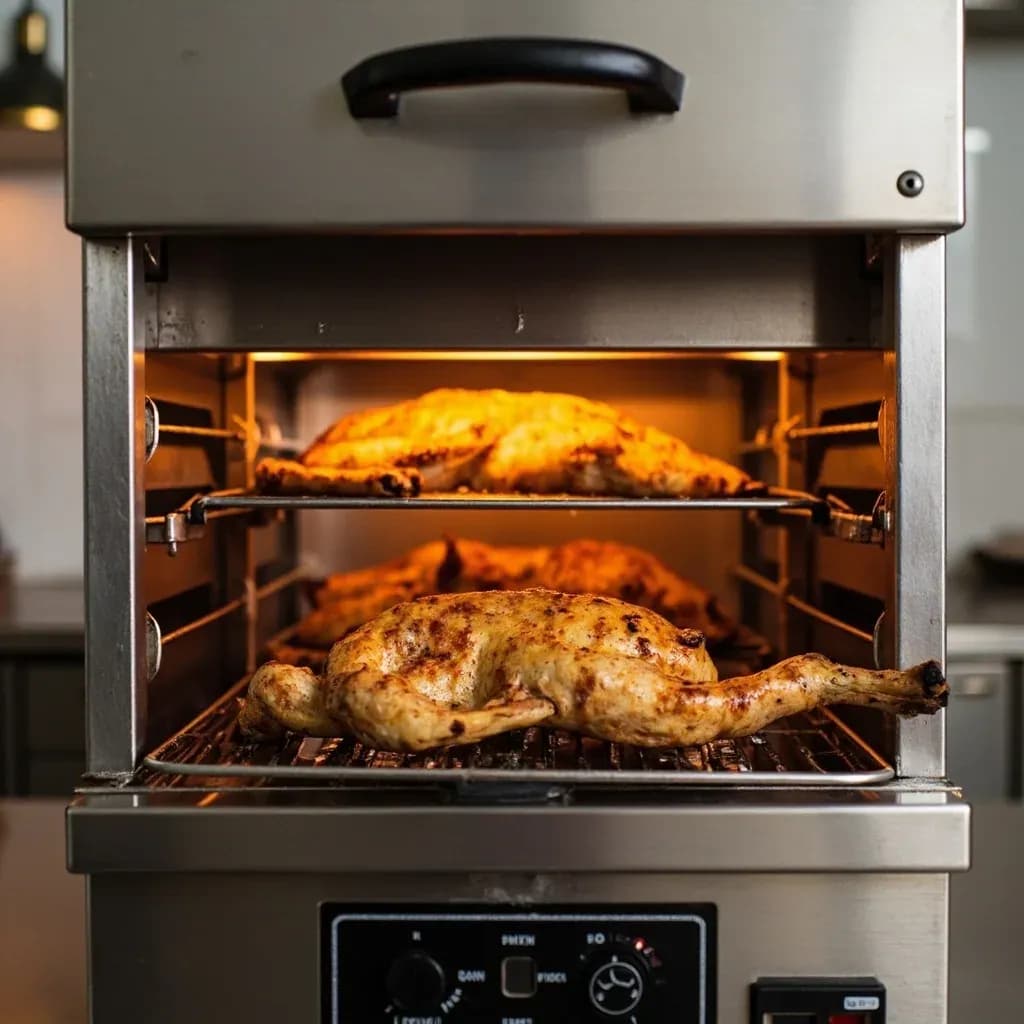
Appliances & Heat
Salamander Broiler
An overhead high-intensity broiler used to brown, glaze, and finish dishes from the top.
A salamander is a compact, wall- or shelf-mounted broiler with a powerful heat element radiating downward, common in professional kitchens. Chefs slide plates or pans under it to caramelize creme brulee, melt and brown cheese, blister gratins, and reheat or finish a dish at the pass. The intense top heat browns surfaces fast without cooking the food through.
The salamander broiler is a specialized piece of finishing equipment that delivers intense, top-down radiant heat to the surface of an already-cooked dish. Where a standard oven broiler does double duty for everything from raw chops to weeknight vegetables, a salamander is built to do one job extremely well: add color, crust, and a final glaze in seconds. It sits at the pass in most à la carte kitchens, mounted to the wall or ceiling above a hood, so a cook can slide a plate under it, brown the top of a French onion soup or a gratin, and send it out without missing the next ticket.
Heat comes from above and only from above — a fixed gas flame, a quartz halogen tube, or a ceramic infrared tile, depending on the model — and the cook controls the intensity of browning almost entirely by raising or lowering the working rack, not by adjusting the burner. That geometry is the whole point. Top-down radiant heat drives the Maillard reaction and caramelizes sugars far more aggressively than ambient oven heat, so a dish can go from pale to deeply bronzed in under a minute. Treat it as a precision finisher rather than a cooking appliance: thick cuts of raw meat will not cook through under it, but a thin layer of cheese, a glaze, or a breadcrumb crust will set and color exactly when you want it to.
The name comes from the mythical salamander, said to live in fire, and the original tool was just that idea made literal: a round iron disk on a long handle, heated in the hearth and passed over food like an open-flame finishing iron. That medieval form is still occasionally used in wood-fired kitchens, but the modern salamander is essentially an overhead broiler mounted in a stainless housing. It is one of the few pieces of kitchen equipment whose core idea has survived essentially unchanged from the 14th-century hearth to the contemporary pass.
Alternatives
Types & varieties
A heavy iron disk on a long handle, heated in coals or flame and passed over food. Still used in some wood-fired kitchens and historically in older French and European restaurants.
A fixed overhead gas broiler, 24–36 in wide, vented under a hood. Standard on restaurant à la carte lines.
A compact unit on a stand with a pull-out lower rack; gas or electric, typically 15–24 in. Common in smaller kitchens and pastry work.
Quartz halogen tubes deliver instant, very intense radiant heat; heats in seconds and recovers fast, favored for high-volume finishing.
Gas-fired ceramic tile or screen that radiates intense, even infrared heat. Preferred in many modern kitchens for control and evenness of color.
A lower-temperature electric version, about 350–450 °F, used mainly for melting cheese, glazing, and gentle warming — essentially a salamander dialed down.
Home alternatives
A true salamander is a restaurant tool, but its essential job — intense top-down heat for a few seconds at a time — can be approximated in a home kitchen. None of these substitutes reproduce the even, sweeping radiant field of a real unit, but each handles small finishing tasks well.
- Oven broiler on high with the rack on the top setting: the closest analog for gratins, glazed vegetables, and toast. Pull the rack to 3–4 inches from the element, watch constantly, and accept slightly slower and less even browning.
- Kitchen torch (culinary butane): ideal for small surface work like crème brûlée sugar, browning meringue peaks, or glazing a single portion of pâté en croûte. Use a continuous sweeping motion to avoid scorching one spot.
- Screaming-hot cast-iron skillet or plancha: heat the pan until a drop of water skitters across it (the Leidenfrost point), then hold the bottom of the pan close over the food to mimic the radiant sweep of a cast-iron salamander. Works well for finishing fish fillets or crisping a tart top.
- Toaster oven on broil: a small but surprisingly effective stand-in for gratinating individual portions, melting cheese, or browning the top of a small cocotte.
Common uses
Tips & pitfalls
- It's a finisher, not a cooker. Use it to color the surface of food that is already cooked through; it will not reliably cook thick raw cuts.
- Preheat the unit for 5–10 minutes (gas) or a few minutes (electric infrared) before service. Radiant heat must be stable for even browning.
- Control browning by rack height, not by time alone. A few inches of vertical change can be the difference between a golden glaze and a scorch.
- Watch constantly. Infrared heat forgives a few seconds of inattention, then crosses quickly to burned — never walk away from a loaded salamander.
- Pat food dry before placing it under the salamander. Surface moisture steams the top and prevents the Maillard crust you are after.
- Use shallow heatproof dishes — metal, tempered glass, or fireproof ceramic. Avoid plastic handles and thin glass that can crack from thermal shock.
- For gratins and glazed items, finish with the sauce or glaze already on the surface. The salamander sets and colors it; sauce added afterward will not color.
- Clean the catch tray and reflector regularly. Splatter smokes, carbonizes on the element, and can flavor the next dish or ignite.
- With a traditional cast-iron salamander, heat the disk until a drop of water skitters across it (the Leidenfrost point) before passing it over food. That is the working temperature.
- Ventilation matters. Salamanders throw a lot of radiant heat and combustion byproducts, so they belong under a hood in a pro kitchen.
Good to know
- Origin
- Medieval Europe, 14th–15th century; mentioned in Le Ménagier de Paris (1393) and the Taillevent tradition (Le Viandier).
- Original form
- A round cast-iron plate or disk on a long iron handle, heated in the hearth or fire and passed over food to brown it.
- Heat source
- Gas (open burner or ceramic infrared), electric quartz or quartz halogen tubes, or older electric calrod / tubular elements; ceramic infrared is widely used in modern pro kitchens.
- Operating temperature
- Radiant surface heat typically 500–700 °F (260–370 °C); ceramic infrared can exceed 1,500 °F (815 °C) at the element.
- Power
- Electric units commonly 2.4–6 kW on countertop models, up to ~10 kW on wall units (208–240 V in North America). Gas units roughly 20,000–60,000 BTU/h depending on width.
- Adjustability
- The element is fixed at the top; browning is controlled by raising or lowering the rack (or by time and distance), since the unit itself cannot move.
- Working width
- Wall-mounted units typically 24–36 in; countertop units 15–24 in; the traditional cast-iron salamander is a single handheld disk.
- Also called
- Overhead broiler, finishing broiler, salamander grill; lower-heat countertop versions are sold as 'cheese melters' or 'toaster salamanders.'
Also called
Salamander · Overhead Broiler
Related

Stovetop
The everyday burners where most cooking actually happens

Oven
Enclosed dry heat for roasting, baking, and braising

Grill
Live-fire or gas grates for char, smoke, and high heat

Smoker
Low, slow heat and wood smoke for barbecue and brisket

Air Fryer
Countertop convection that crisps with little or no oil

Slow Cooker
Set-and-forget low heat for stews, beans, and braises

Pressure Cooker
Sealed steam pressure that cooks tough food in a fraction of the time

Rice Cooker
Foolproof, perfectly steamed rice every single time