Appliances & Heat
Samovar
A metal urn that heats and holds water for serving tea, with a concentrated brew kept warm on top.
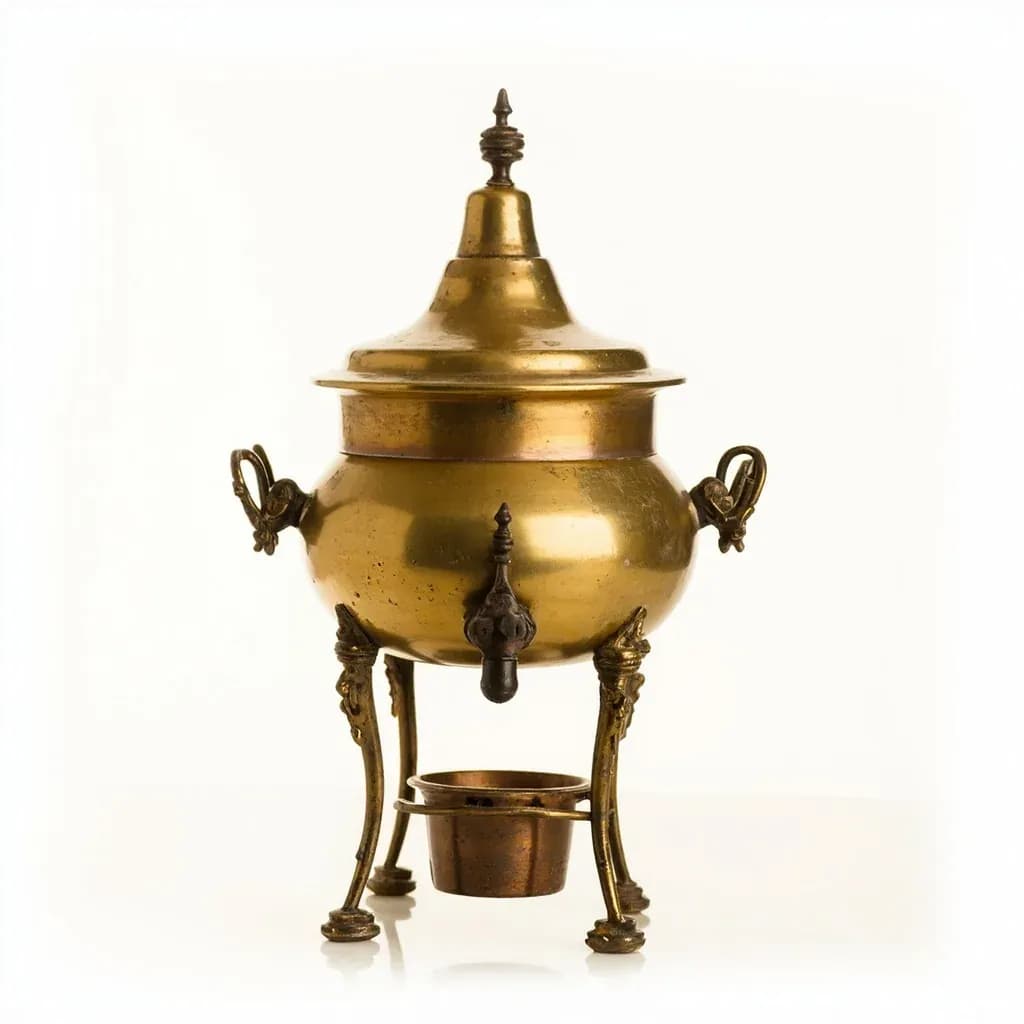
A samovar is a tall metal vessel, traditionally heated by an internal charcoal flue and now often electric, that boils and keeps a large volume of water hot. A small teapot of strong concentrate sits warming on top, and each cup is diluted to taste from the samovar's spigot. Central to Russian, Persian, Turkish, and Caucasian tea culture, it lets a household serve tea continuously through long gatherings.
A samovar is a metal urn designed to do two jobs at once: hold a large reservoir of near-boiling water and brew a small pot of intensely strong tea on top. The defining mechanical feature is a vertical chimney running up the center of the water vessel. In a traditional model, charcoal or pinecones burn in that chimney, sending heat up through the water while simultaneously heating a small teapot (the zavarochny chainik) perched on the chimney's mouth. A spigot at the base dispenses the hot water; the small teapot delivers the concentrate. This dual-output design is what makes a samovar a hospitality object rather than a kettle — guests serve themselves, diluting the concentrate with hot water to taste.
The samovar emerged in Russia by the 18th century, with Tula becoming its craft capital, though the word itself is Persian/Urdu (samavar, "self-boiler"), reflecting the shared tea culture that runs from the Caucasus through Iran and into Central Asia. Tula brass and copper samovars are the most collected; Persian versions tend to be taller and more heavily ornamented. Modern electric samovars keep the silhouette and the spigot but swap the coal chimney for an internal heating element, making them a common sight in post-Soviet kitchens.
For the cook, the practical takeaway is that a samovar is a heat-and-hold device optimized for continuous service over hours, not a fast-boil kettle. The water stays at drinking temperature without aggressive boiling, the concentrate stays warm without scorching, and the spigot removes the need to lift or pour from a heavy vessel. That makes it equally useful for a Russian-style tea table with zakuski, a Persian afternoon spread, or simply a kitchen that wants hot water on tap for an entire morning.
Alternatives
Types & varieties
Russian classic; brass body, charcoal-burning, often squat with ornate legs and a ball- or urn-shaped reservoir; the most collected and copied style.
Modern household version with an internal heating element instead of a flue; retains the spigot and top teapot design; common in post-Soviet kitchens.
Taller, narrower silhouette, often heavily engraved brass or silver; designed for both stovetop and standalone use.
Hybrid with both an electric heating element and a charcoal chimney; used when the fragrance of wood smoke is desired.
Smaller, lighter 1–2 L models intended for picnics, railway use, and small gatherings; sometimes with detachable legs.
Oversized 15–40 L models with decorative engraving, made for weddings, dachas, and restaurant display.
Brewing the zavarka: how the concentrate works
The little teapot on top is not a gimmick — it is the heart of the samovar system. Because the chimney is hot but not boiling, the concentrate brews on gentle radiant heat and rising steam, the same principle as a Turkish çaydanlık. The result is a tea that is dark, tannic, and intensely flavored, but never scorched, and it can hold at strength for an hour or more without going bitter. The cook's job is to choose the leaf, charge the pot correctly, and let the geometry of the chimney do the work.
- Use a robust black tea — Indian Assam, Ceylon, or a Kenyan — at roughly 1 part tea to 4 parts water by volume in the top pot.
- Fill the top pot only one-third to one-half full of dry leaf and cold water; the brew will more than double as it steams.
- Allow 15–25 minutes on a working chimney for the concentrate to reach full strength; longer steeping is fine, but never reboil.
- When serving, pour concentrate into the cup first, then top with hot water from the spigot to taste — usually 4–6 parts water to 1 part concentrate.
- Sweeten in the cup with sugar cubes or рафинад, or with jam held on the side; milk is not traditional in Russian or Persian service.
Common uses
Tips & pitfalls
- Always fill the water reservoir before lighting the chimney; an empty or low samovar over direct heat can warp soldered seams and ruin the vessel.
- Use dry hardwood charcoal, pinecones, or purpose-made samovar cones — never briquettes, which smoke heavily and taint the water with binder fumes.
- Prime the chimney by lighting kindling at the base first, then add fuel gradually; rushing the fire produces soot that settles inside the reservoir.
- Keep the top teapot about one-third full of dry leaf before placing it on the chimney; steam and radiant heat, not boiling, is what brews the concentrate properly.
- Descale monthly in hard-water areas: boil a solution of water and citric acid (1–2 tbsp per liter) in the reservoir, then flush through the spigot several times.
- On electric samovars, never run the element dry, and operate the spigot fully open or fully closed — partial opening wears the seal and causes drips.
- For authentic Russian service, offer jam, lemon slices, sugar cubes, or sugar candy (рафинад) alongside the tea, not milk.
- If the concentrate turns bitter, it has been stewing too long on too-hot a chimney — remove the teapot and let it rest; do not reboil, which only deepens the astringency.
Good to know
- Origin
- Developed in Russia, with Tula the historic production center by the late 18th century; the word comes from Persian/Urdu 'samavar' meaning 'self-boiler.'
- Traditional material
- Brass, copper, or nickel-plated copper; luxury models in silver.
- Heat source
- Charcoal, pinecones, or wood chips burned in a central vertical chimney; modern versions are electric.
- Capacity
- Common household sizes 3–7 L; large ceremonial models hold 30+ L.
- Key components
- Main water reservoir, central flue/chimney, small teapot on top (zavarochny chainik), spigot (kran) at the base, and a chimney cap with hinged lid.
- Brew strength
- Concentrate in the top pot is typically 8–10 times stronger than drinking strength.
- Serving ratio
- Traditionally diluted with hot samovar water at roughly 1 part concentrate to 4–6 parts water, adjusted to taste.
- Fuel load
- A traditional coal-filled chimney burns 20–40 minutes per load, depending on size and fuel.
- Cultural regions
- Russia, Ukraine, Belarus, Iran, Turkey, the Caucasus, and Central Asia; Persian samovars are typically taller and more ornate.
Also called
Tea Samovar
Related

Stovetop
The everyday burners where most cooking actually happens

Oven
Enclosed dry heat for roasting, baking, and braising

Grill
Live-fire or gas grates for char, smoke, and high heat

Smoker
Low, slow heat and wood smoke for barbecue and brisket

Air Fryer
Countertop convection that crisps with little or no oil

Slow Cooker
Set-and-forget low heat for stews, beans, and braises

Pressure Cooker
Sealed steam pressure that cooks tough food in a fraction of the time

Rice Cooker
Foolproof, perfectly steamed rice every single time