Appliances & Heat
Sandwich Press
A hinged electric griddle that toasts and presses sandwiches between two hot plates.
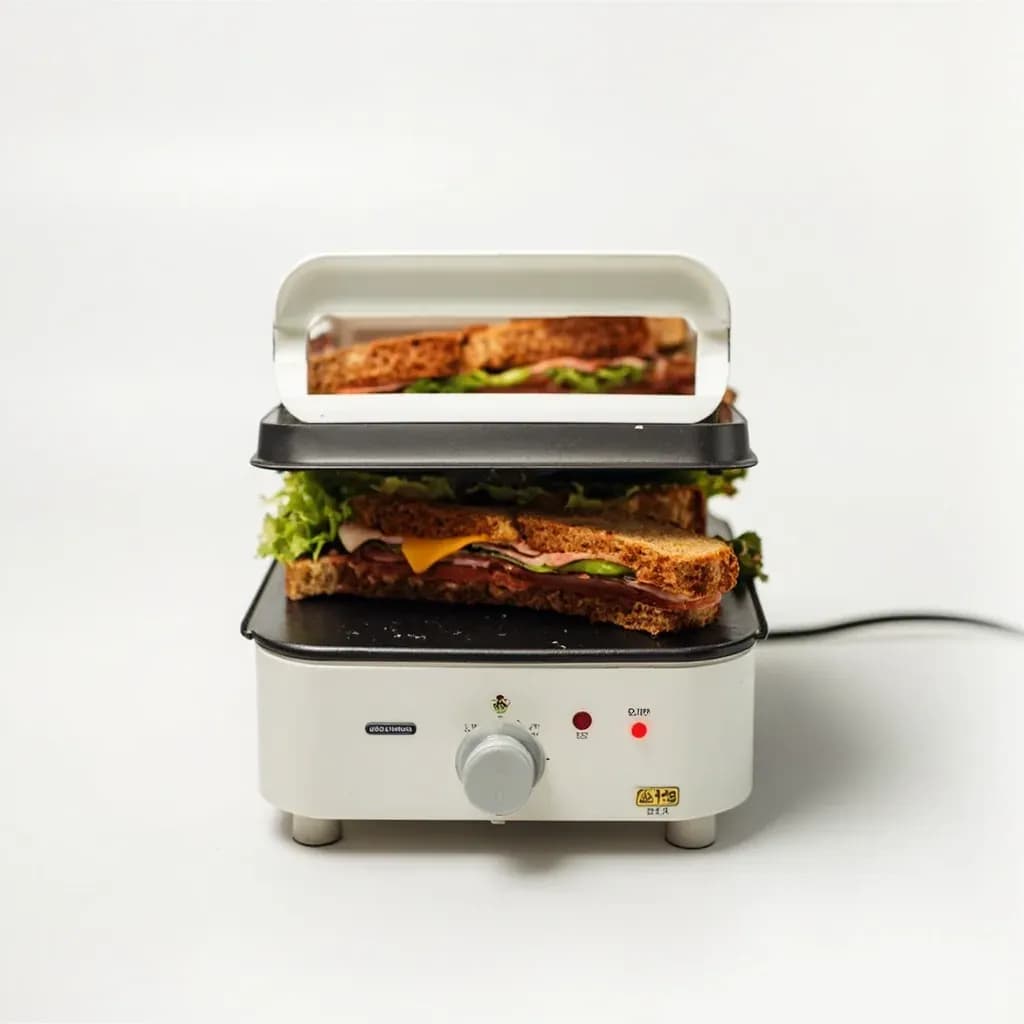
A sandwich press cooks a filled sandwich between two heated plates, toasting both sides at once while compressing and melting the filling. Cooks use it for grilled cheese, panini, toasties, and Latin American pressed sandwiches, with ridged plates leaving grill marks. The weighted hinged lid does the pressing, so the bread crisps evenly without flipping by hand.
A sandwich press is a small countertop appliance built around two heated plates that close like a clamshell, pressing and toasting a filled sandwich in one motion. The bottom plate holds the food while a hinged upper plate drops under its own weight — typically via a floating hinge that adjusts to thickness — applying even pressure as electric elements deliver heat to both sides at once. British and Australian models cut and crimp the bread edges into a sealed triangle or rectangle, locking in melted cheese and damp fillings; open-ridged models sold as panini presses skip the sealing die and instead leave grill marks on flatbread or focaccia.
The combination of direct contact heat and uniform pressure does more than toast: it drives out excess moisture, collapses air pockets in the bread, and flattens the sandwich into a compact packet that browns in two to four minutes. The Maillard crust outside contrasts with steam trapped inside the seal, which melts cheese and warms ham or vegetables through — a dry-outside, moist-inside texture that is hard to replicate in a frying pan. That efficiency is why the press has held its place in domestic kitchens since 1934 and remains a workhorse in cafés and food trucks.
The core design has barely changed since Ted Palmer patented the Toastwich in Brighton, England, though the category has split in two directions: cheap, lightweight sealed toasters aimed at the home, and heavy open-ridged contact grills built for commercial throughput. Domestic units are almost always non-stick and pre-set to a single temperature; commercial presses offer independent top-and-bottom thermostats, cast-iron plates, and brushed or grooved surfaces. Most cooks benefit from owning at least one of each.
Alternatives
Types & varieties
Hinged clamshell design that cuts and seals edges; the original 1934 form. Available in triangular or rectangular seal.
Open or floating-platen style with ridged plates; used in cafés for pressed Italian-style sandwiches. Usually larger, often with temperature control.
Larger, heavier cousin with ribbed plates and drip trays; doubles as a grill for vegetables and meats.
Tall hinge to accommodate thicker fillings; popular in the UK and Australia for loaded toasties.
Interchangeable plates for waffles, griddle, and sandwich press; common in domestic mid-range models.
Cast-iron ribbed plates, often with independent top-and-bottom thermostats and brushed plates for defined grill marks.
Bread, fillings, and assembly
- Standard sliced sandwich bread 10–12 mm thick is the most reliable; anything thicker browns unevenly on a domestic unit.
- Day-old bread toasts more evenly than fresh because it has lost some surface moisture.
- Apply fat to the outside of the bread, not the plates — butter, mayonnaise, or a brush of oil all work well.
- Spread a thin layer of butter, mustard, or mayonnaise on the inside of the bread as a moisture barrier against wet fillings like tomato or pickle.
- Keep fillings thin and pre-cook anything watery such as mushrooms, onions, or spinach to drive off moisture before sealing.
- Place cheese between other fillings rather than directly against the plates, so it melts cleanly instead of fusing to the surface.
- For grill-marked panini on a ridged press, brush the outside of the bread with oil rather than butter, which scorches at higher temperatures.
Care and lifespan of the plates
- Unplug and clean while the plates are warm but no longer hot — crumbs release easily and the non-stick coating is less prone to damage.
- Wipe with a damp cloth, paper towel, or soft brush; avoid metal utensils, scouring pads, and abrasive cleaners that strip the coating.
- Never submerge the unit or rinse it under a tap; the heating elements and electricals will be ruined.
- On older or commercial cast-iron versions, season the plates with a thin film of oil after cleaning, the same as a cast-iron skillet.
- PTFE coatings do wear out under regular use; once food starts to stick or the surface looks pitted, the plates should be replaced.
Common uses
Tips & pitfalls
- Always preheat the press fully until the ready light comes on; a cold unit dries out bread before it browns.
- Butter or oil the outside of the bread, not the plates — fat on the non-stick surface smokes and degrades the coating.
- Don't press down on the lid — the floating hinge adjusts to thickness and added force squeezes fillings out the seams.
- Place cheese between other fillings rather than directly on the plates so it melts cleanly instead of fusing to the surface.
- Clean while the plates are warm but not hot, with a damp cloth or soft brush; never submerge the unit or run it under a tap.
- On commercial cast-iron plates, season with a thin film of oil after cleaning, the same as a cast-iron skillet.
Good to know
- Invented
- 1934 by Ted Palmer in Brighton, England, as the Toastwich
- Also known as
- Sandwich toaster, toastie maker, jaffle maker, panini press (open-style variant)
- Power range
- 700–2000 W; roughly 750 W for compact 2-slice, 1400–2000 W for larger units
- Plate material
- Cast aluminum with non-stick coating (PTFE or ceramic in newer models)
- Hinge type
- Floating or adjustable to accommodate sandwich thickness
- Capacity
- Common sizes: 2-slice (one sandwich) or 4-slice (two sandwiches)
- Shape options
- Triangular (sealed diagonally) or rectangular seal
- Preheat and cook time
- 3–5 minutes to preheat; 2–4 minutes per sandwich
Also called
Sanguchera · Sandwich Toaster (Sanduchera) · Sandwich Press (Sanduicheira) · Electric Sandwich Press · Panini Press
Related

Stovetop
The everyday burners where most cooking actually happens

Oven
Enclosed dry heat for roasting, baking, and braising

Grill
Live-fire or gas grates for char, smoke, and high heat

Smoker
Low, slow heat and wood smoke for barbecue and brisket

Air Fryer
Countertop convection that crisps with little or no oil

Slow Cooker
Set-and-forget low heat for stews, beans, and braises

Pressure Cooker
Sealed steam pressure that cooks tough food in a fraction of the time

Rice Cooker
Foolproof, perfectly steamed rice every single time