Appliances & Heat
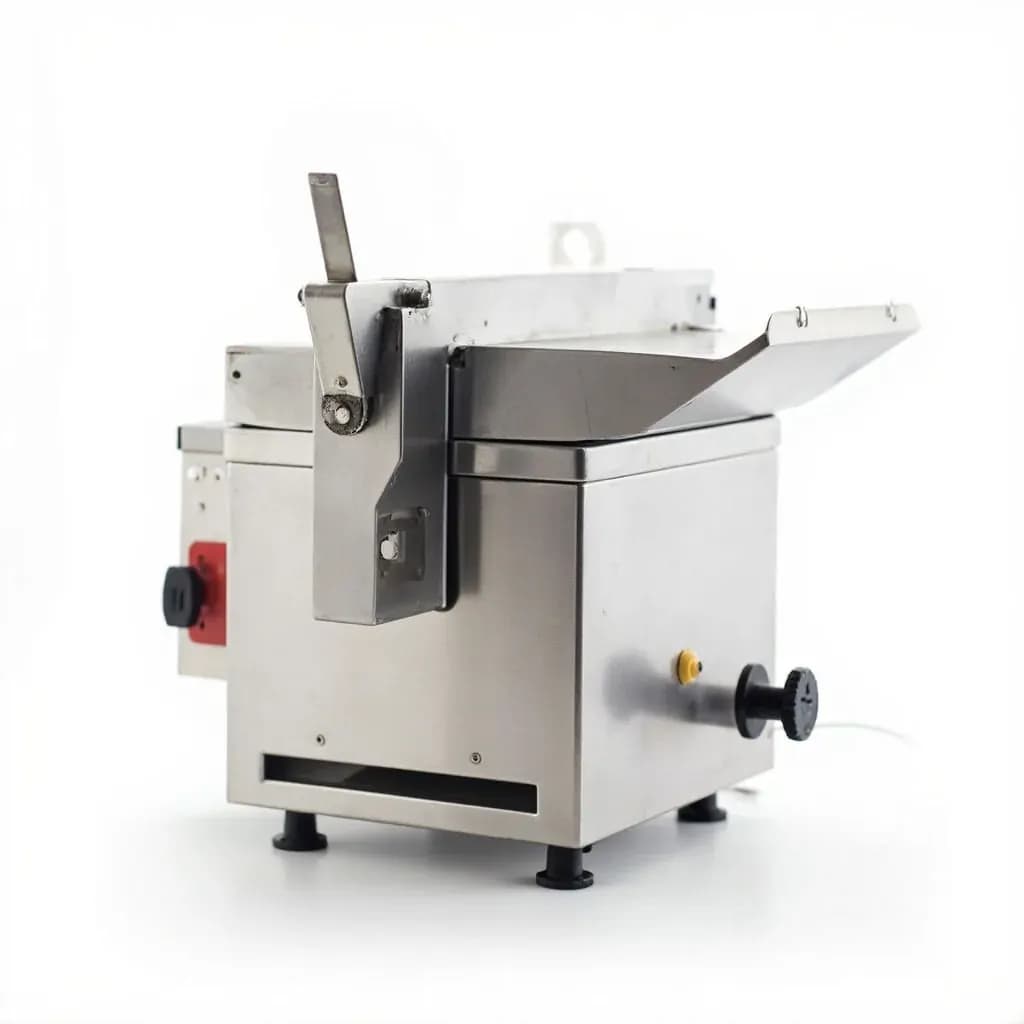
Deli Slicing Machine
A rotary-blade machine that cuts meats, cheeses, and bread into thin, even slices.
A deli slicing machine uses a large spinning circular blade and an adjustable carriage to shave consistent slices of cured meat, cheese, and vegetables. A thickness dial sets everything from paper-thin prosciutto to thick sandwich cuts, and the carriage holds the product safely against the blade. It is a deli and restaurant staple for speed and uniformity that a knife cannot match.
The deli slicer is a precision cutting tool built around a rapidly rotating circular blade, a sliding carriage, and an adjustable thickness plate. Where a knife produces a slice whose width and raggedness depend entirely on the cook's hand, a slicer turns out wafer-thin prosciutto, paper-uniform roast beef, and clean shavings of aged gouda at a set thickness on every stroke. That repeatability is its real value in a serious kitchen: it controls portion cost, plating, and how a hot roast behaves when sliced for service, since a 3 mm slice will rest and reabsorb juices far more quickly than a 12 mm chop.
Wilhelmus van Berkel patented the first commercial rotary slicer in Rotterdam in 1898, and the basic architecture has changed little since: a hardened steel disc spinning at relatively low rpm, a carriage that glides past the edge, and a graduated dial that sets the gap between the gauge plate and the blade. What has changed is scale. Countertop home models in the 7–9 in blade range now bring the technology to small kitchens, while commercial gravity-feed and automatic slicers from manufacturers such as Berkel, Bizerba, Hobart, Globe, and Vollrath anchor every deli, butcher shop, and production kitchen. The exposed edge is unforgiving — a properly running slicer blade is sharper than a razor and cuts on both faces — so the tool rewards cold product, a secure grip against the gauge plate, and a disciplined hand with the food pusher.
In practice, the slicer is a cold-shop tool. Firm-but-not-frozen meat, well-chilled cheese, and bread that has spent an hour or two in the freezer give the cleanest cuts with the least drag, crumble, and smearing. Sharpening is built into the design: most quality units carry a two-stone hone on the blade guard that lets a cook true the edge in under a minute. That combination of adjustable thickness, cold cutting, and in-place sharpening is what makes a deli slicer genuinely useful well beyond the deli counter — both for the home charcuterie board and the portion-controlled roast in a restaurant pass.
Alternatives
Types & varieties
Standard commercial design; the carriage tilts so gravity helps feed the product to the blade. Best all-around for deli work.
Carriage stays vertical; used for tall or awkward items like bone-in roasts and whole hams.
Motorized carriage advances the product past the blade automatically; built for high-volume production lines.
Hand-rotated blade; the antique Berkel flywheel design is still used in specialty butcher shops for both function and visual appeal.
Smaller 7–9 in blade, 120 V plug-in units from Chef'sChoice, Cuisinart, Meat! Your Maker, Anova Precision, and others.
Motor drives the blade via a rubber or polyurethane belt; quieter, less torque, easier field repair.
Motor turns the blade through enclosed gears; more powerful and durable under sustained commercial loads.
Sharpening and Edge Care
A slicer blade is hardened to roughly Rockwell 56–60, which is why it holds a working edge through hundreds of pounds of product but cannot be touched up with a standard kitchen steel. The two-stone sharpener mounted on the blade guard is matched to the blade's geometry and is the only tool most cooks should ever use on the edge.
- The sharpening stone removes metal to reset a rounded edge; the honing stone realigns and polishes the micro-fine edge left behind. Use both, in that order.
- A quick touch-up on the hone alone is enough for daily cleaning; a full sharpening-and-honing cycle is reserved for every several weeks of regular service.
- Clean the stones with a dry brush; buildup of steel fines and food grease will glaze them and stop cutting.
- Replace blades professionally rather than re-sharpening once the diameter has been reduced by repeated grinding — a thinner disc flexes more and is a more dangerous disc.
Common uses
Tips & pitfalls
- Chill the product to 30–40°F before slicing; partially frozen meat and cheese cut the cleanest with the least drag and crumble.
- Always use the food pusher or hold the product firmly against the gauge plate — never let fingers ride the carriage past the blade.
- Sharpen every few weeks of regular use, not only when slices start tearing; the hone stone restores the working edge, the sharpening stone resets it.
- After sharpening, set thickness to zero and run the empty blade briefly to dislodge the loose burr before it touches food.
- Wipe the blade with a damp (not dripping) cloth, moving away from you and along the circumference; the edge cuts on both sides and is sharper than a razor.
- Wipe the blade and carriage between different foods — especially raw meat followed by cheese or produce — to prevent cross-contamination.
- Never push bone, fully frozen food, or very hard items like winter squash through the slicer; they will nick or chip the hardened edge.
- After cleaning, leave the thickness dial set to zero so the gauge plate covers the edge and protects both the blade and your fingers in storage.
- For clean cheese slices, lightly oil the blade or temper the cheese at room temperature 5–10 minutes so it doesn't drag and stick.
- Bolt commercial units to a stand or heavy board; the torque of the blade can walk a lightweight, unsecured unit across the counter.
Good to know
- Invented
- 1898 by Wilhelmus van Berkel in Rotterdam, Netherlands; the Berkel patent launched the commercial rotary slicer
- Core mechanism
- Rotating circular blade (typically 7–14 in / 18–35 cm diameter) with a sliding carriage that feeds food past the edge
- Thickness range
- Roughly 0 to 1 in (0–25 mm), set by a numbered index knob
- Drive type
- Belt-driven (lighter, quieter, easier to repair) or gear-driven (heavier, more powerful, built for hours of daily use)
- Power (typical)
- Home: 120–180 W; small commercial: 250–500 W; heavy-duty: 0.5–1+ HP
- Built-in sharpener
- Most quality slicers include a two-stone hone (one stone sharpens, the other hones) mounted on the blade guard
- Best food temperature
- Meat 30–40°F / –1 to 4°C; cheese 40–45°F; crusty bread 1–2 hours out of the freezer for clean bias slices
- Cleaning
- Blade, carriage, and thickness plate are removable for hand washing; never submerge the motor housing
Also called
deli slicer · meat slicer · electric slicer
Related

Stovetop
The everyday burners where most cooking actually happens

Oven
Enclosed dry heat for roasting, baking, and braising

Grill
Live-fire or gas grates for char, smoke, and high heat

Smoker
Low, slow heat and wood smoke for barbecue and brisket

Air Fryer
Countertop convection that crisps with little or no oil

Slow Cooker
Set-and-forget low heat for stews, beans, and braises

Pressure Cooker
Sealed steam pressure that cooks tough food in a fraction of the time

Rice Cooker
Foolproof, perfectly steamed rice every single time