Appliances & Heat
Pellet Smoke Tube
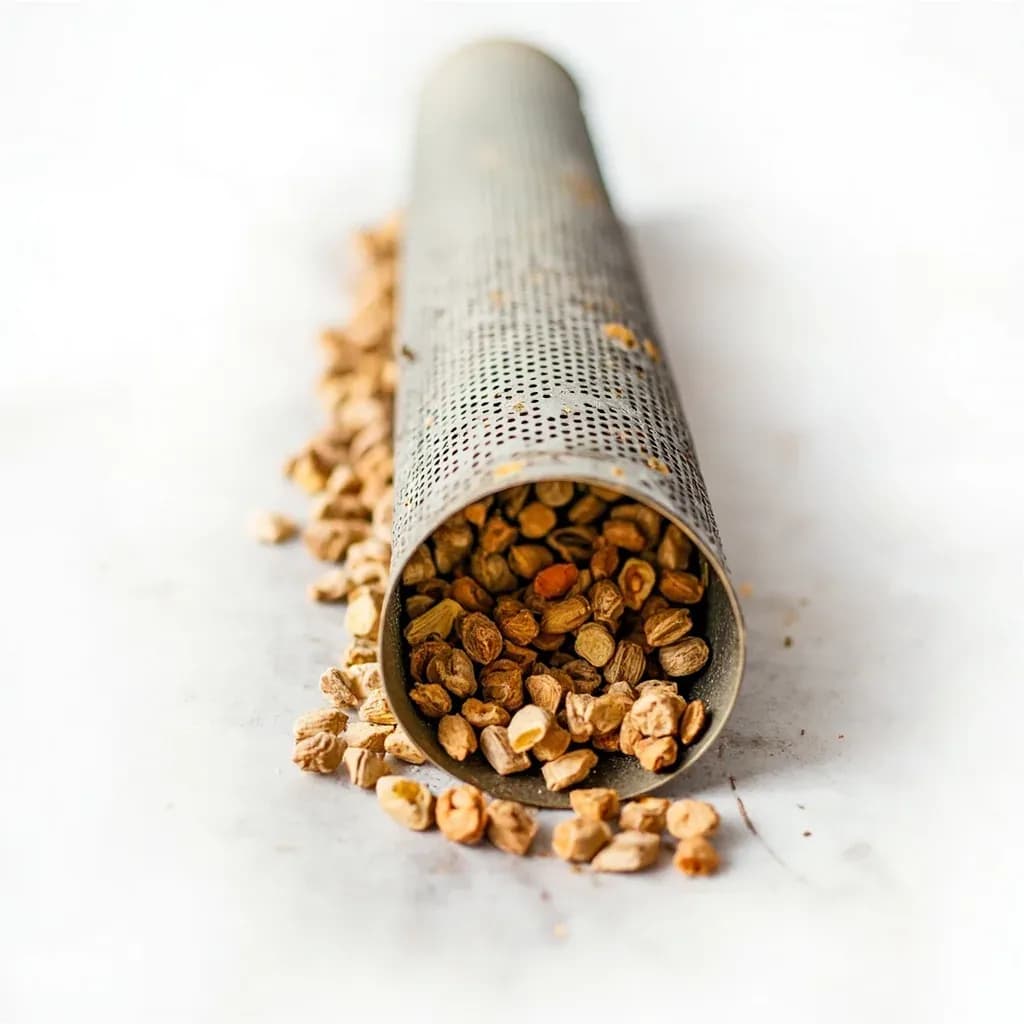
A perforated metal tube packed with wood pellets that smolders to add smoke flavor on any grill.
A pellet smoke tube is a hollow perforated steel cylinder filled with hardwood pellets or dust, lit at one end so it slowly smolders rather than burns. Set inside a gas grill, kettle, or pellet smoker, it produces hours of clean cold or hot smoke to flavor meat, cheese, or vegetables without a dedicated smoker. Cooks use it for cold-smoking and to boost smoke output on grills that run too clean.
A pellet smoke tube is a short stainless-steel cylinder, drilled with small holes and packed with food-grade wood pellets, that smolders on a grill to deliver real wood-fire flavor where the grill itself can't make any. It exists to solve a single, common frustration: gas, electric, and even some charcoal setups don't produce meaningful smoke, so the cook who owns one and still wants brisket bark, salmon's mahogany glaze, or a hit of hickory in a pork chop has very few practical options. The smoke tube is the cheapest and most flexible of them.
After the initial flame is blown out, the pellets smolder — fed by oxygen drawn in through the perforations — and push a steady stream of thin smoke out the same holes. That slow combustion is what makes the tool useful: it produces flavor for two to five hours depending on tube length, generates no meaningful heat of its own, and can sit beside a cook on virtually any fuel source. It's also the standard way home cooks run a basic cold smoke in a cooler or cardboard box, because the tube can smolder at ambient temperatures without warming the food.
In short, a smoke tube is a smoke generator without a smokehouse. It won't replace a dedicated offset smoker on long, deep-barrel cooks, but it adds genuine wood character to almost any setup for the price of a bag of pellets and a few minutes of torch work.
Alternatives
Types & varieties
The most common form: a sealed-end stainless cylinder drilled with small holes. Sold in 6, 8, and 12 in lengths.
A flat V-shaped or serpentine channel tray (A-MAZE-N style) that holds pellets in a maze pattern. Same smolder principle, broader footprint, slightly different airflow.
Offered by some makers for rigidity and to rest on grill grates without rolling. Functionally identical to round tubes.
Most have one fixed end and a screw-on or push-on cap; some are fully open on one end for faster refill access.
Higher-end versions add a sliding vent or cap with an air-control hole to throttle burn rate and stretch fuel.
Cold Smoking with a Smoke Tube
A smoke tube is one of the cheapest ways to cold smoke at home, but the rules are different from a hot cook. Cold smoking means the food is held in an unheated environment — typically below 90 °F / 32 °C — and exposed to smoke for hours, sometimes days. The tube sits in a separate chamber (a small cardboard box, a picnic cooler with a vent hose, or a purpose-built cold-smoke cabinet) so its smoldering heat and any accidental flare-up never reach the food. The food itself must be cured, salted, or otherwise preserved first, because those temperatures are far too low to cook anything safely.
- Use a vent hose or small outlet hole to keep air moving through the chamber — stagnant smoke will smother the pellets.
- Run 6–12 hours for cheese, salt, and butter; 12–24 hours for salmon and nuts; anything longer needs a dedicated cold-smoke setup with humidity control.
- Rest the tube on a metal sheet, brick, or foil-lined surface inside the chamber, and keep it well away from cardboard walls or anything flammable.
- Cold-smoke outdoors whenever possible, or in a garage with ventilation — wood smoke in enclosed living spaces is unpleasant and a fire risk.
Common uses
Tips & pitfalls
- Fill the tube only to the top of the perforations — leaving a small air gap at the top helps the flame front travel cleanly down the column.
- Use a butane torch, long-stem lighter, or a heated electric starter cube; a kitchen match often can't sustain ignition across the pellets.
- Let the pellets burn with a visible flame for 5–10 minutes until the top layer is fully engulfed, then blow out the flame. Smoke pouring steadily from the holes — not a lazy wisp — is the signal to put it on the grill.
- Place the tube over indirect heat, not directly over a burner or open flame. Direct flame over-oxygenates the pellets and burns them to ash in minutes.
- Use only food-grade BBQ pellets; hardware-store heating-pellet bags may contain accelerants or non-food binders that will taint the smoke.
- For the longest burns, light the tube vertically with the cap end down so the flame front moves downward on its own and feeds fresh pellets gradually.
- Pair fruit woods (apple, cherry) with poultry and pork; hickory and mesquite with beef; avoid mesquite on anything that smokes past two hours, as it turns bitter.
- Common mistake: not waiting long enough after lighting. Putting the tube on the grill while pellets are barely smoldering produces weak, acrid smoke instead of the clean, thin blue smoke you want.
- Common mistake: sealing the cap on too tightly during ignition. Oxygen starvation kills the pellets the moment you blow out the flame and the tube goes out on the grill.
Good to know
- Material
- 304 stainless steel on most models; cheaper tubes use aluminized steel
- Typical sizes
- 6 in (≈15 cm), 8 in (≈20 cm), and 12 in (≈30 cm) lengths; ≈1.25–1.5 in (3.2–3.8 cm) diameter
- Hole pattern
- Laser- or punched-drilled perforations along the body to feed oxygen and release smoke
- Burn time
- Roughly 2–2.5 h (6 in), 3 h (8 in), 4–5 h (12 in) when fully lit and smoldering
- Compatible fuel
- Food-grade BBQ wood pellets only — never hardware-store heating pellets, which can contain binders or accelerants
- Compatible grills
- Gas, charcoal, electric, kamado, kettle, pellet grills (as supplemental smoke), offset smokers, and cold-smoke chambers
- Working temperature
- Smolders cleanly from cold-smoke ambient (~40 °F / 4 °C) up to about 400 °F (200 °C) grill heat
- Capacity
- A 12 in tube holds roughly 150–200 g of pellets; a 6 in tube holds about 60–90 g
- Cleaning
- Burn off residue at high heat, then tap out ash; do not soak, as residual pellet oils can off-gas
- Approximate cost
- $10–$25 USD for the tube; brand-name versions (e.g., A-MAZE-N, Smoke Daddy, LIZZQ) run $15–$40
- Origin
- The perforated-pellet-tube concept was popularized in the U.S. around 2014–2015 by A-MAZE-N Products, adapting the older maze/pellet-tray design for general grill use
Also called
smoke tube · pellet tube smoker · cold smoke tube
Related

Stovetop
The everyday burners where most cooking actually happens

Oven
Enclosed dry heat for roasting, baking, and braising

Grill
Live-fire or gas grates for char, smoke, and high heat

Smoker
Low, slow heat and wood smoke for barbecue and brisket

Air Fryer
Countertop convection that crisps with little or no oil

Slow Cooker
Set-and-forget low heat for stews, beans, and braises

Pressure Cooker
Sealed steam pressure that cooks tough food in a fraction of the time

Rice Cooker
Foolproof, perfectly steamed rice every single time