Appliances & Heat
Solar Cooker (Parabolic)
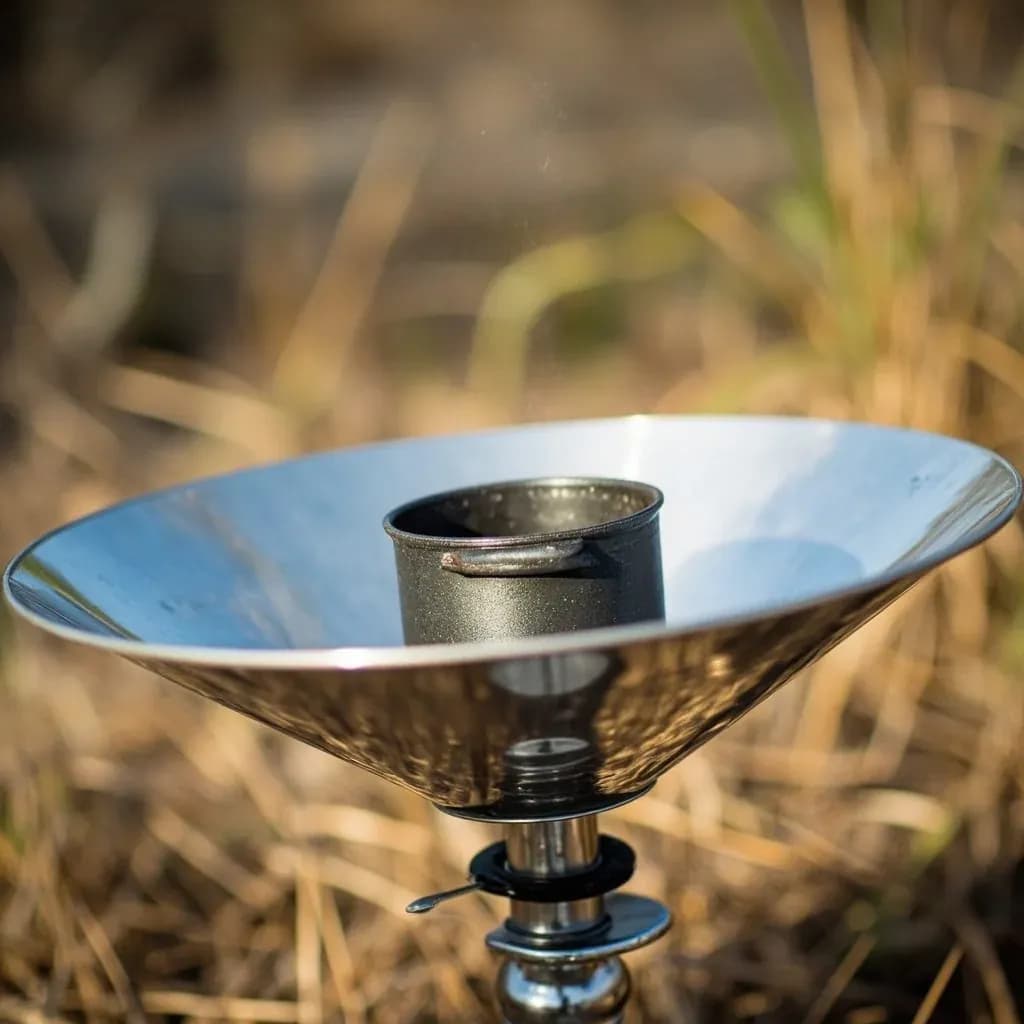
A reflective dish that concentrates sunlight to a focal point to cook food with no fuel.
A parabolic solar cooker is a curved mirrored dish that focuses the sun's rays onto a small spot where a pot is suspended, reaching frying and boiling temperatures without any fuel or smoke. It must be aimed at the sun and tracked as it moves, and it works only in strong sunlight. It is used to cook and boil water where fuel is scarce or expensive.
A parabolic solar cooker is a curved reflective dish that gathers parallel rays of sunlight and focuses them onto a single point suspended above its center, where a pot or pan rests on a small stand. It is the only widely available household solar cooker that genuinely reaches frying temperatures — roughly the output of a strong gas burner — and is therefore the solar-cooking enthusiast's choice for real stovetop work rather than slow simmering.
In full, direct sun the focal point can climb to around 400°C (750°F), delivering 600 to 1,500 W of thermal energy depending on dish size, with a 5 to 10 minute heat-up time from cold. The trade-off for that power is attention: a parabolic dish must be re-aimed toward the sun roughly every 15 to 30 minutes, and any cloud, gust, or wandering shadow collapses the heat almost instantly. It is also the most safety-sensitive of the common solar cookers — the concentrated beam will scorch paper and dry vegetation, melt plastic, and damage retinas in seconds.
For cooks, the practical distinction is that a parabolic dish is a burner replacement, not a slow-cooker substitute. Used with dark, matte cookware and steady attention to aim, it will sear a steak, stir-fry vegetables, or boil a stockpot with no fuel cost and no combustion fumes, which makes it especially useful in arid regions, off-grid settings, and summer outdoor kitchens.
Alternatives
Types & varieties
A single curved solid reflector; the highest-performance household design, but the heaviest and the one needing the most frequent re-aiming
A cylindrical curve that focuses onto a tube running along its length; lower peak temperature, but needs only seasonal tilt rather than constant tracking
Built from many small mirror facets on a frame; lighter, easier to ship, and easier to repair field-side than a one-piece molded dish
A garden umbrella or salvaged satellite dish covered in aluminized mylar; cheap and quick to make, but short-lived and lower in output
Smaller parabolic elements paired with a dedicated pot support and aim mechanism, as on Skarab and Haines-style commercial units
Large 1.5–2.5 m institutional reflectors suspending 10–30 L pots for school or village feeding programs
Cookware and pot preparation
Cookware is the single biggest variable in how a parabolic dish actually performs. The dish is doing the concentrating; the pot is doing the absorbing, and any reflectivity on the pot's surface sends useful heat back toward the dish rather than into the food. Get the cookware right and the rest of the cooking feels familiar; get it wrong and a parabolic will underperform even on a perfect sunny day.
- Use cast iron, carbon steel, or any heavy-gauge steel pan with a dark, matte surface — bare polished aluminum reflects too much radiant energy back out of the pot.
- Blacken pot exteriors with a coat of flat black high-temperature paint if the metal is bright; this lifts absorptivity noticeably and is one of the cheapest upgrades you can make.
- Skip any pot with plastic handles or silicone grips — the focal point will melt common thermoset handle materials such as Bakelite within minutes at searing temperatures.
- Keep the pot as small as the dish will support; an oversized pot spreads the focal energy too thin and turns a frying setup into a slow warm-up.
- Choose a pot with a tight-fitting metal lid. With frequent sun-tracking interruptions, a covered pot holds heat through cloud passes and short re-aiming gaps.
Working with the focal point
The focal point is not just hot — it is small. A 1.2 m dish typically concentrates its useful energy into a circle roughly the size of the pot base, and moving the pot a few centimeters up or down the axis of the dish changes the heat from a sear to a simmer without changing the aim at all.
- Find the focal plane by holding a piece of cardboard above the dish while aiming — the smallest, brightest spot of light is the focal plane, and the pot belongs there for maximum heat.
- Drop the pot a few centimeters below the focal plane for gentle simmering and braising, where you want the heat spread wider and gentler across the pan base.
- Use the pot's shadow on the dish as your aiming indicator — when the shadow is round and small, you are on-axis; when it stretches into an oval or crescent, the sun has moved and the dish needs re-aiming.
Safety and weather
A parabolic dish is the most demanding solar cooker to use, and most of that demand comes from the safety profile of the concentrated beam rather than from the cooking itself. Treat it the way you would treat a deep fryer on a windy patio: useful, fast, and unforgiving of inattention.
- Never look down the axis of the dish toward the focal point — the reflected intensity can cause retinal damage in a single glance. Wear sunglasses that block UV and IR when adjusting the aim.
- Keep a clear zone around the dish: dry grass, paper, plastic bags, and wooden cutting boards left under or near the focal area will scorch or ignite.
- Anchor the base or weigh it down with sandbags; even a 15 km/h gust can rotate a light dish or knock the pot off the stand.
- Do not cook with a parabolic in wind strong enough to sway the dish without a windscreen around the pot — convection losses at the focal point are extreme and will sabotage the cook.
Common uses
Tips & pitfalls
- Re-aim every 15 to 30 minutes by minimizing the pot's shadow on the dish; a stretched shadow means the sun has drifted and your heat has dropped.
- Mark the dish's noon position on the ground with a stake or chalk so you can return to it quickly after each adjustment.
- Cook mid-morning or mid-afternoon for simmer- and braise-like performance; save the noon window for searing, stir-frying, and boiling.
- Clean the reflector regularly — dust, pollen, and bird droppings measurably reduce output, and even a smudge on a mirror facet can drop focal performance noticeably.
- Pair the dish with an insulated pot cover (lid plus a folded towel) to ride out brief cloud passes and the minutes you spend re-aiming.
- Accept that winter solar cooking at higher latitudes means a short midday window and plan menus accordingly — long braises work, searing does not.
- If the dish feels underpowered, suspect the pot before the sun: a shiny aluminum pan on a perfect dish will still cook slowly, while a blackened cast-iron skillet on the same dish will sear effectively once at the focal plane.
- Do not walk away from a hot dish even briefly; the dry, focused heat can scorch the pot support or ignite debris within a few minutes of inattention.
Good to know
- Operating principle
- Reflects parallel sunlight to a single focal point — a true point-focus design
- Focal temperature
- Up to roughly 400°C (750°F) in strong direct sun
- Power output
- Approximately 600–1,500 W thermal, depending on dish size and sun angle
- Heat-up time
- About 5–10 minutes from cold to cooking temperature
- Usable cooking window
- Typically 3–6 hours of direct sun per day, varying with latitude and season
- Tracking
- Manual re-aiming every 15–30 minutes required
- Cookware
- Dark, matte-finished metal only (cast iron, carbon steel, blackened steel); no plastic or rubber
- Safety
- Concentrated beam can ignite paper, melt plastic, and cause retinal damage; never leave unattended and never look at the focal point
Also called
Parabolic Solar Cooker · Solar Stove
Related

Stovetop
The everyday burners where most cooking actually happens

Oven
Enclosed dry heat for roasting, baking, and braising

Grill
Live-fire or gas grates for char, smoke, and high heat

Smoker
Low, slow heat and wood smoke for barbecue and brisket

Air Fryer
Countertop convection that crisps with little or no oil

Slow Cooker
Set-and-forget low heat for stews, beans, and braises

Pressure Cooker
Sealed steam pressure that cooks tough food in a fraction of the time

Rice Cooker
Foolproof, perfectly steamed rice every single time