Appliances & Heat
Spiral Dough Mixer
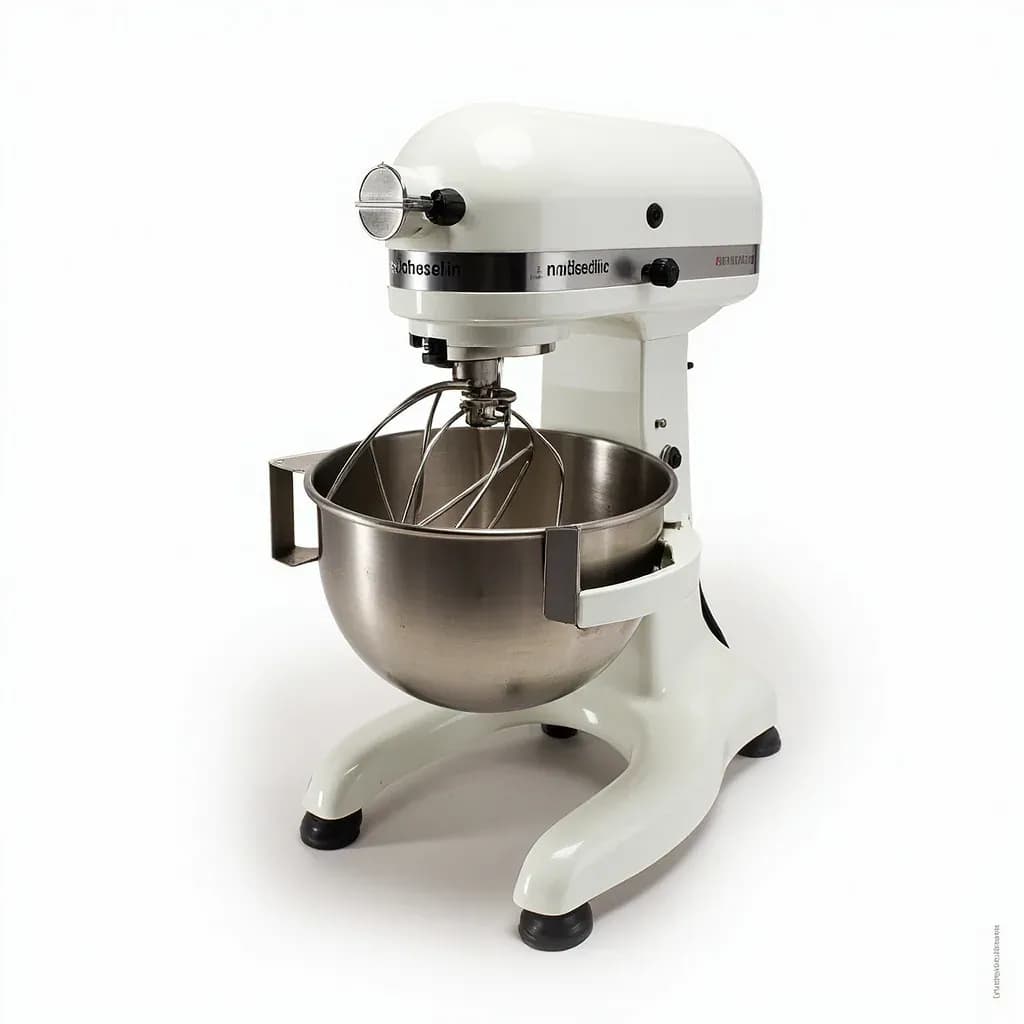
A bakery mixer with a spiral hook and rotating bowl that kneads large dough batches.
A spiral dough mixer is a heavy-duty machine with a fixed spiral-shaped hook and a rotating bowl, designed to knead large quantities of bread dough with minimal heat buildup. The geometry develops gluten efficiently while keeping the dough cool, which is ideal for high-hydration and lean breads. It is a workhorse in bakeries and pizzerias.
A spiral dough mixer is the workhorse of the artisan pizzeria and the small-to-mid bakery, designed to knead dough in batches that would overwhelm a home stand mixer. Its defining feature is a spiral-shaped hook that rotates on its own axis inside a bowl that turns in the opposite direction, producing a folding, low-friction knead rather than the smearing action of a planetary mixer. That counter-rotation keeps friction low, so dough exits the machine at a controlled 24–26 °C (75–78 °F) with a well-developed gluten network — a real advantage in warm kitchens and tight schedules.
The spiral mixer is not a general-purpose machine. There is no whisk attachment, no way to cream butter and sugar efficiently, and no reliable way to handle very high-hydration, slack doughs. It exists for one job: developing stiff, low-hydration doughs like pizza, bagels, baguette, and rustic hearth breads, in quantities a home stand mixer cannot touch.
For a pizzeria, the practical sweet spot is a 16–25 kg fixed-bowl, two-speed unit on single-phase power; for a bakery turning out hearth loaves and rolls, 40–60 kg tilting or removable-bowl machines on three-phase power are standard. Italian-made machines (Esmach, Sigma, and several OEM brands) dominate the category, and a serious home baker can find countertop 8–12 kg units that noticeably outperform a stand-mixer dough hook.
Alternatives
Types & varieties
Bowl stays in the machine; head lifts or guard opens to extract the dough. Most common in pizzerias and small bakeries.
Bowl lifts out on a trolley or hoist, useful for batch handling and hygienic transfer to a proofer or divider.
Bowl tips forward to pour the dough out; favored in larger bakeries handling 40 kg+ batches.
Low speed for incorporating flour, high speed for gluten development; gentler on the dough and easier to control temperature.
Simpler, lower-cost units common in pizzerias; the operator controls development by time and observation.
Compact 8–12 kg units used by small cafés, food trucks, and serious home bakers.
Uses a curved fork-shaped tool with a rotating bowl; gentler still, suited to delicate or enriched doughs. Often grouped with spiral mixers by retailers.
How a spiral mixer kneads
A planetary mixer pushes the dough with a hook that orbits the bowl, dragging a single mass around a stationary wall. A spiral mixer does something fundamentally different. The hook itself is shaped like a coil, so as it turns it picks up dough at the bottom of the bowl, folds it over itself, and lays it back down. The bowl rotates in the opposite direction, so the dough meets the hook from a continuously changing angle. The result is a folding, stretching action with very little smearing.
Two practical consequences follow. First, friction is low, so dough temperature stays controlled — a 25 kg batch in a spiral mixer will come out several degrees cooler than the same batch in a planetary. Second, gluten develops quickly because the folds align the strands efficiently. Eight to twelve minutes is usually enough for a fully developed dough; overmixing is a more common failure than undermixing.
- Spiral hook coils pick up dough from the bowl bottom and fold it over
- Counter-rotating bowl changes the angle of contact continuously
- Less friction than a planetary means cooler dough and better yeast and gluten survival
- Fast gluten development means shorter mix times and less risk of oxidation
Sizing a spiral mixer
Capacity ratings are nominal dough weights (roughly flour plus water), not the dough weight you should actually load. As a working rule, fill to roughly 70–80% of the stated capacity; a machine rated for 25 kg is comfortable with an 18–20 kg dough, and that headroom matters for mixing quality and motor life.
Pizzerias running a single dough per day are well served by a 16–25 kg two-speed fixed-bowl unit on single-phase power. Bakeries producing hearth breads, rolls, and pan loaves in volume typically step up to 40–60 kg tilting or removable-bowl models on three-phase power, where the ability to swap bowls speeds up the production flow. Countertop 8–12 kg spiral mixers are an honest step up for serious home bakers; the dough quality difference against a stand-mixer dough hook is immediate.
- Load to 70–80% of rated capacity, not the full number
- Pizzerias: 16–25 kg two-speed, single-phase, fixed bowl
- Hearth bakeries: 40–60 kg tilting or removable bowl, three-phase
- Home and café use: 8–12 kg countertop units; noise and footprint are the trade-off
When a spiral mixer is the wrong tool
The spiral hook is engineered for one class of dough: stiff, low-hydration, gluten-leaning. Push it outside that and it struggles. Very wet doughs above roughly 70% hydration tend to climb the spiral and wrap around the shaft, where the machine cannot rescue them. A fork mixer or a planetary with a dough hook is the right answer for slack doughs, ciabatta pools, or high-hydration pan loaves.
The spiral mixer is also not a creaming or whipping machine. There is no whisk attachment, and the action of the hook against the bowl is far too aggressive for butter-and-sugar work. Plan to keep a planetary or a dedicated whisk mixer alongside it for any prep the spiral cannot do.
- Avoid for very wet doughs (~70%+ hydration) — the dough climbs the hook
- No whisk attachment; cannot cream butter or whip egg whites
- For enriched doughs, watch mixing time carefully; overdeveloped enriched doughs lose volume
- Chunky inclusions are best folded in by hand after the main mix
Common uses
Tips & pitfalls
- Weigh ingredients. A spiral mixer is unforgiving of badly measured flour, and the difference between 1000 g and 1100 g of flour in a 20 kg dough shows up in the finished crumb.
- Use ice water in summer to keep the finished dough in the 24–26 °C range; warm kitchen plus machine friction adds up faster than you expect.
- Run the hook briefly dry with a dusting of flour before the first batch to coat it; this prevents the first mix from sticking and helps balance the bowl on start-up.
- Add liquids in stages on low speed so the flour hydrates evenly before gluten development begins; pouring it all in at once leaves dry pockets at the bottom.
- Avoid loading more than 70–80% of the rated capacity. Overloading stalls the hook, overheats the motor, and produces unevenly developed dough.
- Switch to second speed only after the dough comes together; running dry flour at high speed throws it out of the bowl and coats your kitchen.
- Watch the dough, not the clock. A clean bowl, a smooth elastic body, and a dough that releases from the hook cleanly are the real signals of done.
- For very wet doughs above about 70% hydration, prefer a fork or planetary mixer; a spiral will climb the hook and refuse to let go.
Good to know
- Tool type
- Specialized commercial dough kneader combining a spiral-shaped hook with a rotating bowl
- Capacity range
- Roughly 8 kg (countertop) to 80 kg (industrial); common bakery sizes are 16, 20, 25, 40, and 60 kg
- Hook motion
- Spiral hook rotates on its own axis while the bowl turns in the opposite or same direction, creating a folding knead
- Speeds
- Single- or two-speed; two-speed models use low for incorporating flour, high for gluten development
- Bowl options
- Fixed, removable (lift-out on a trolley or hoist), or tilting (pours forward)
- Heat of friction
- Significantly less dough temperature rise than a planetary mixer of the same batch size
- Kneading time
- Approximately 8–12 minutes for a developed pizza or bread dough at moderate speed
- Target dough temperature
- Final dough around 24–26 °C (75–78 °F) when used correctly
Also called
spiral mixer · bakery dough mixer
Related

Stovetop
The everyday burners where most cooking actually happens

Oven
Enclosed dry heat for roasting, baking, and braising

Grill
Live-fire or gas grates for char, smoke, and high heat

Smoker
Low, slow heat and wood smoke for barbecue and brisket

Air Fryer
Countertop convection that crisps with little or no oil

Slow Cooker
Set-and-forget low heat for stews, beans, and braises

Pressure Cooker
Sealed steam pressure that cooks tough food in a fraction of the time

Rice Cooker
Foolproof, perfectly steamed rice every single time