Appliances & Heat
Spiral Dough Mixer
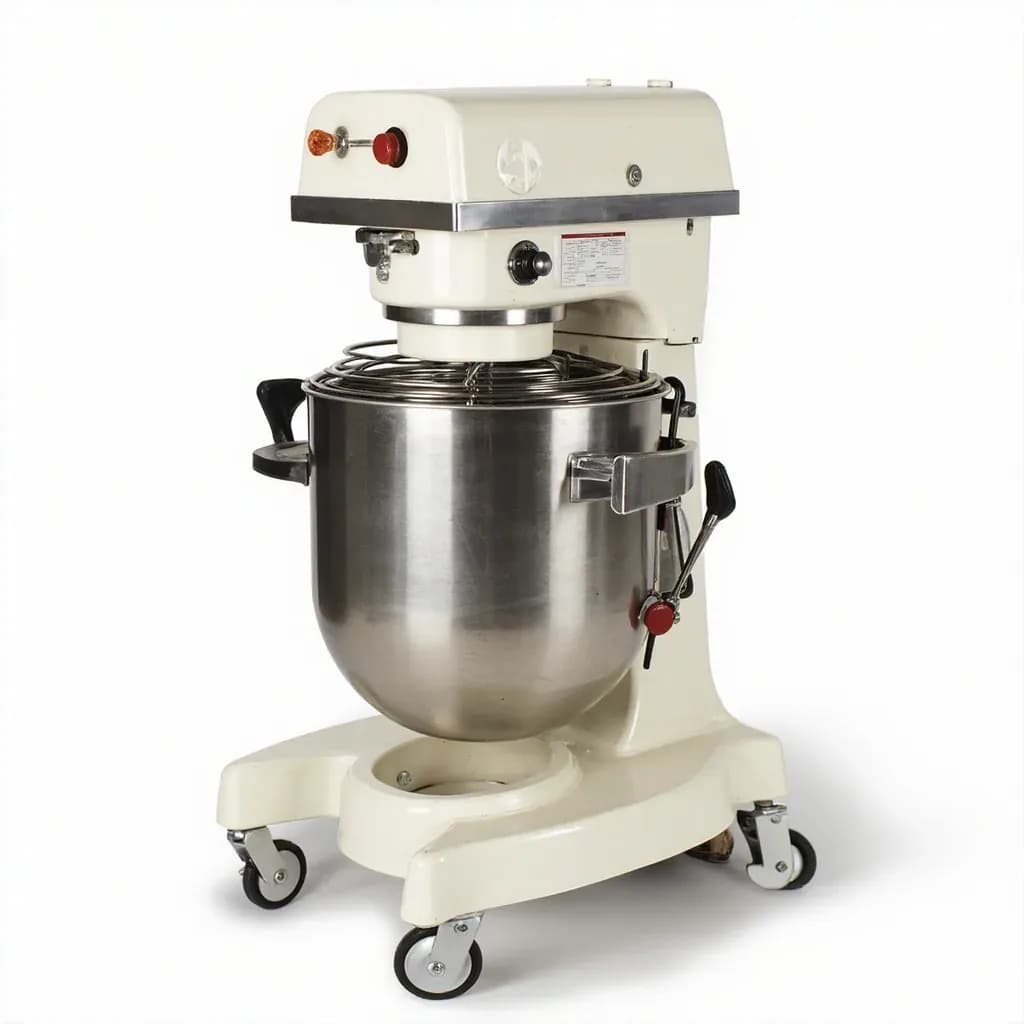
A bakery mixer with a spiral hook and rotating bowl that kneads bread dough gently.
A spiral dough mixer has a fixed spiral-shaped hook and a rotating bowl that work the dough against a central bar, kneading it thoroughly while keeping it cool. Bakeries use it for bread and pizza dough because it develops gluten efficiently without overheating the dough the way a planetary mixer can. The bowl rotation means the hook stays in one spot, gradually incorporating the whole batch.
A spiral dough mixer is the workhorse of any bakery that handles stiff bread dough — bagels, pizza, hearth loaves, pretzels — and it works on a fundamentally different principle than the planetary stand mixer most home cooks know. Instead of a beater orbiting a stationary bowl, a spiral mixer has a fixed-axis helical hook inside a bowl that rotates in the opposite direction. The two surfaces turn past each other, so the dough is stretched and folded between them in a motion that closely mimics hand kneading. Because the dough is never flung against the bowl wall, far less friction is generated, far less air is whipped in, and the dough stays noticeably cooler.
That gentle, low-oxidation action is the entire reason the machine exists. In a bagel shop, where hydration may sit at 50–55%, or in a Neapolitan pizzeria working a 55–60% dough, a planetary mixer would heat the mass, overwork the gluten, and oxidize the flour color. A spiral mixer handles the same batch in 8–14 minutes and lifts it out at a target 24–26°C / 75–78°F. The trade-off is real: a spiral mixer cannot aerate, cannot scrape a bowl wall, and is the wrong tool for anything soft or airy.
You will find spiral mixers in three rough tiers — countertop units in the 10–30 L range for small shops and serious home bakers, mid-size 40–80 L floor models for artisan bakeries, and industrial 150 L+ machines with bowl hoists for wholesale production. All share the same core geometry and the same two-speed logic: slow to hydrate, fast to develop.
Alternatives
Types & varieties
Bowl stays on the machine; dough is lifted or scraped out. The most common configuration in mid-size shops.
Head tilts back to access the bowl; standard on countertop and smaller floor units.
Bowl lifts off on a trolley or hoist; favored in high-volume bakeries for continuous batch turnover.
Standard commercial setup — low speed for hydration, high speed for gluten development.
Inverter drive gives stepless speed control; useful for R&D, delicate doughs, and labs dialing in hydration.
Compact 10–30 L units aimed at small bakeries, pizzerias, and serious home bakers.
60 L and up, on legs, often with a bowl hoist; bakery and wholesale production.
Uses a Z- or fork-shaped tool rather than a true spiral; gentler still and preferred for laminated, enriched, and softer hydrated doughs.
Spiral vs. Planetary: Why the Geometry Matters
In a planetary mixer the beater orbits a stationary bowl, sweeping the sides and whipping the dough against the wall. That motion generates friction, warms the dough, and beats air into the mass — fine for a cake, ruinous for a stiff 50–55% hydration bagel dough. In a spiral mixer the bowl itself turns, and the hook rotates on a fixed axis inside it. The relative motion between the two surfaces stretches and folds the dough in a pattern that resembles hand kneading. Because the dough is never flung against the bowl wall, less friction heat is generated and far less oxidation occurs, which is why spiral mixers are the standard in bagel shops and artisan pizzerias. If a recipe was developed on a planetary and feels slack when you move it to a spiral, drop hydration by 2–4% — a spiral cannot rescue a dough that is too wet, because the mass will simply climb the hook instead of kneading.
Hydration, Sizing, and the Bowl-Fill Rule
A spiral mixer's capacity is governed less by bowl volume than by how much dough the geometry can actually engage. The working rule: 1 L of bowl volume handles roughly 0.6–0.8 kg of finished dough for stiff formulas, and closer to 0.5 kg for very wet doughs. A 60 L machine is therefore realistic for about 30–45 lb of bagel or pizza dough per batch, not 60 L of finished dough. Exceeding roughly 50–60% of bowl volume is the most common operator mistake — an overfull spiral mixer cannot catch and fold the mass, and the dough rides around on top of the hook instead of being kneaded. If a formula calls for more, split it into two batches rather than one heroic one.
- Stiff doughs (50–58% hydration): up to ~0.8 kg per liter of bowl volume.
- Medium doughs (58–65% hydration): ~0.6 kg per liter.
- Wet doughs (above 65%): closer to 0.5 kg per liter, and consider a fork mixer instead.
- If in doubt, scale the recipe down and run two batches — overfilled bowls knead poorly and strain the drive.
When a Fork Mixer Is the Better Choice
Manufacturers often group fork mixers with spiral mixers, but the action is different enough to matter in a recipe. A fork mixer uses a Z- or fork-shaped tool that dips and lifts the dough in a gentler folding motion. It is the preferred tool for laminated doughs (croissant, Danish), enriched doughs like brioche and panettone, and softer hydrated formulas where a true spiral would tear the dough or overwork the butter layers. If you find a spiral climbing or tearing on a soft dough, switch to a fork — or, for very small batches, finish by hand.
Sourcing Notes
Common commercial lines include Hobart, Globe, Doyon, Varimixer, Sottoriva, Sinmag, and Berjaya, plus a long tail of Italian and Chinese commercial brands. Countertop 'pro-sumer' units in the 10–20 L range have become popular in serious home kitchens and small pizzerias; expect a learning curve before the machine feels as intuitive as a planetary stand mixer.
Common uses
Tips & pitfalls
- Do not overload the bowl — work in batches if a formula exceeds 50–60% of bowl volume; an overfull spiral cannot engage the dough.
- Start on low speed for 3–4 minutes to fully hydrate the flour, then switch to high for gluten development.
- Watch dough temperature, not the clock — friction from the spiral can overheat dough fast in summer; use ice water or chilled flour to stay in the 24–26°C range.
- Do not use a spiral mixer for cake batter, whipped egg whites, or buttercreams — it will not aerate and can deflate mixtures.
- Unlike a planetary, the spiral does not sweep the bowl walls; stop once mid-mix on stiff doughs and scrape the hook and bowl sides down by hand.
- Test the finished dough with an instant-read probe the moment it comes out of the bowl — aim for 75–78°F before bulk fermentation.
- Clean the hook and bowl the same day; hardened dough on a spiral is difficult to remove and can harbor bacteria.
- Reserve a dedicated bowl and hook for rye or strongly flavored doughs if cross-flavor is a concern.
Good to know
- Type
- Commercial/industrial dough mixer with a helical hook and a rotating bowl
- Hook motion
- Spiral turns on its own fixed axis while the bowl rotates underneath it, in coordinated directions
- Speed settings
- Typically two fixed speeds — low for hydration, high for gluten development; some models variable via inverter drive
- Best hydration range
- Roughly 50–65% — stiff bagel and pretzel doughs through medium artisan loaves
- Typical mix time
- 8–14 minutes total for most bread doughs (incorporation + development)
- Target dough temperature
- 24–26°C / 75–78°F out of the bowl; friction can warm dough quickly on hot days
- Bowl fill guideline
- No more than 50–60% of bowl volume; an overfull bowl cannot engage the dough
- Key advantage over planetary
- Lower friction and oxidation; gentler gluten development on stiff doughs; cooler finished dough
- Not suited for
- Cake batter, whipped cream, meringue, or any task requiring aeration or bowl-wall scraping
Also called
Spiral Mixer · Bakery Dough Mixer
Related

Stovetop
The everyday burners where most cooking actually happens

Oven
Enclosed dry heat for roasting, baking, and braising

Grill
Live-fire or gas grates for char, smoke, and high heat

Smoker
Low, slow heat and wood smoke for barbecue and brisket

Air Fryer
Countertop convection that crisps with little or no oil

Slow Cooker
Set-and-forget low heat for stews, beans, and braises

Pressure Cooker
Sealed steam pressure that cooks tough food in a fraction of the time

Rice Cooker
Foolproof, perfectly steamed rice every single time