Cookware
Stockpot
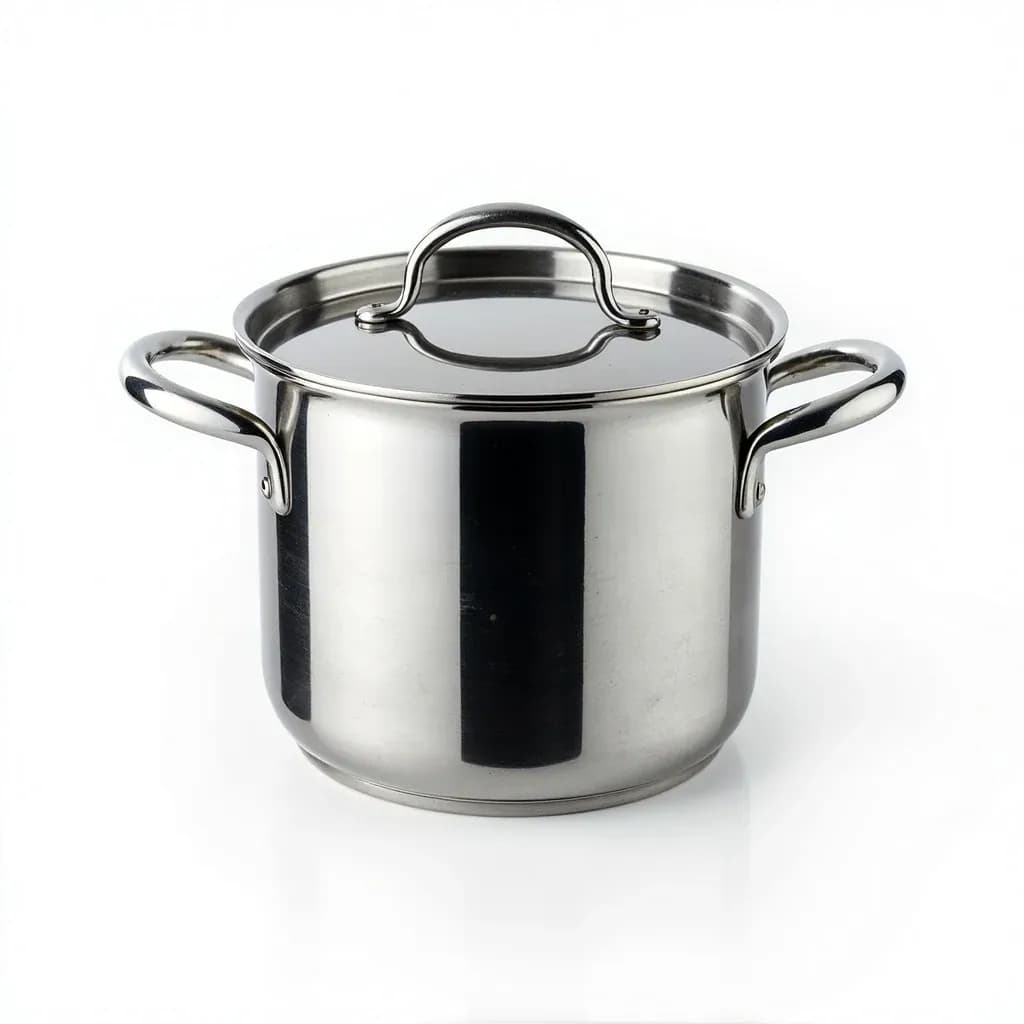
Tall, large-capacity pot for simmering stocks, soups, pasta, and big-batch boils.
A stockpot is a tall, deep pot with a wide base and two looped handles, built to hold large volumes of liquid. Its height limits evaporation, making it ideal for long, slow simmering of stocks, broths, soups, and stews, as well as boiling pasta or blanching vegetables. Most are stainless steel or aluminum, often 6 to 20 quarts, and many come with a tight-fitting lid to control reduction.
The stockpot is the tall, straight-sided, high-capacity pot built for any cooking job that needs a deep column of liquid — from a long, gentle simmer of bones and aromatics to a rolling boil for a crowd-sized batch of pasta. Its defining geometry is the key: a height roughly equal to (or greater than) its diameter, with sides that rise vertically rather than sloping outward. That tall profile minimizes evaporation during the long, low simmer at the heart of stock-making, while still leaving plenty of surface area for skimming foam and lifting ingredients out. It is the workhorse of both home and professional kitchens, the pot you reach for when a saucepan is too small and a Dutch oven is too short.
How a stockpot behaves depends almost entirely on its material and wall thickness. Thin aluminum heats fast and is light to lift, but reacts with acidic ingredients and warps under high heat. Heavy clad stainless — stainless sandwiched around an aluminum or copper core — heats more evenly, holds temperature well, and tolerates acidic foods like tomato-enriched stocks. Enameled cast iron is the slowest to heat and the heaviest to lift, but it holds a steady simmer beautifully and is kind to long reductions. Most cooks settle on a single 12- to 16-quart clad stainless model as the everyday workhorse, then add larger or specialty pots as needs dictate.
The tall sides do more than hold volume: they contain splatter when deep-frying, give stock room to expand without boiling over, and provide enough depth for a steamer insert to sit well above simmering water. They also make the pot awkward to store and heavy to lift when full — a fair trade for a piece of equipment that will, with reasonable care, outlast almost everything else in the kitchen.
Alternatives
Types & varieties
The tall, straight-sided workhorse with a tight lid — the default for stocks, soups, and large-batch boils.
Stainless exterior with an aluminum or copper core for faster, more even heating and less scorching during long simmers.
Heavy and superb at retaining heat; ideal for long, steady simmers but slow to heat up and punishing to lift when full.
Stockpot sold with a perforated insert that lifts out to drain pasta without a separate colander.
A wider, shallower variant of the stockpot family, usually paired with a steamer insert for batch-steaming tamales.
Large aluminum pot with a mesh basket, designed for crab, lobster, shrimp, and corn boils; often sold as a kit with burner and basket.
Countertop electric pot with a built-in thermostat; useful where stove space is tight or precise temperature holding matters.
A heavy-lidded, stockpot-shaped vessel specifically tested and listed for safe home canning of low-acid foods.
Tall stockpot fitted with a perforated drop-in basket that lifts pasta, vegetables, or seafood straight out of the boiling water, draining without a colander.
Choosing the right material
Material is the single biggest decision after size, and it shapes how the pot cooks as much as its weight in your hand. The three options worth weighing:
- Clad stainless (stainless with an aluminum or copper core) is the most versatile and the easiest to live with: it heats evenly, tolerates acidic ingredients, handles metal utensils, and is dishwasher-safe. The trade-off is cost and a slightly longer preheat than aluminum.
- Bare aluminum heats fastest and is the lightest to lift, which matters when a 16-quart pot is full of stock. It reacts with acidic foods (turning tomato or wine-based liquids gray and slightly metallic) and is more prone to warping over high heat. Many cooks reserve it for non-acidic, high-volume jobs like seafood boils.
- Enameled cast iron holds a simmer like almost nothing else and looks beautiful on the stove. The liquid in a 12-quart already weighs around 25 pounds, and the pot itself adds another 15 to 20, so a full pot can easily top 40 pounds. The enamel can also chip if banged, and the pot is the slowest to come up to temperature — fine for stocks, frustrating for pasta.
Common uses
Tips & pitfalls
- Choose a 12- to 16-quart size for most home cooking; go to 20+ quarts only if you regularly feed a crowd, since larger pots are slow to heat and punishing to lift.
- Simmer, don't boil, stocks — a rolling boil emulsifies fats and proteins into the liquid, producing a cloudy, greasy stock rather than a clean one.
- Skim foam and surface fat during the first hour of stock-making for a clearer, cleaner result.
- Fill no more than two-thirds to three-quarters full when cooking anything that expands or foams (beans, pasta, grains, milk-based soups) to prevent boil-overs.
- Keep the lid slightly ajar when simmering stocks to allow evaporation and concentration; close it fully when holding finished soup hot.
- Use stainless steel or enameled cast iron for stocks and acidic foods; reactive metals like bare aluminum or copper can discolor and flavor the liquid.
- Salt pasta water until it tastes like the sea — roughly 1 tablespoon of salt per gallon — and wait for a full rolling boil before adding pasta.
- Avoid nonstick stockpots for long simmers: high heat and prolonged cooking degrade the coating.
- When deep-frying, fill no more than half full; tall sides contain splatter, but oil still rises sharply when food is added.
- Let the pot cool before washing to avoid warping, especially with aluminum or clad pieces; a thermal shock from cold water on a hot pot is the most common way to buckle a base.
- To lift stuck-on residue, fill with hot water plus a splash of white vinegar or baking soda and simmer briefly.
- Confirm magnetic compatibility before buying if you cook on induction — not all stainless pots are induction-ready.
Good to know
- Also called
- Stock pot; historically bouillon pot
- Typical capacity
- 8 to 20 quarts at home; 20 to 80+ quarts in commercial kitchens
- Common materials
- Stainless steel (often clad with aluminum or copper), aluminum, enameled cast iron, copper, hard-anodized aluminum
- Defining geometry
- Height-to-diameter ratio of roughly 1:1 or taller, with straight (not sloped) sides
- Lid
- Tight-fitting, usually domed so condensation runs back into the pot rather than dripping from the rim
- Heat compatibility
- Gas, electric, induction (requires magnetic base), and oven use within manufacturer limits
- Handles
- Two riveted loop handles on larger sizes; smaller models may carry one long handle
- Defining contrast
- Tall, straight-sided shape distinguishes it from a Dutch oven (shorter, wider, thicker walls) and a saucepan (smaller)
Also called
stockpot · stock-pot · large-stockpot · large-stock-pot · deep-stockpot · deep-pot · soup-pot · large-soup-pot · cooking-pot-large
Related

Steamer
Gentle moist heat that keeps vegetables, fish, and dumplings tender

Frying Pan
Shallow sloped pan for frying, sautéing, and quick sears

Saucepan
Tall, straight-sided pot for sauces, grains, and small batches

Sauté Pan
Wide straight-sided pan with room to brown and braise

Dutch Oven
Heavy lidded pot that turns tough cuts tender over hours

Stock Pot
Tall, roomy pot for stocks, pasta, and big-batch cooking

Wok
High-sided bowl pan built for blistering-hot stir-fries

Griddle
Flat, broad surface for pancakes, smash burgers, and breakfast