Prep Tools
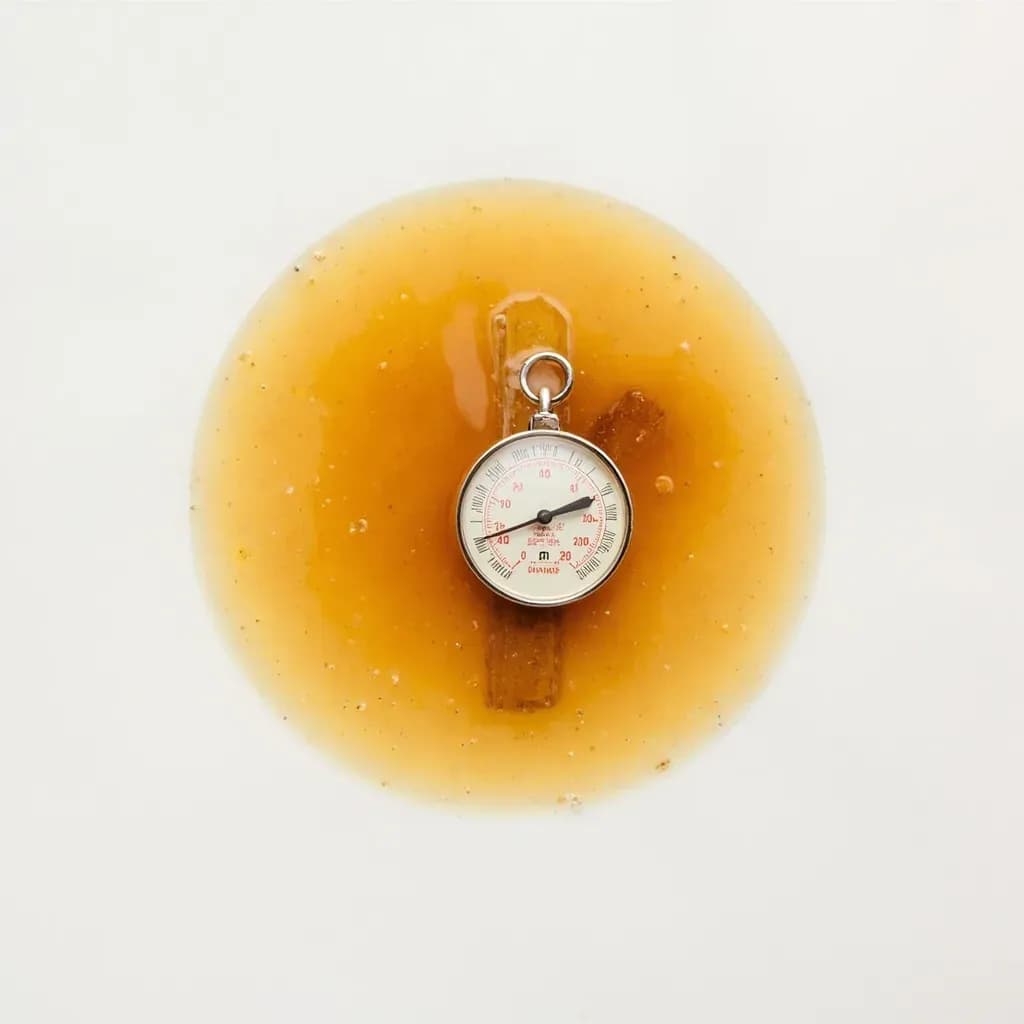
Sugar (Candy) Thermometer
High-range thermometer that tracks sugar syrup through its precise cooking stages.
A thermometer calibrated to high temperatures for monitoring boiling sugar syrup as it passes through soft-ball, hard-crack, and caramel stages. Precise temperature control is critical in candy making, caramel, and confections, where a few degrees change the final texture. Many clip to the pan rim and mark the key sugar stages right on the scale.
A sugar or candy thermometer is a long-stem, high-range thermometer built to track boiling sugar syrups through their narrow but consequential cooking stages. Where a meat thermometer gives up around 200°F, a candy thermometer typically spans 100°F to 400°F, with heavy-duty models reaching 500°F, covering the full range from a thin syrup up through deep amber caramel. The probe is suspended in the liquid by an adjustable clip on the pot rim, so the cook can read temperature continuously without holding anything, freeing both hands to swirl the pan, brush the walls, and watch color develop.
The reason such a tool exists at all is that sugar does not behave like most other ingredients. Between roughly 230°F and 350°F it passes through a tight sequence of physical stages — thread, soft ball, firm ball, hard ball, soft crack, hard crack, and caramel — each of which corresponds to a different finished texture, from a pourable fondant to a snap-hard brittle. Each stage spans only a few degrees, and a difference of 5°F can move a batch from soft fudge to tooth-breaking toffee. Reading the syrup by color alone is a skill that takes years to develop; reading it by temperature is something a candy thermometer delivers reliably on the first try.
The everyday workhorse is the bimetal dial thermometer, but the category also includes liquid-in-glass units (still prized for precision), digital probes (fast and alarm-equipped), and combination fry-and-candy models. Treated as a precision instrument — calibrated, kept clean, positioned away from the cookware — a good candy thermometer replaces guesswork with reproducibility and turns candy cookery into a teachable craft.
Alternatives
Types & varieties
The classic candy thermometer: a coiled metal strip drives a needle on a dial. Durable, needs no batteries, slower to respond than digital.
Old-style spirit-filled glass tube. Highly accurate and prized by confectioners, but fragile; mercury versions have been largely phased out.
Electronic probe with a digital display. Fast reading, often with programmable target-temperature alarms; batteries required.
Non-contact surface reader. Handy for oil in a fryer but unreliable on dark or foaming sugar syrups, so it is not a true candy thermometer.
Marked with both oil-frying ranges and candy-stage temperatures; common in home kitchens where one tool does both jobs.
Analog dial with candy stage names (soft ball, hard crack, and so on) printed on the face for direct visual reference while cooking.
The candy stages at a glance
Sugar cookery is unusual because a single ingredient changes state dramatically over a span of about 120°F, and the line between one stage and the next is sometimes only 4°F. The thermometer exists to make those stages legible. The classic progression, by temperature, runs as follows. Each stage name describes what a small spoonful of syrup does when dropped into cold water — the traditional cold-water test that candy thermometers were designed to replace.
- Thread (230–234°F / 110–112°C): thin syrup that draws into fine, syrupy threads in cold water; the basis for sugar syrups and some dessert sauces.
- Soft ball (234–240°F / 112–116°C): syrup forms a soft, pliable ball that flattens when handled; used for fudge, fondant, and pralines.
- Firm ball (244–250°F / 118–121°C): a firmer ball that holds its shape but still compresses; used for caramels, marshmallows, and Italian meringue.
- Hard ball (250–266°F / 121–130°C): a ball that holds its shape firmly and is chewy in the mouth; used for divinity, nougat, gummy candies, and some toffees.
- Soft crack (270–290°F / 132–143°C): syrup separates into threads that bend softly before breaking; used for butterscotch and taffy.
- Hard crack (300–310°F / 149–154°C): threads snap cleanly and brittles shatter; used for brittles, hard lollipops, and candy apples.
- Caramel (320–350°F / 160–177°C): golden to deep amber liquid; used for caramel sauce, flan, praline, spun sugar, and the dark caramel stage of many pastries.
Common uses
Tips & pitfalls
- Clip the thermometer to the pot BEFORE applying heat so it pre-warms and reads accurately as the syrup rises; a cold probe lags behind.
- Keep the probe tip suspended in the liquid — touching the pan bottom reads too high (because of conducted heat from the burner) and touching the side wall reads too high for the same reason.
- Read the dial at eye level; viewing from above or below introduces parallax error of several degrees, which is enough to skip a candy stage.
- Stir gently before taking a reading. Sugar syrups stratify as they cook, and the top of the liquid can be 10–20°F cooler than the bottom.
- Brush down the inside walls of the pot with a wet pastry brush early in the cook to prevent sugar crystals from seeding the batch and turning it grainy.
- Calibrate bimetal dials in an ice bath before first use and every few months thereafter; turn the hex nut on the back until the needle sits exactly at 32°F / 0°C.
- Wipe the stem clean of hardened sugar immediately after cooking. A crusted probe reads low and responds slowly, and a sticky stem is also a hygiene problem.
- Choose a thermometer rated to at least 400°F if you plan to cook dark caramel or beyond — most budget units cap at 400°F and will not register higher stages.
Good to know
- Type
- Long-stem, high-range cooking thermometer
- Typical temperature range
- 100°F to 400°F (40°C to 200°C); heavy-duty models reach 500°F (260°C)
- Primary purpose
- Measuring boiling sugar syrups, caramel, and frying oil
- Mounting
- Adjustable clip or vise that grips the pot rim, suspending the probe in the liquid
- Probe length
- Usually 5 to 12 inches (12–30 cm) to suit different pot depths
- Readout type
- Bimetal dial (most common), liquid-in-glass (legacy), or digital probe
- Scale
- Usually dual °F / °C; many analog dials print candy-stage names beside the temperatures
- Calibration
- Ice-point (32°F / 0°C) and boiling-point (212°F / 100°C); adjustable hex nut on bimetal models
Also called
Candy Thermometer · Confectionery Thermometer · Jam Thermometer
Related

Peeler
Swift blade for stripping skin off fruit and vegetables

Grater
Sharp-toothed surface for shredding cheese and vegetables

Microplane
Ultra-fine rasp for citrus zest, garlic, and hard cheese

Mixing Bowl
All-purpose bowl for combining, whisking, and tossing

Whisk
Looped wires that beat air into eggs, cream, and sauces

Spatula
Flat blade for flipping, lifting, and scraping

Slotted Spoon
Pierced spoon that lifts solids and drains the liquid behind

Wooden Spoon
Gentle, heat-friendly spoon for stirring anything