Appliances & Heat
Refrigerated Sushi Display Case (Neta Case)
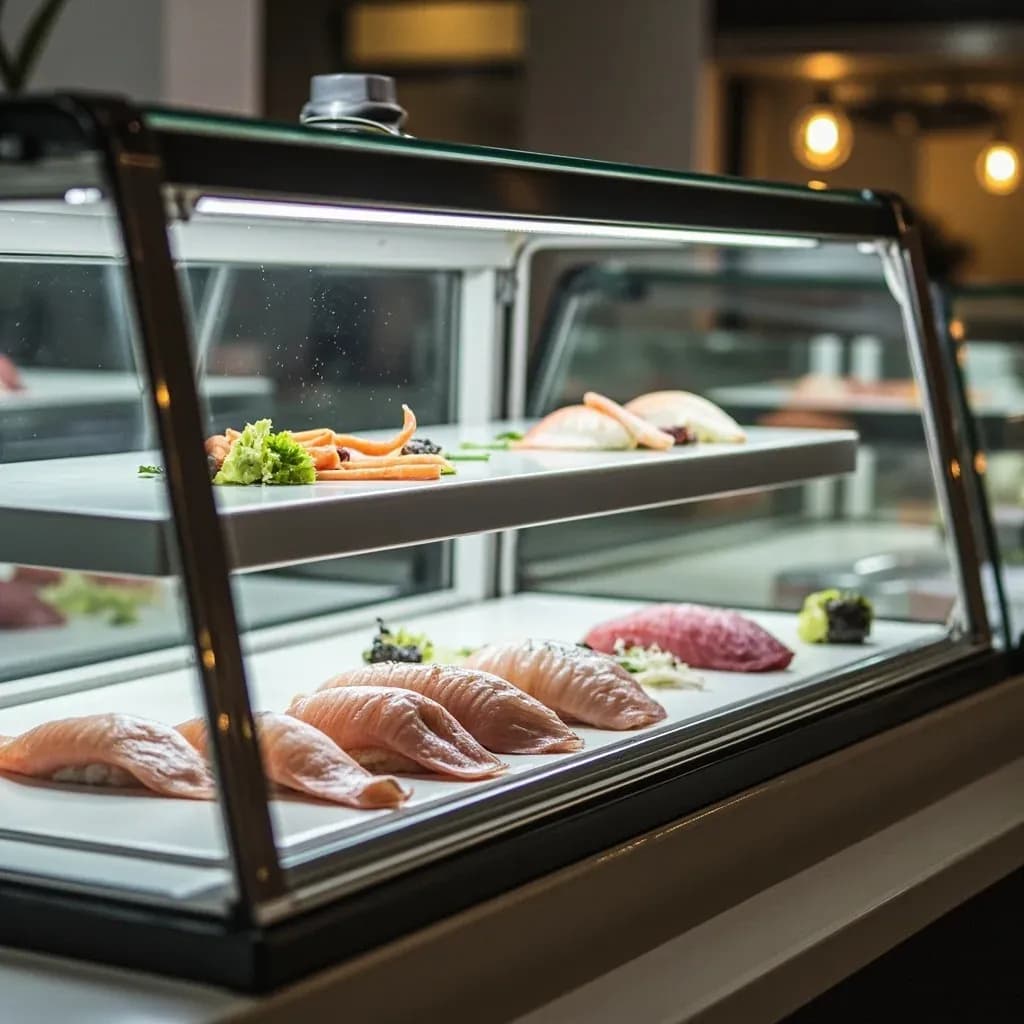
A chilled glass case at the sushi counter that keeps fish toppings cold and visible.
A refrigerated sushi display case, or neta case, is a glass-fronted chilled cabinet set into the sushi counter where the chef stores fish, shellfish, and other toppings at safe cold temperatures. It keeps the neta fresh and visible to guests while the chef works. Precise temperature and humidity control protect delicate raw fish.
The neta case (ネタケース) is the refrigerated glass-fronted cabinet that anchors every sushi counter, holding finished pieces and pre-portioned toppings at a tight 2–5°C band. Its shallow, sloped display well is engineered for the small, fast-turnover portions of nigiri, gunkan, and sashimi — food that is loaded, sold, and rotated within hours, not days. Unlike a deli case, saladette, or pizza prep table (which run warmer at 5–8°C and have deeper wells), the neta case keeps the surface layer of delicate fish such as hamachi, engawa, or uni supple and bright rather than freezing it or drying it out.
Beyond food safety, the case is also the chef's silent stage and menu board. The glass front lets the guest read the day's selection, while giving the itamae a backdrop to display knife work without ever leaving the work station. The lighting is always heat-free LED in any modern unit, chosen as much for colour rendition as for energy savings. The case also sets the rhythm of service: it tells the chef at a glance what is moving, what is drying, and what needs to be pulled from the line.
When selecting a case, pay attention to how quickly temperature recovers after the lid opens, how even the cooling is across the full length of the well, and whether there is a low-front cutout so the chef can reach in without breaking the visual barrier between kitchen and guest.
Alternatives
Types & varieties
Compact 90–120 cm unit that sits directly on the sushi bar; standard for à la carte restaurants and omakase counters.
Larger 150–210 cm glass-front cabinet with a recessed display well, used in high-volume shops and standing-room sushi-ya.
Refrigerated display that sits above or beside a moving belt running through the dining room; sized to feed plates at speed.
Insulated well set flush into the counter with a lift-up glass hood; favoured for minimalist, modern sushi bars.
Traditional shallow case cooled by a reservoir of crushed ice beneath a false stainless tray; still found in older shops and market stalls.
Twin-zone unit with a warmer section for the hangiri or rice tub (kept near body temperature) and a chilled section for toppings, so the chef can build nigiri in one motion.
Setting temperature by protein
Not everything in the case should sit at the same number. Marine fish that will be eaten near-raw — tuna, yellowtail, salmon, mackerel, scallop — wants 2–3°C: cold enough to keep the flesh firm and the surface sealed, warm enough that the natural sweetness and umami of properly handled fish is still present. Items already transformed by cure, such as saba (vinegared mackerel), ika (salt- and vinegar-cured squid), tako (boiled and tenderised octopus), and aji (lightly cured horse mackerel), can sit a degree or two warmer at 4–5°C; below that, the cure dulls and the texture tightens. Uni and ikura are the most fragile — they want the lower end of the range and should never sit under direct airflow, which is why they are usually staged in their trays or on a small plate rather than placed flat in the well.
- Raw marine fish (tuna, hamachi, salmon, hirame): 2–3°C
- Cured or vinegared fish (saba, ika, tako, aji): 4–5°C
- Uni and ikura: 2–3°C, sheltered from direct airflow
- Tamago, tsukemono, tofu: 4–5°C, top of the case to avoid drip contamination
Loading, rotation, and daily care
A neta case is unforgiving of bad habits. Because the well holds at the narrow band where bacteria grow slowly but never stop, every minute a piece sits out is counted twice — once against freshness, once against food safety. Discipline at the case is what separates a good sushi-ya from a tired one.
- Pre-chill all fish to holding temperature before loading; warm fish raises the whole well and condenses on the glass.
- Space pieces 1–2 cm apart so cold air can circulate; overpacking creates warm pockets and dries exposed edges within two to three hours.
- Date-mark every plate and use strict FIFO; pull older pieces first even if they look fine.
- Cover the case with sliding glass lids between services or in quiet periods to lock in cold and humidity.
- Drain the well and wipe with food-safe sanitiser at end of shift; fish drippings become a bacteriology problem overnight.
- Brush the condenser coil monthly and check the door gaskets; a dust-coated coil forces the compressor to run hot and swings interior temperature upward.
- Refill in small batches during service rather than topping up the whole tray at once — steady rotation keeps every piece in front of the guest at peak condition.
Common uses
Tips & pitfalls
- Never load warm fish into the case — pre-chill every portion to the holding temperature first, or the whole well will drift above the safe band and condense on the glass.
- Leave gaps between pieces so cold air can circulate; overpacking creates warm pockets and dries out exposed edges within two to three hours.
- Use LED lighting only — halogen and incandescent bulbs radiate enough heat to dry out tuna and change the colour of lean white fish within an hour of service.
- Set the case to 2–3°C for raw marine fish and 4–5°C for items already cured in salt or vinegar; one number for everything dulls flavour and over-chills the cured items.
- Keep soy-sauced or pre-seasoned pieces out of the case for long stretches; the salt draws moisture, which pools in the well and off-flavours the fish below.
- Run strict FIFO with date marks on every plate — surface oxidation begins within two to three hours even in a well-tuned case.
- Pull the case out and brush the condenser coil monthly; a dust-coated coil forces the compressor to run hot and quietly raises interior temperature during service.
- Drain and wipe the well at the end of every shift — fish drippings left overnight become a serious bacteriology problem by the next lunch service.
Good to know
- Japanese name
- ネタケース (neta kēsu)
- Typical holding temperature
- 2–5°C (35–41°F); raw marine fish at the lower end, salt- or vinegar-cured items at the upper end
- Construction
- Stainless steel interior, tempered glass panels, often a sloped display tray, drain plug, and removable drip tray
- Common sizes
- Counter-top units 90–150 cm wide; floor-standing and conveyor-belt showcase units 150–270 cm wide
- Cooling method
- Forced-air refrigeration with an evaporator coil; older or budget units use a crushed-ice reservoir beneath a false stainless tray
- Lighting
- Cool-white or warm LED strips; incandescent and halogen bulbs are avoided because their radiant heat dries the fish and dulls colour
- Power
- Single-phase 100V in Japan, 220–240V for export; typical draw 200–600 W
- Hygiene standards
- NSF/ANSI 7 (commercial refrigeration) in the U.S.; equivalent JHFA standards in Japan
Also called
neta case · sushi refrigerator case
Related

Stovetop
The everyday burners where most cooking actually happens

Oven
Enclosed dry heat for roasting, baking, and braising

Grill
Live-fire or gas grates for char, smoke, and high heat

Smoker
Low, slow heat and wood smoke for barbecue and brisket

Air Fryer
Countertop convection that crisps with little or no oil

Slow Cooker
Set-and-forget low heat for stews, beans, and braises

Pressure Cooker
Sealed steam pressure that cooks tough food in a fraction of the time

Rice Cooker
Foolproof, perfectly steamed rice every single time