Appliances & Heat
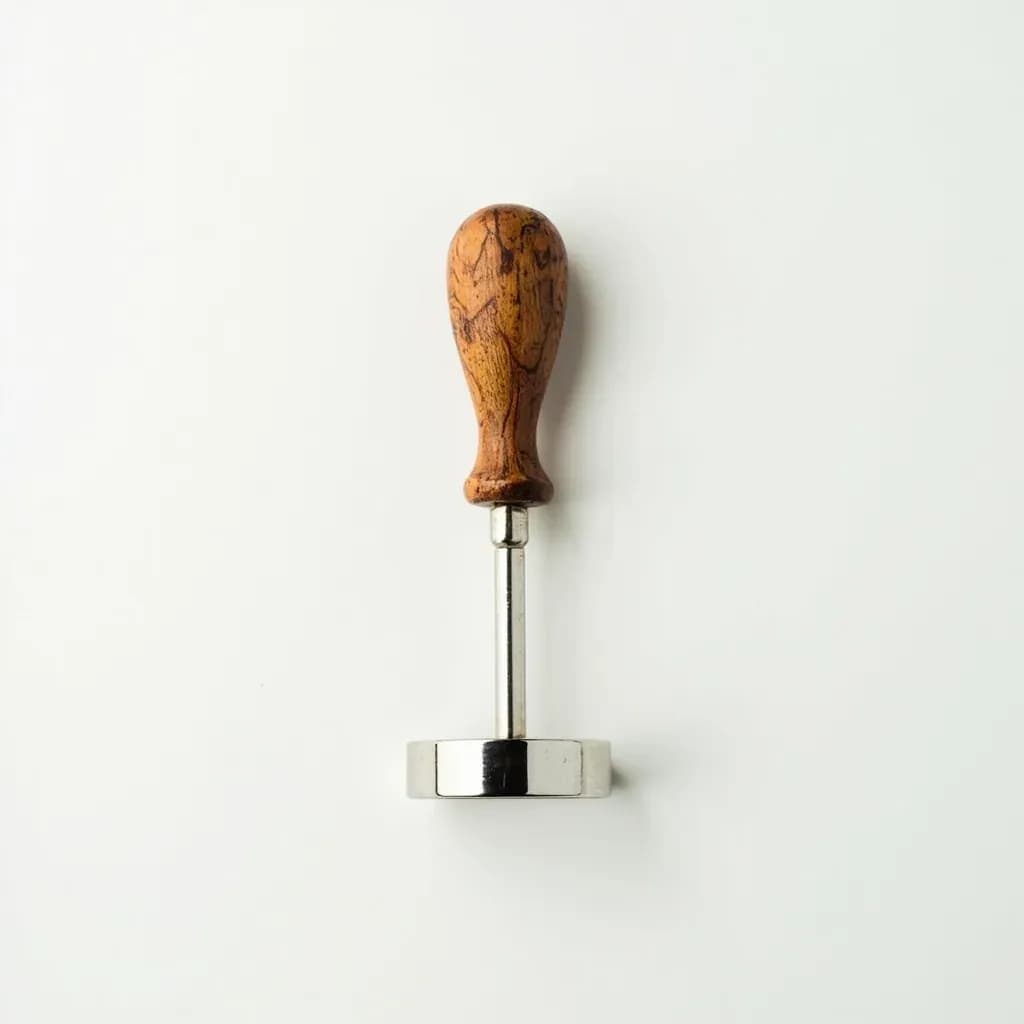
Espresso Tamper
A weighted hand tool that compresses coffee grounds into a level puck for espresso.
An espresso tamper is a short handle with a flat, weighted base sized to a portafilter basket, used to press ground coffee into a firm, even puck. Consistent, level tamping creates uniform resistance so water extracts the shot evenly without channeling. The base diameter must match the basket, and many baristas use calibrated tampers for a repeatable pressure.
An espresso tamper is a short, weighted hand tool with a flat or slightly domed base sized to fit snugly inside a portafilter basket. The barista presses it straight down onto a bed of ground coffee to compress the loose grounds into a dense, level puck before locking the portafilter into the espresso machine. Without that compression, water finds the path of least resistance through loose or uneven grounds and rushes out as a thin, sour shot.
The tamp matters because espresso is brewed under roughly nine bars of pump pressure, and that pressure is only useful if it pushes uniformly through a uniform bed. Even small gaps, cracks, or low-density zones along the puck wall create channels where water escapes without fully extracting the coffee. A proper tamp removes those escape routes by giving every square centimeter of the puck roughly the same density, so the bed resists water evenly from the moment the pump starts.
Done well, tamping is a quiet, shoulder-driven motion with a steady wrist and a level tool. The hardware is simple, but the variables — basket diameter, base shape, applied force, and the prep work done before the press — are what separate a clean, balanced shot from a channelled one. Treating the tamper as one step in a broader puck-prep routine rather than the whole job is what most home baristas miss.
Alternatives
Types & varieties
The most common style. Produces a perfectly level puck surface and gives a flat reference for diagnosing extraction problems.
Slightly domed base that leaves a faint crown on the puck. Some baristas report fewer edge channels; the curve is harder to keep clean.
Spring-loaded so the base clicks or stops at a fixed pressure (commonly ~30 lb). Removes guesswork and is the simplest fix for inconsistent puck density.
Bench-top device such as the Puqpress that delivers a programmed, identical tamp every time. Used in busy cafés and by enthusiasts chasing total consistency.
Single tools (such as lever tamps or norms-style distributors) that level and compress the grounds in one motion, replacing a separate WDT and tamper step.
Choosing the right tamper
Selecting a tamper is mostly a matter of matching the basket, then deciding how much repeatability you want from the press. The most useful spec is the basket diameter: a tamper that is even 1 mm too small leaves an under-tamped ring at the wall where water will channel.
- Measure your portafilter basket directly or check the machine's spec sheet. The most common home baskets are 58 mm (prosumer and commercial standard) and 54 mm (Breville and similar machines).
- A flat stainless base is the most forgiving choice for a beginner: it gives a level reference, is easy to wipe clean, and will not mark the basket.
- A calibrated tamper is the simplest fix for inconsistent tamp pressure at home. An auto-tamper goes further and removes the human variable entirely, at the cost of counter space and price.
- Wood or polymer handles stay cooler than bare metal and grip better, especially when pulling back-to-back shots on a busy bar.
- Avoid aluminum bases for daily use; they dent and scratch, and the burrs then score the puck surface.
Beyond the tamper: building a puck-prep routine
A tamper alone will not fix an uneven bed. The cleanest shots come from a short routine that distributes and levels the grounds before the press, and supports the portafilter during it.
- Dose into the portafilter through a dosing funnel so grounds stay inside the basket and the rim stays clean for the group-head gasket.
- Break up clumps and distribute with a WDT tool — a handheld whisk of fine needles — or a spinning distribution tool, working the bed until it looks level.
- Tamp on a rubber mat or fitted tamping stand so the portafilter sits flat and the spouts do not absorb the impact; this also protects the counter.
- Pull the funnel away before locking the portafilter into the group head so it does not interfere with the seal.
Common uses
Tips & pitfalls
- Always match the tamper diameter to the basket; even a 1 mm shortfall leaves an under-tamped ring at the wall where water will channel.
- Distribute the grounds before tamping — with a finger-level, a WDT tool, or a distributor — so the bed is even before you press.
- Hold the tamper like a doorknob (thumb and index on top, palm on the side) and drive force straight down with the shoulder, not the wrist.
- Aim for about 30 lb of pressure with a level, vertical press; consistency of force matters more than the absolute number.
- Tamp on a rubber mat or fitted tamping stand to protect the portafilter spouts and the counter.
- A light polishing twist at the end of the press is fine, but avoid grinding or twisting under heavy load, which can stress the wrist and damage the basket screen.
- Keep the tamper base dry and free of oils and grounds; a wet or grimy base glides and produces a smeared, uneven puck.
- Replace or re-bottom your tamper if the base becomes scored, convex from a drop, or out-of-round — all of which leave visible tamp marks in the puck.
- If you brew on machines with different basket sizes (for example 58 mm and 54 mm), keep a matched tamper for each rather than improvising.
- Calibrated tampers and auto-tampers are the simplest fixes for inconsistent puck density in a home setup.
Good to know
- Primary function
- Compresses ground coffee into a level, dense puck inside a portafilter basket so water flows evenly during espresso extraction.
- Common basket diameters
- 58 mm (commercial and prosumer standard), 57 mm (legacy commercial), 54 mm (Breville and many home machines), with 53, 51, and 49 mm also seen; the tamper base must match the basket.
- Typical target pressure
- About 30 lb (≈13.6 kg); most baristas work in a 20–30 lb range, and calibrated tampers lock at a fixed force.
- Base materials
- Stainless steel (most common, food-safe, durable), aluminum (lighter, scratches easily), and brass or bronze (heavier, used in some prosumer tools).
- Handle materials
- Stainless steel, aluminum, walnut and other hardwoods, polypropylene, and Delrin. Wood and polymer handles stay cooler and grip better during long shifts.
- Base shape
- Flat (the standard) or convex/domed (often called a C-curve); convex bases leave a slight crown on the puck that some baristas credit with reducing edge channeling.
- Typical weight
- Hand tampers run roughly 350–600 g, with most of that mass in the base to help apply force with a steady arm.
Also called
Tamper · coffee tamper
Related

Stovetop
The everyday burners where most cooking actually happens

Oven
Enclosed dry heat for roasting, baking, and braising

Grill
Live-fire or gas grates for char, smoke, and high heat

Smoker
Low, slow heat and wood smoke for barbecue and brisket

Air Fryer
Countertop convection that crisps with little or no oil

Slow Cooker
Set-and-forget low heat for stews, beans, and braises

Pressure Cooker
Sealed steam pressure that cooks tough food in a fraction of the time

Rice Cooker
Foolproof, perfectly steamed rice every single time