Appliances & Heat
Tatung Multi-Cooker (大同電鍋)
A Taiwanese steam-jacket cooker that steams, boils and braises by heating water in an outer pot.
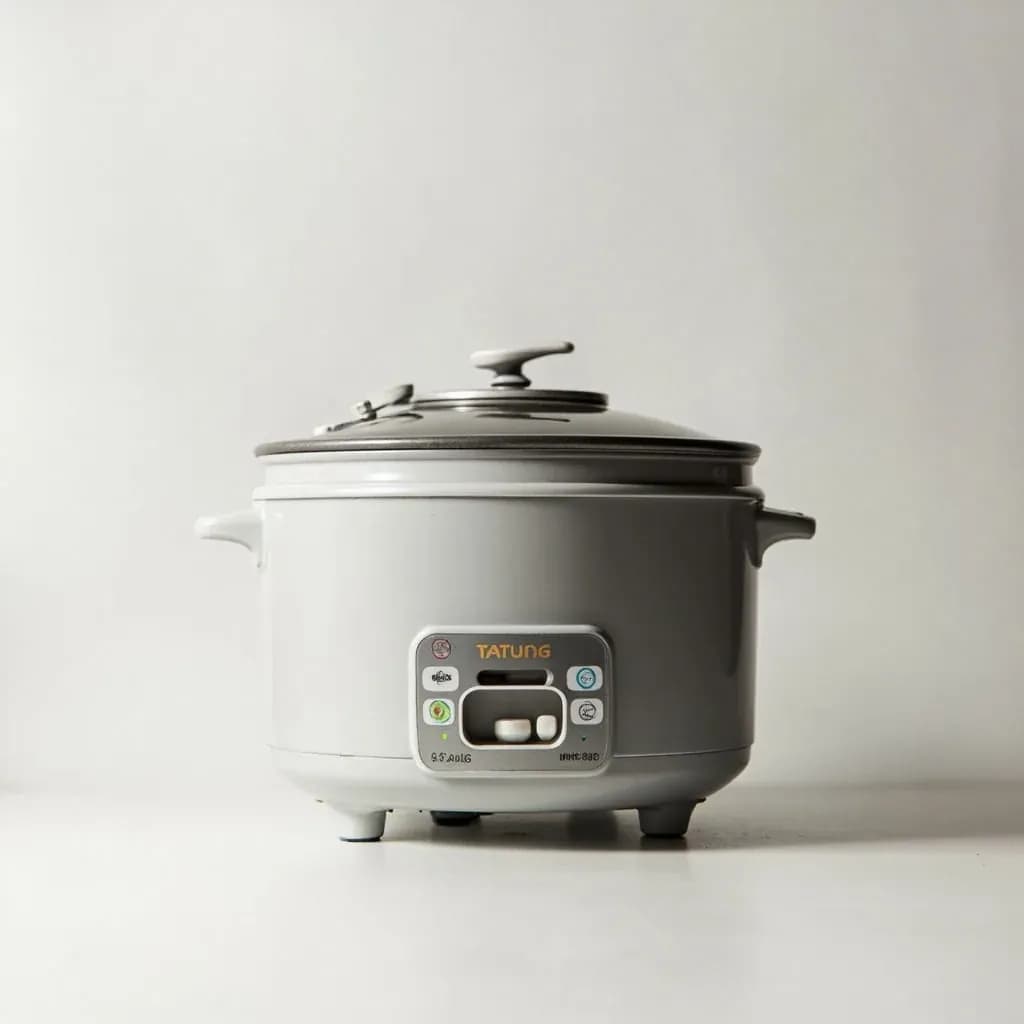
The Tatung electric cooker (datong dianguo) cooks by heating water in an outer pot whose steam cooks the food in an inner pot, then switches off when the water runs dry. Beyond rice, it steams dumplings, braises, reheats and slow-cooks soups, making it a do-everything appliance in Taiwanese homes. Adding more or less water in the outer pot sets the cooking time.
The Tatung Multi-Cooker (大同電鍋, almost always shortened to 電鍋 in Taiwanese kitchens) is a Taiwanese steam-jacket electric cooker that has anchored home cooking since the 1960s. It is built around a deliberately simple three-part geometry: an outer pot with a built-in heating element holds a measured amount of water, a perforated inner pot sits inside to hold the food, and a domed aluminum lid traps the steam. As the outer water boils, steam rises through the perforations and circulates around the food, cooking by indirect, surrounding steam at a steady ~100 °C — never by direct contact with a hot surface.
That single mechanism turns one appliance into a rice cooker, a steamer, a slow braiser, and a soup simmerer, which is why a Tatung sits on the counter of nearly every Taiwanese household and a great many Chinese and Southeast Asian ones. The controls are austere: a two-position switch clicks between COOK (煮) and WARM (保溫), and cooking ends automatically when the outer pot boils dry. There is no thermostat, no timer, no fuzzy logic — and that austerity is the point. The design produces a gentle, hands-off heat suited to long braises, herbal tonics, and congee without scorching, and authentic units routinely run 20 to 40 years with nothing more than an occasional replacement switch or inner pot.
An authentic Tatung, marked by the red 大同 logo and a hefty aluminum-alloy body, is a different machine from the inexpensive "rice cookers" that copy its silhouette. Those clones use a direct-heat bowl and a weaker switch; the genuine Tatung's steam-jacket geometry and robust switch are why second-hand units pass between families for decades. A cook who learns the water-measurement system — every recipe is calibrated to cups of water in the outer pot — gains a quietly powerful tool that rewards patience over precision.
Alternatives
Types & varieties
The iconic small-household model with aluminum inner pot; standard 110 V for Taiwan and US markets.
A less common middle size used by small families.
Common mid-size, a balanced choice for 3–5 person households.
The workhorse — the most versatile size, popular with bigger families and small eateries.
Large-capacity unit for batch cooking, extended family, or food prep.
Newer releases that swap the classic aluminum inner pot for a SUS304 stainless one; cooks identically but resists discoloration and reactive ingredients.
Inexpensive mainland-Chinese or unmarked "rice cookers" mimic the silhouette but use direct-heat bowls and weaker switches; they do not cook like an authentic Tatung.
The water-measurement system
Every Tatung recipe is built around a single principle: the amount of water you pour into the outer pot determines how long the cooker runs. Inside the outer pot is a vertical row of cup-markings; each marking corresponds to one cup of water, and each cup takes roughly 8–10 minutes to boil off into steam. So three cups of outer water means about 25–30 minutes of cooking; six cups means close to an hour. This is why Tatung recipes read like "2 cups rice, washed and drained; 3 cups outer water" — the ratio is the recipe. For rice, start at one cup of outer water per cup of dry rice for a firmer grain, then add an extra half-cup to account for evaporation as the unit heats up, and a bit more for softer textures. For braises, set the outer water high enough to run the full intended braise time; the cook can leave the house knowing the unit will click to WARM on its own. Once you internalize the cup-markings, the machine has almost no learning curve.
Tatung vs. a modern rice cooker
- Mechanism: indirect steam from a jacket pot, versus a direct-heat bowl with a thermostat or induction element.
- Best at: long, gentle, unattended cooking — rice, congee, steamed buns, braises, herbal soups, custards.
- Not good at: searing, frying, pressure cooking, or producing the precise al-dente grains a Japanese-style induction cooker targets for sushi rice.
- Control: two switch positions versus menus, timers, and keep-warm schedules; the Tatung's simplicity is also its reliability.
- Durability: authentic Tatung units commonly reach 20–40+ years of daily use; modern electronic rice cookers vary widely in build quality and lifespan.
- Repair: switches, inner pots, and heating elements are sold as individual parts, so a worn switch is a 10-minute fix rather than a replacement appliance.
Caring for an aluminum inner pot
The classic aluminum inner pot darkens with use, developing a soft gray patina. This is oxidation, not grime, and many Taiwanese cooks prize it — the patina contributes to the pot's natural non-stick quality and is a sign of a well-used machine. Wash the inner pot by hand with mild soap and a soft sponge; avoid steel wool, scouring pads, and harsh dishwasher detergent, all of which strip the patina. For mineral buildup from hard water, boil a solution of water plus a tablespoon of citric acid or a few tablespoons of white vinegar in the outer pot, then discard and rinse.
Common uses
Tips & pitfalls
- Measure outer-pot water with the included cup — one cup per cup of dry rice is the baseline, and adding 1–2 extra cups yields softer, more tender grains. This is the single most important habit to learn.
- Line the perforated inner pot with a cabbage leaf, cheesecloth, or steaming paper when cooking small items (grains, peas, tiny dumplings) so nothing falls through the holes.
- Never submerge the electrical base or outer pot in water — wipe with a damp cloth only. Water reaching the heating element will destroy the unit.
- The darkening of an aluminum inner pot is normal oxidation, not dirt; do not scrub it with steel wool or harsh abrasives, which strip the patina and the pot's natural non-stick quality.
- For long braises, fill the outer pot generously (3–6 cups of water depending on desired cook time). The cooker runs completely unattended and shuts off when the water is gone.
- If the switch will not click down to COOK, the outer pot is usually short of water or the inner pot is misaligned and blocking the sensor weight — check both before assuming the switch is broken.
- Avoid lifting the lid during the first 10 minutes of cooking rice; the disrupted steam cycle yields uneven, gummy grains.
- After the COOK cycle ends, leave the rice on WARM with the lid closed for 10–15 minutes — residual steam finishes the grains and dries surface moisture for fluffy results.
Good to know
- Origin
- Taiwan, made by Tatung Company (大同公司), founded 1918; the electric steamer-cooker was introduced in the 1960s and became the standard Taiwanese home cooker.
- Construction
- Three parts — an outer pot with a built-in heating element, a perforated inner pot (aluminum classic, or stainless steel on newer models), and a domed aluminum lid.
- Controls
- A single two-position switch toggles between COOK (煮) and WARM (保溫); there is no thermostat, timer, or temperature dial. Cooking ends when the outer pot boils dry.
- Sizing
- Rated in cups of uncooked rice / "persons" (人份). The classic line runs 6, 8, 10, 11, and 15 cups (TAC-06, TAC-08, TAC-10, TAC-11, TAC-15).
- Heat profile
- Steady indirect steam at roughly 100 °C — ideal for long, unattended cooking but unable to sear, fry, or exceed boiling.
- Lifespan
- Famous for longevity; 20–40+ years of daily use is common, with replacement switches, inner pots, and heating elements sold individually.
- Voltage
- Classic Taiwanese and US-export models are 110 V; later international releases are offered in 110 V and 220 V versions depending on the market.
Also called
Tatung Rice Cooker · Datong Dianguo · Tatung Steam Cooker
Related

Stovetop
The everyday burners where most cooking actually happens

Oven
Enclosed dry heat for roasting, baking, and braising

Grill
Live-fire or gas grates for char, smoke, and high heat

Smoker
Low, slow heat and wood smoke for barbecue and brisket

Air Fryer
Countertop convection that crisps with little or no oil

Slow Cooker
Set-and-forget low heat for stews, beans, and braises

Pressure Cooker
Sealed steam pressure that cooks tough food in a fraction of the time

Rice Cooker
Foolproof, perfectly steamed rice every single time