Appliances & Heat
Teppanyaki Griddle (Teppan)
Large flat iron cooking surface for searing meat, seafood, and vegetables tableside.
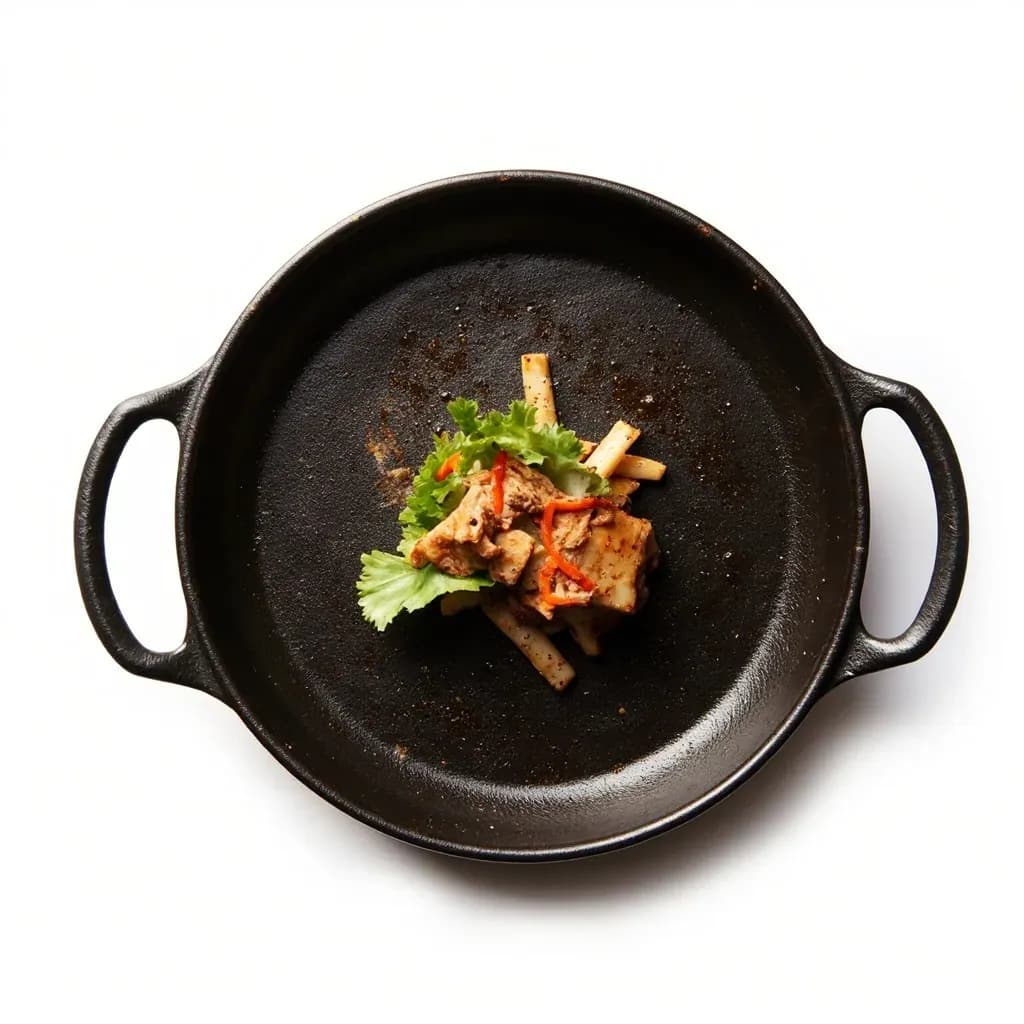
A teppan is a large, flat iron griddle heated from below, used to cook meat, seafood, vegetables, and fried rice on a smooth surface, often in front of diners. The broad even heat sears food quickly and gives the cook room to manage many items at once. Restaurant versions are built-in; home cooks use freestanding electric or stovetop flat plates.
A teppanyaki griddle — the 'teppan' — is a thick, solid plate of iron or steel heated from below by gas burners or embedded electric elements, used to cook food directly on its flat surface, usually in front of diners. The name is a literal compound: teppan (鉄板) means 'iron plate' and yaki (焼き) means 'grilled or pan-fried.' What separates the teppan from an ordinary skillet is thermal mass. A commercial plate is 12–25 mm (½–1 in) thick and is brought up to searing temperature — typically 200–260 °C / 400–500 °F — long before food touches it. That mass lets it recover almost instantly when a cold steak or pile of rice hits the surface, which is why a teppan can sear without the temperature sag you get in a home pan.
Because the surface is vast and uniformly hot, the teppan is as much a workspace as a cooking medium. The chef uses two metal spatulas — a broad flat one and a smaller 'spatula-knife' — to chop, push, press, and flip, working ingredients around the plate much like a pastry cook works dough on a slab of marble. The hottest zone sits at the chef's side of the plate; the cooler guest-facing edge is where finished food is 'landed' to rest without overcooking. Learning to read those temperature zones is the practical skill that defines teppanyaki cooking.
The tool is inseparable from a service style. The classic experience is tableside: the chef seasons, portions, and finishes each diner's food in real time, and the diner watches the entire cook. That is why teppanyaki restaurants traditionally cluster seating around the plate rather than in booths. At home the same tool (in smaller, often electric form) behaves the same way, but the pleasure is largely your own.
Alternatives
Types & varieties
Heavy, thick iron plate over high-BTU gas burners; the restaurant standard, prized for fast heat recovery after cold food hits the surface.
Thinner plate with heating elements beneath; common in domestic kitchens and open-plan show kitchens where open flame is restricted.
Smaller units, gas or electric, sized for two to four diners; widely sold for home use in Japan and increasingly elsewhere.
Plate scored with raised ridges that leave grill-style marks and channel fat away from the food.
The classic configuration; best for eggs, rice, noodles, and small vegetables that would fall between ridges.
Stainless-looking and less porous than bare iron; easier to clean but develops a less seasoned patina and is uncommon in serious teppanyaki restaurants.
Reading the temperature zones
A teppan is rarely one even temperature across its surface. The area directly above the burners (usually the chef's side or the centre, depending on the model) runs hottest; the far edges radiate and cool. Skilled teppanyaki chefs use these zones deliberately, moving food from hot to cool as it cooks.
- Sear proteins on the hottest zone, then slide them toward the guest-facing edge to rest without overcooking.
- Reserve a small 'warm corner' for holding finished pieces — buttered shrimp, seared scallops, cut steak — so they stay hot while you finish the rest of the plate.
- Fried rice, noodles, and eggs go on the moderately hot middle zone, where they can be pressed, chopped, and tossed without scorching.
Domestic substitutes
Few home kitchens can fit a true commercial teppan, but you can approximate the cooking with a heavy, flat metal surface and strong heat.
- A thick cast-iron griddle or carbon-steel plancha spanning two burners is the closest substitute: enough thermal mass to sear, flat enough for fried rice and eggs.
- A flat-top griddle (the diner-style kind) works for volume but lacks the heat recovery of a dedicated iron plate.
- Outdoor gas burners under a steel plate are the closest home approximation to the restaurant experience — high BTU and very even heat.
Common uses
Tips & pitfalls
- Preheat longer than you think — a teppan needs 15–20 minutes of preheat on gas to even out temperature across the plate; cold spots cause uneven browning.
- Oil the food, not the plate, when searing proteins; a film of oil on the plate smokes and polymerizes into a sticky residue.
- Do not overcrowd. Each portion should have a clear patch of hot metal; piling food together steams rather than sears.
- Use two spatulas as a pair — one holds, the other cuts. The classic chop-and-flip motion for rice and noodles is what teppanyaki is built around.
- Work from the back of the plate toward the front: the chef's side is hottest, the guest-facing edge is cooler, so finished food migrates toward the diner and stays warm without overcooking.
- Clean by scraping off residue with the edge of a spatula while the plate is still hot, then wiping with a damp cloth — never flood a hot iron surface with cold water, which warps the metal.
- If the plate is bare carbon steel or iron, season it like a skillet: a thin film of high-smoke-point oil, heat until it just smokes, wipe, repeat; build a dark patina over time.
- Salt proteins only when they hit the plate, not before, to get a proper Maillard crust and avoid pulling moisture to the surface.
Good to know
- Origin
- Japan; teppanyaki is widely credited to the Misono restaurant in Kobe, which began serving it in 1945, though flat-iron cooking has older antecedents.
- Etymology
- From Japanese 鉄板焼き: 'teppan' (鉄板) = iron plate, 'yaki' (焼き) = grilled, pan-fried, or broiled.
- Material and thickness
- Solid iron or steel, typically 12–25 mm (½–1 in) thick on commercial units, to retain heat and recover quickly between batches.
- Heat source
- Gas burners beneath the plate (the restaurant standard) or embedded electric elements (common in domestic and some commercial models).
- Surface temperature
- Usually 200–260 °C / 400–500 °F at the plate; the surface is brought up to heat well before food is added.
- Plate area (commercial)
- Most restaurant teppans seat 4–8 guests around a plate roughly 60–90 cm wide and 50–70 cm deep.
- Standard accessories
- Two metal spatulas (a flat one and a small 'spatula-knife'), an oil ladle or brush, and sometimes a wooden paddle for rice.
- Distinction from hibachi
- Hibachi uses a smaller, open-grate charcoal brazier; the teppan is a solid flat iron plate, almost always gas or electric in modern use.
Also called
Teppan · Flat-Top Griddle · Hibachi Griddle
Related

Stovetop
The everyday burners where most cooking actually happens

Oven
Enclosed dry heat for roasting, baking, and braising

Grill
Live-fire or gas grates for char, smoke, and high heat

Smoker
Low, slow heat and wood smoke for barbecue and brisket

Air Fryer
Countertop convection that crisps with little or no oil

Slow Cooker
Set-and-forget low heat for stews, beans, and braises

Pressure Cooker
Sealed steam pressure that cooks tough food in a fraction of the time

Rice Cooker
Foolproof, perfectly steamed rice every single time