Appliances & Heat
Texture Analyzer (TPA)
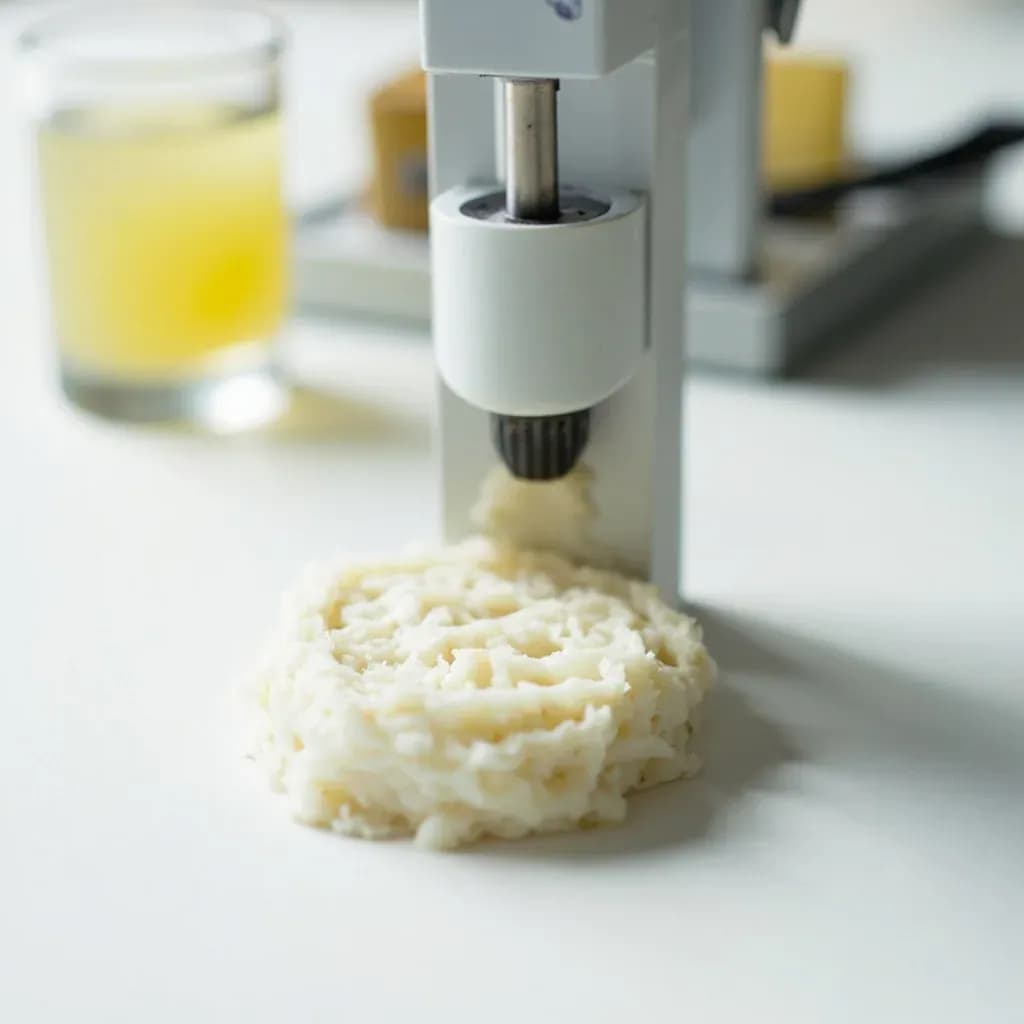
Lab instrument that compresses food to measure hardness, chewiness and other texture properties.
A texture analyzer is a precision instrument that presses, pulls or shears a food sample with a calibrated probe and records the force required. Cooks and R&D kitchens use Texture Profile Analysis (TPA) to quantify properties like firmness, springiness, cohesiveness and gel strength so recipes stay consistent batch to batch. It is mainly a development and quality-control tool rather than a daily-line gadget.
A Texture Analyzer running Texture Profile Analysis — universally shortened to TPA and nicknamed the "two-bite test" — is the workhorse bench instrument of food texture science. Codified in 1963 by Alina Szczesniak and colleagues at General Foods, it deliberately imitates the act of chewing: a probe descends onto a sample, compresses it, retracts, then compresses it again, while a load cell draws a continuous curve of force against distance and time. From that curve, seven standardized parameters are calculated, each one a number meant to stand in for a sensation a human mouth would otherwise describe.
Those seven parameters — hardness, cohesiveness, springiness, adhesiveness, gumminess, chewiness, and resilience — are the language of modern product development. A bread engineer dialing in tender crumb watches hardness and resilience. A sausage maker dialing in bite works with chewiness and springiness. A gummy candy formulator balances cohesiveness against adhesiveness. TPA gives each of these soft, mouthfeel words a chart, a unit, and a number you can compare from batch to batch.
For cooks and food developers, the instrument matters because it quietly shapes what reaches the shelf: every reformulated cookie, every new plant-based cheese, every batch of pet kibble has almost certainly been through a TPA run. Understanding what the numbers mean — and, just as importantly, what they don't — is part of reading a modern food label and a modern recipe-development report with your eyes open.
Alternatives
Types & varieties
Compact units like the Brookfield CT3 or Stable Micro Systems TA.XTplus — the everyday workhorses of QA labs
Larger load frames such as the Instron 3360 series or TA.HDplus for hard or large samples (whole crackers, bones, dense bars)
The default for most TPA work; produces clean compression curves on gels, cheeses, meats, and bakery items
Used on soft or irregular samples where a flat platen would crush unevenly or skip over a curved surface
Penetration-style measurements for spreads, soft cheeses, puddings, and other semi-solids
Specialty fixture for measuring extensibility and resistance-to-extension in dough sheets
Attachments used when TPA is the wrong test — for brittle snaps or multi-particle foods like mixed salads
Exponent (Stable Micro Systems) and TexturePro CT (Brookfield) auto-calc the seven parameters from the raw curve
The seven TPA parameters, decoded
Each parameter is read off the force–distance–time curve from the two compression cycles. They are engineered numbers, not direct mouthfeel measurements, but each maps onto a recognizable sensation.
- Hardness — the peak force on the first compression. Higher = firmer bite. Think carrot stick vs. tofu.
- Cohesiveness — the ratio of the area under the second bite's curve to the first. Higher = the sample holds together rather than crumbling or shattering.
- Springiness — how far the sample recovers between bites, measured as the ratio of recovered height to original compressed height. Higher = bouncier; a marshmallow scores high, a cracker scores near zero.
- Adhesiveness — the negative work (area under the curve) required to lift the probe off the sample. Higher = sticker; this is what makes peanut butter cling to the roof of the mouth.
- Gumminess — hardness × cohesiveness, used for semi-solids (gummy bears, soft cheese, processed cheese spreads).
- Chewiness — gumminess × springiness, used for solids that require actual chewing (beef jerky, sausage, bagels).
- Resilience — how well the sample snaps back during the first compression, measured on the upstroke. Higher = more elastic recovery; useful for bread crumb and cake.
Common uses
Tips & pitfalls
- Always report the compression ratio, crosshead speed, probe geometry, sample dimensions, and temperature — TPA numbers from different labs are not comparable unless those match
- Run at least 5–10 replicates per condition; texture is inherently variable and a single curve is a single story
- Bring samples to a defined temperature before testing — even a 2–3 °C swing measurably changes hardness and springiness in fats, gels, and chocolate
- Cut samples to identical shape and orientation; a chipped edge or tilted face ruins the curve and biases the second bite
- Retract the probe fully between cycles; incomplete lift-off inflates adhesiveness and distorts springiness
- Clean the probe and stage between samples — crumbs, grease, or moisture from the last run bias the next reading
- For hard or brittle foods (crackers, hard candy, toast), prefer a single compression or three-point bend; TPA was designed for soft, deformable foods and misrepresents brittle ones
- Don't treat the seven TPA numbers as objective truth — they are a 1963 lab imitation of chewing, useful as a shared reference but never a substitute for a trained sensory panel
Good to know
- Full name
- Texture Profile Analysis (TPA), a.k.a. the two-bite test
- Originated
- 1963, Szczesniak, Brandt & Friedman at General Foods
- Seven parameters
- Hardness, cohesiveness, springiness, adhesiveness, gumminess, chewiness, resilience
- Typical compression
- 50–75% of original sample height on each of the two cycles
- Crosshead speed
- Usually 0.5–2 mm/s; results shift with speed, so it must be reported
- Sample geometry
- Cylinders or cubes of defined dimensions, oriented the same way every run
- Probe types
- Cylindrical (flat), spherical, conical, blade, or specialty rigs (e.g., Kieffer for dough)
- Major manufacturers
- Stable Micro Systems (TA.XTplus, TA.HDplus), Brookfield (CT3), Instron, Mecmesin, Food Technology Corporation (TMS), Shimadzu
- Load cell range
- Typically 5 N to 1,500 N, selected to match the expected hardness of the product
- Cost range
- Benchtop units roughly $5,000–$60,000; heavy-duty floor systems can exceed $100,000
- Primary users
- Food R&D labs, QA/QC departments, pet food manufacturers, and academic food science programs
Also called
TPA · Texture Profile Analyzer
Related

Stovetop
The everyday burners where most cooking actually happens

Oven
Enclosed dry heat for roasting, baking, and braising

Grill
Live-fire or gas grates for char, smoke, and high heat

Smoker
Low, slow heat and wood smoke for barbecue and brisket

Air Fryer
Countertop convection that crisps with little or no oil

Slow Cooker
Set-and-forget low heat for stews, beans, and braises

Pressure Cooker
Sealed steam pressure that cooks tough food in a fraction of the time

Rice Cooker
Foolproof, perfectly steamed rice every single time