Appliances & Heat
Thermomix
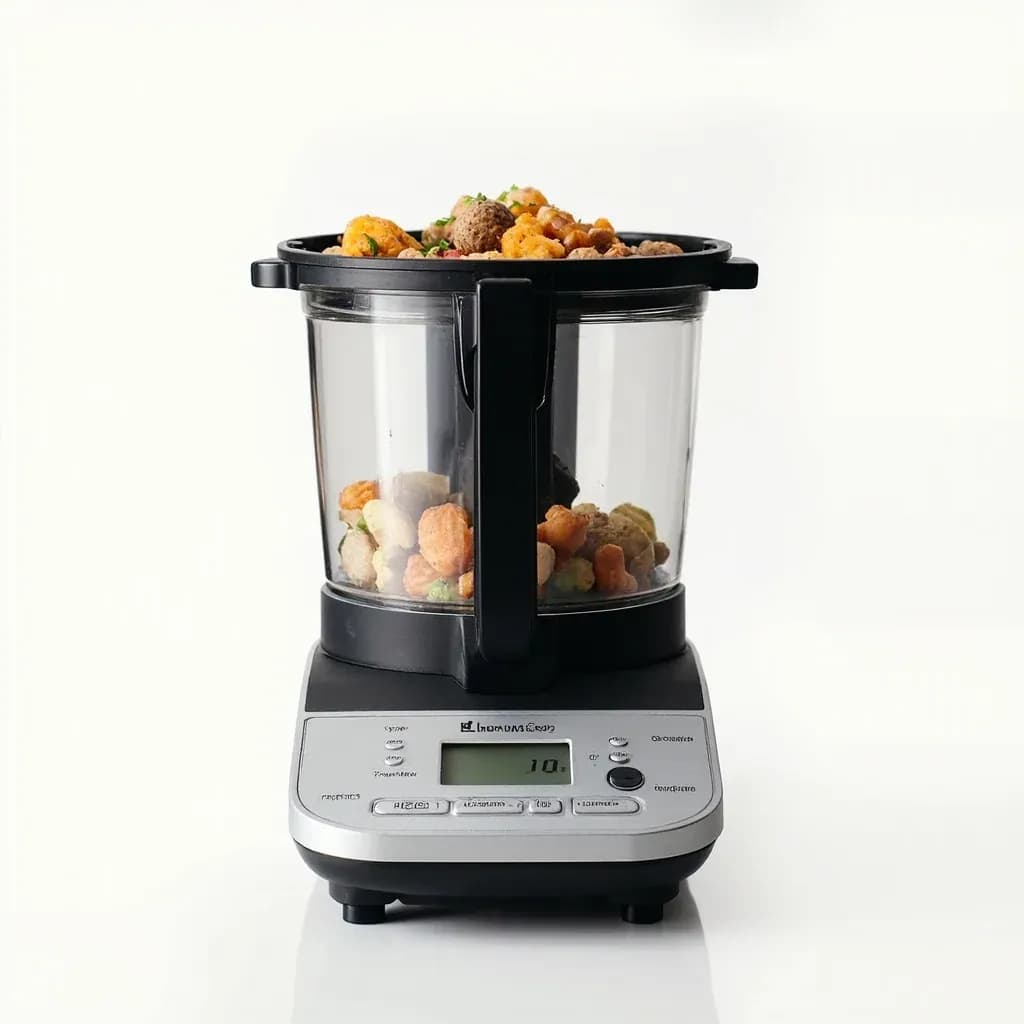
An all-in-one cooking appliance that chops, blends, weighs, heats, and stirs in a single heated bowl.
A Thermomix is a multifunction kitchen machine that combines a powerful blender, built-in scale, and precise heating element so it can chop, mix, knead, steam, and slow-cook in one bowl. Guided recipes coordinate timing, temperature, and blade speed, letting one device make sauces, soups, doughs, and risottos with minimal hands-on work. Its precise temperature control suits delicate tasks like custards and emulsions that risk breaking on a stovetop.
The Thermomix is a German-built, countertop heated multi-tool that consolidates roughly a dozen single-purpose appliances into one stainless-steel bowl driven by a variable-speed motor, a temperature-controlled heating plate, and a built-in gram scale. Made by Vorwerk since 1971, it is best understood not as a blender or food processor with extras, but as a closed-loop cooking system: the weight sensor, temperature probe and motor all feed back into a single processor, which is why guided recipes can claim to stir, weigh and time themselves. That integration is also why its recipes, accessories and even cookbooks are written in a vocabulary of speeds, temperatures and timings that often does not transfer to other machines.
In practical terms, the bowl chops, emulsifies, kneads, whips, slow-cooks, sous-vides and steams in sequence without the cook transferring food between vessels. The signature accessory, the Varoma, stacks on top of the lid as a two-tier steamer above the simmering bowl, so a sauce or grain can cook underneath while fish, vegetables or dumplings steam above. The current TM6 model adds Wi-Fi access to Vorwerk's Cookidoo recipe platform, sous-vide and fermentation modes, and a touchscreen that walks the user through each step, weight and timer.
Alternatives
Types & varieties
Current flagship (2019–). 7-inch touchscreen, Wi-Fi, Cookidoo access, sous-vide, fermentation, high-speed up to 10,700 rpm.
Released 2014. Introduced the 2.2 L bowl and larger touchscreen; no sous-vide or built-in Wi-Fi.
Released 2009. Workhorse with metal dial interface, very durable; the basis for most third-party Thermomix cookbooks still in print.
Released 2001. Predecessor with a square plastic body and digital display.
The original 1971 machine that established the heated-bowl concept.
Companion appliance designed for the TM6: a non-heating extra bowl that links to the host unit for parallel preparation.
The Varoma steamer
The Varoma is the accessory that most redefines what the machine can do, because it stacks a steamer on top of the cooking bowl in a single tower. The deeper Varoma dish sits on the bowl lid and holds food in its perforated base; a shallower tray nests above it, sealed by a domed lid. Steam from the simmering liquid below rises through the bowl opening and cooks the contents above, which is how Cookidoo recipes deliver, for example, salmon, rice and asparagus together in roughly twenty minutes.
Two rules govern reliable Varoma cooking. First, the liquid in the bowl must already be at an active simmer before the Varoma is stacked; Cookidoo's timings are calibrated to that, and stacking on cold water stretches the cook and can leave the upper tier underdone. Second, the bowl must not be filled above the 2 L liquid line, because the steam needs headroom and a boil-over will wet the Varoma contents and dilute their flavor. For dense vegetables such as potatoes or whole beets, cut them small (about 2 cm) or pre-blanch in the bowl before stacking.
- Steam cooks gently and evenly, so it is well suited to fish fillets, dumplings, eggs and custards that would split in direct heat.
- Stagger cook times by loading delicate items (fish, leafy greens) in the upper tray and sturdier ones (root vegetables, chicken breasts) in the lower tray.
- Always confirm the Varoma lid is seated flat; a tilted lid vents steam sideways and slows cooking.
Reading speeds, times and temperatures
Recipes written for the Thermomix use a tight shorthand: a speed number (1–10, with half-steps), a time in minutes or seconds, and a temperature in degrees Celsius. Lower speeds (1–3) stir and fold, useful for risotto and emulsions; mid speeds (4–6) chop and combine; speeds 7–10 progressively blend and finally pulverize, reaching a smoothie-grade purée at speed 10. The turbo / interval function delivers short bursts at full power for crushing ice or chopping nuts without overworking softer ingredients.
Because the heating plate sits beneath the bowl rather than around it, the temperature control is steady but not instant; it cannot sear or brown in the way a skillet can. This is why most Thermomix recipes that call for browning do so in a separate pan, then return the deglazed fond to the bowl for the long, gentle phase. Treat the temperature dial as a holding and cooking tool, not a Maillard-reaction tool, and the results will be predictable.
- Speeds 1.5–4 suit the butterfly whisk; above that it whips too aggressively and loses contact with the food.
- 37 °C is the lower bound and matches body temperature, which is why it is the natural setting for yogurt culturing and bread proofing.
- 120 °C is the bowl's ceiling temperature; Varoma mode runs at that ceiling to generate steam for cooking food in the trays above.
Common uses
Tips & pitfalls
- Always seat the bowl and lock it until it clicks before starting; the safety interlock will refuse to run the motor otherwise.
- Respect the two MAX lines printed inside the bowl: 2 L for liquids (to leave steam headroom and prevent boil-over) and the higher line for solids only.
- Add ingredients through the hole in the lid rather than lifting the measuring cup, which keeps heat in and prevents hot splatter, especially when working above 80 °C.
- Replace the blade gasket every 12–18 months; once it hardens it leaks and steam escapes from under the lid, which throws off Cookidoo timings.
- Use the dough / kneading mode (the kneading icon, an interval speed) for yeasted and pasta doughs rather than continuous high speed, which can overheat and kill the yeast.
- For blade-safe chopping of onions, nuts and herbs, pulse in short bursts (turbo / interval) rather than running continuously, which liquefies rather than chops.
- When blending hot soup, hold the measuring cup in place with a folded kitchen towel, start at speed 1 and ramp up; hot liquids expand and will force the cup out if you begin at high speed.
- Tap to tare the built-in scale before each new ingredient; the scale is calibrated to the empty bowl on the base, and skipping tares is the most common cause of failed Thermomix baking.
Good to know
- Manufacturer
- Vorwerk, Wuppertal, Germany
- First introduced
- 1971 as the VM 2200
- Current model
- TM6 (released 2019)
- Bowl capacity
- 2.2 L (2 L max for liquids)
- Speed range
- 40–10,700 rpm (TM6)
- Temperature range
- 37–120 °C; Varoma mode for steaming
- Built-in scale
- 1 g resolution up to 6 kg
- Power draw
- approx. 1,500 W
- Sales model
- Direct sales through independent consultants
Also called
All-in-One Cooking Machine · Cooking Robot
Related

Stovetop
The everyday burners where most cooking actually happens

Oven
Enclosed dry heat for roasting, baking, and braising

Grill
Live-fire or gas grates for char, smoke, and high heat

Smoker
Low, slow heat and wood smoke for barbecue and brisket

Air Fryer
Countertop convection that crisps with little or no oil

Slow Cooker
Set-and-forget low heat for stews, beans, and braises

Pressure Cooker
Sealed steam pressure that cooks tough food in a fraction of the time

Rice Cooker
Foolproof, perfectly steamed rice every single time