Appliances & Heat
Three-Stone Wood Fire
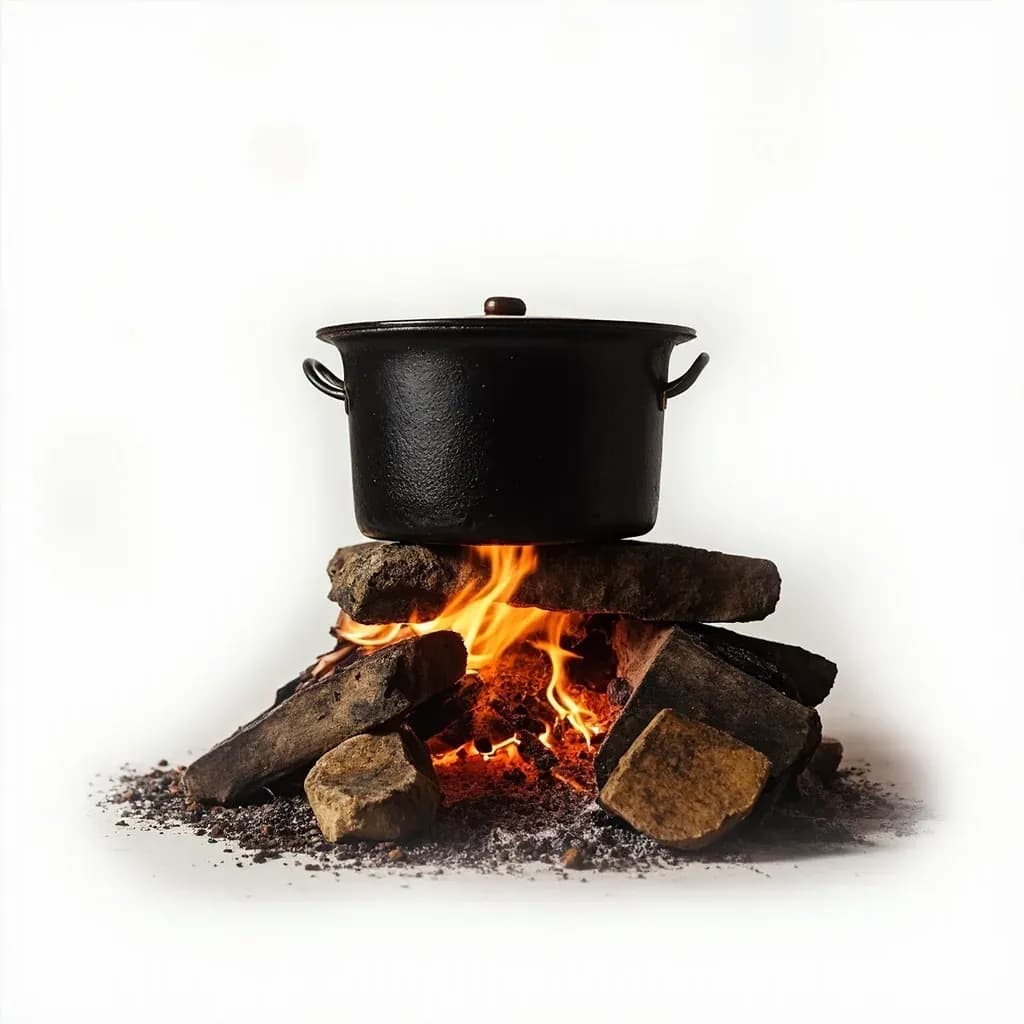
Open wood fire with three stones arranged to support a pot above the flames.
A three-stone fire is the most basic cooking hearth, three stones or bricks placed to cradle a pot or pan over a wood fire built between them. Used for millennia and still common in rural kitchens, it cooks stews, flatbreads and boils water using only firewood. It is simple and free to build but smoky and fuel-hungry compared with enclosed stoves.
The three-stone fire is the most elemental cookstove ever devised: three rocks of roughly equal height set in a triangle around a small wood fire, with a pot straddled across their tops. The geometry is so simple that the pot's own weight pins it in place while flames lick up around the base, transferring heat through direct contact and rising hot gases. There is no grate, no enclosure, no thermostat, and no moving parts — in minutes, three stones and a handful of dry sticks can deliver a rolling boil or a gentle simmer.
What makes the configuration enduring is its universality. It remains the default cooking setup across rural Africa, much of South and Southeast Asia, Indigenous communities in the Americas, and anywhere that a manufactured stove is unaffordable, unavailable, or simply unnecessary. Anthropologists treat it as the direct ancestor of every later hearth, from the banked kitchen fireplace to the enclosed wood range to the modern gas burner, all of which preserve the same principle: suspend a vessel above a controlled fire and capture the heat. Understanding the three-stone fire is, in effect, understanding the logic of every stove you have ever used.
Its limitations are equally clear. The open fire produces heavy smoke and burns fuel inefficiently, heat is uneven and hard to modulate, and the lack of a wind shield lets a steady breeze cool the pot or scatter embers. None of that has stopped it from feeding an estimated two to three billion people, or from remaining the first rig taught in nearly every bushcraft school.
Alternatives
Types & varieties
Three stones of roughly equal height set around a small wood fire; supports one pot and is the standard configuration worldwide.
Four or more stones used for wider, oblong, or heavy cauldrons, distributing weight and stabilizing vessels with broad or irregular bases.
Stones set around or above a shallow dug pit; the pit improves airflow, concentrates heat, and shields the fire from wind.
Built on a stone or packed-earth platform to raise the working height, useful for seated cooks or for keeping children away from the flames.
Two green forked sticks driven into the ground with a crossbar between them, used in regions where suitable stones are scarce; functionally similar to the stone version.
Choosing and placing the stones
The stones are the only equipment, and choosing them poorly is the single most common cause of a failed three-stone fire. The right stone is dry, dense, and uncracked — granite and basalt are ideal because they hold heat without absorbing moisture. River-worn stones are tempting but dangerous: any trapped water flashes to steam inside the rock and can shatter it violently, throwing shrapnel into the pot and into the cook. Field stones that crumble, flake, or feel unusually light should be set aside. Painted, glazed, or concrete stones are equally unsuitable, since their binders and coatings can release toxic fumes at cooking temperatures, and concrete can spall as trapped moisture expands.
When placing the stones, aim for a triangle just wider than the pot's base, with each stone's tallest face angled slightly inward so it cradles the pot rather than letting it roll. Flat-topped stones give the steadiest platform; rounded tops are fine for a kettle but will rock a frying pan. If the available stones are too short, stack two or set a flat rock as a trivet between the pot and the stones to raise the working height and even out an irregular base. A pot with a rounded or narrow foot should always sit on a trivet or flat stone to prevent tipping.
Building and tending the fire
The fire behaves like any small open wood fire, and the cook's job is to manage airflow, fuel size, and the bed of coals rather than chase a flame. Start with a small tipi of pencil-width tinder in the center of the triangle, light it, and feed progressively larger sticks from the sides. Once a bed of glowing embers has formed — usually five to ten minutes in — set the pot in place. Cooking over coals rather than active flames gives steadier, more even heat and is far easier to simmer on.
Heat is controlled by three levers: the size of the fire, the height of the pot on the stones, and the placement of the fuel. A tall fire with small sticks crammed into the center delivers fast, fierce heat for boiling; spreading the coals out or raising the pot onto taller stones drops the temperature for a simmer. A piece of metal sheeting or a flat stone set as a windbreak on the leeward side dramatically improves performance in breezy conditions and is the single easiest upgrade to the basic design.
From three stones to a modern stove
Every enclosed cookstove descends from this configuration. The first leap was simply building a wall of stones around the fire to shield it from wind and reflect heat back onto the pot — the open hearth. Adding a chimney to draw smoke upward produced the fireplace and the wood-burning range. Containing the fire in a small iron box with a grate and a damper gave the cast-iron cookstove, and from there the step to gas burners and electric coils is largely a matter of fuel. Understanding the three-stone fire, in other words, is understanding the logic of the kitchen range in its most unmediated form.
Common uses
Tips & pitfalls
- Never use river or field stones that may contain moisture — trapped water can flash to steam and explode the rock. Choose dry, dense igneous stone such as granite or basalt, or purpose-made fire stones.
- Avoid painted, glazed, or concrete stones; their binders and coatings can release toxic fumes at cooking temperatures, and concrete can spall as its trapped moisture expands.
- Use seasoned hardwood — oak, hickory, maple — for clean, sustained heat. Softwoods and green wood smoke heavily and deposit creosote on the pot and the food.
- Wait for the fire to burn down to a bed of glowing coals before placing the pot. Coals give steadier, more even heat than flames and are far easier to simmer on.
- For higher heat, feed small sticks into the center of the fire; for lower heat, push the coals outward, raise the pot onto taller stones, or set a flat rock as a trivet to drop the temperature at the vessel base.
- Build the fire between the stones, not directly under the pot, to keep the pot's base from blackening with soot and to extend its life.
- In windy conditions, set a flat stone or a piece of sheet metal on the leeward side as a windbreak — the single most effective upgrade to the basic three-stone fire.
- Wet green leaves or a metal lid placed over the pot acts as a damper to slow boiling when you need a gentler simmer.
- In wet conditions, build a feather-stick fire or use fatwood to get the three-stone fire lit reliably.
- Always clear a wide ring of ground around the fire, keep water or sand within reach, and never leave an open flame unattended.
Good to know
- Type
- Open-hearth cookfire / primitive outdoor stove
- Heat source
- Wood fuel, typically seasoned hardwood
- Structure
- Three stones arranged in a triangle to suspend a pot above the flames
- Origin
- Prehistoric; one of humanity's oldest cooking technologies, found in virtually every early culture
- Still in use
- Yes — common in rural Africa, South Asia, Southeast Asia, Indigenous Americas, and in camping and survival contexts worldwide
- Pot height above flame
- Roughly 10–20 cm (4–8 in); adjustable by stone size
- Heat control
- Adjusted by fire size, log placement, and pot height — no thermostatic regulation
- Vessel compatibility
- Any pot, kettle, or pan with a flat or slightly curved base
- Setup time
- 5–15 minutes from cold start to stable cooking heat
- Cooking methods
- Boiling, stewing, simmering, frying, roasting on a grate
- Stone requirements
- Dry, dense, non-porous, uncracked; flat tops improve stability
Also called
Three-Stone Wood Fire · wood fire · open wood fire · three-stone hearth
Related

Stovetop
The everyday burners where most cooking actually happens

Oven
Enclosed dry heat for roasting, baking, and braising

Grill
Live-fire or gas grates for char, smoke, and high heat

Smoker
Low, slow heat and wood smoke for barbecue and brisket

Air Fryer
Countertop convection that crisps with little or no oil

Slow Cooker
Set-and-forget low heat for stews, beans, and braises

Pressure Cooker
Sealed steam pressure that cooks tough food in a fraction of the time

Rice Cooker
Foolproof, perfectly steamed rice every single time