Appliances & Heat
Conveyor Toaster
A commercial toaster that carries bread through a heated chamber on a moving belt for nonstop output.
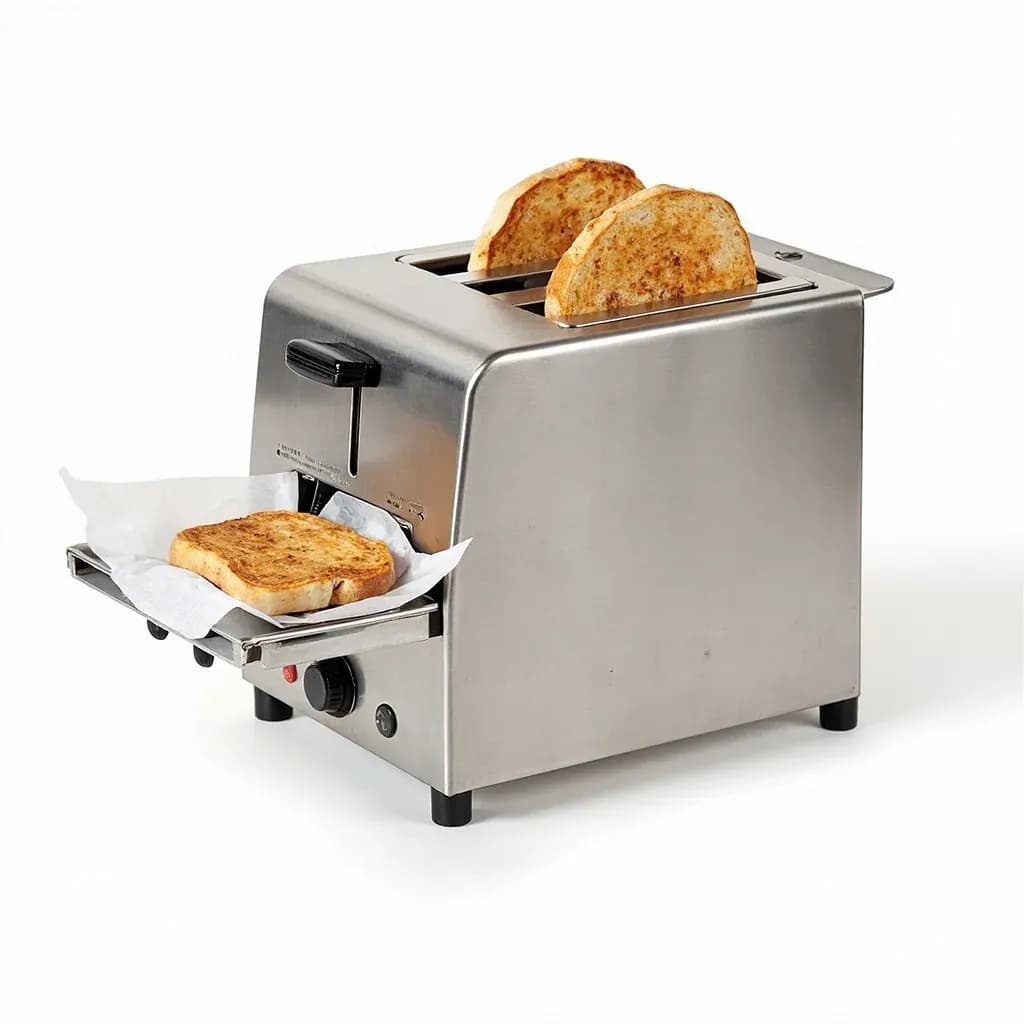
A conveyor toaster feeds bread, buns, or bagels onto a moving belt that carries them past radiant heating elements and out a chute. It toasts a steady stream of items at a consistent color, making it standard in hotels, diners, and high-volume breakfast service. Speed and darkness are adjusted by belt speed and element power rather than a pop-up timer.
A conveyor toaster is a commercial workhorse built around a simple idea: a motor-driven belt carries slices through a tunnel of infrared or quartz elements, and the cook's only job is to feed one end and catch the other. The heating elements are mounted above and below the belt, almost always on independent controls, so you can dial the top and bottom heat to suit anything from a soft sandwich loaf to a thick-cut bagel. The result is consistent, repeatable color across hundreds of slices an hour, with no operator standing over a pop-up lever.
What makes the machine worth its counter space is workflow. In a hotel breakfast line, cafeteria, or quick-service sandwich shop, a conveyor toaster turns toast from a bottleneck into background activity — one staffer can plate eggs or build sandwiches while bread emerges at a predictable pace. The catch is that the machine is tuned for steady demand, not one-off pieces: cold-start runs come out patchy, frozen product can stall the belt, and a stray piece of foil can jam the works. Treated as a steady-throughput appliance rather than a glorified home toaster, it is unmatched for breakfast and sandwich service.
Alternatives
Types & varieties
The most common form; product moves horizontally through the heating chamber and is found in nearly every commercial foodservice setting.
Compact footprint with the belt running upward; built for cramped counters and low-volume cafés where horizontal clearance is limited.
Wider belt (often 18–22 in.) to handle sliced hamburger, hoagie, and club buns without overhang; usually runs reduced top heat so the crown does not burn before the heel is done.
Open on both ends so product can be loaded from the kitchen side and retrieved on the service side; often built into a wall or hood line for hotels, hospitals, and cafeterias.
Larger motors, longer tunnels, and higher wattage for institutions producing 1,000+ slices per hour.
Smaller 120 V plug-in units for coffee shops, delis, and small kitchens; typically 200–600 slices per hour.
Belt speed controls darkness
The single most important operating concept is that on a conveyor toaster, belt speed — not temperature — is the primary control for color. A slower pass means more time under the elements and a deeper, more even browning; a faster pass yields a lighter toast. Reserve the temperature controls for genuine product differences: knock the top element down (or engage a bagel mode, if the unit has one) when running bagels or buns so the cut face toasts while the crust warms rather than scorches. Push both elements up for very dense, very wet, or frozen product that needs extra heat to drive off moisture before it can brown. New operators who chase darkness by cranking temperature almost always end up with scorched exteriors and underdone interiors.
Sizing and electrical planning
The right model for a given kitchen comes down to three numbers: slices per hour needed at peak, belt width large enough for the product, and the electrical service available. A 10-inch belt will not take an 18-inch hoagie roll, and a 120 V plug-in unit will not run a 1,500-slice-per-hour hotel breakfast line. Plan the electrical side ahead of purchase — moving from a light-duty 120 V unit to a production model usually means a dedicated 208 or 240 V circuit, sometimes three-phase, plus a hood or the manufacturer-specified clearances for heat and moisture. In low-volume settings where a conveyor toaster is overkill, a pop-up toaster, salamander, or flat-top griddle can fill in, but none match the labor-free consistency of a conveyor across a full breakfast rush.
- Match belt width to your largest standard product (sliced bun, Texas toast, hoagie roll) with an inch to spare on each side.
- Confirm available electrical service before buying: 120 V caps you near 600 slices/hour; 208/240 V opens up the high-volume range.
- If the unit will sit on a service line, consider a pass-through model so the kitchen side loads and the service side retrieves.
Common uses
Tips & pitfalls
- Preheat the unit for 10–15 minutes before service so the chamber and belt are fully up to temperature; cold-start toast comes out uneven.
- Adjust darkness with the belt-speed dial, not the temperature control, when moving between light rye and dense bagels.
- For bagels, lower the top-element setting or engage the bagel/bottom-only mode (if equipped) so the cut face toasts while the crust warms rather than burns.
- Brush the belt periodically with a food-safe silicone or PTFE release spray to keep cheese- and butter-laden products from sticking and gumming up the wire.
- Empty the crumb tray at the end of every shift — accumulated crumbs are the leading cause of conveyor-toaster fires.
- Do not run frozen product through on settings dialed in for ambient bread; it will steam, can stall the belt, and emerge pale and damp. Thaw first, or use the model's frozen-product setting if it has one.
- Never insert foil, metal skewers, or non-approved utensils; they can catch in the belt, damage elements, or short the controls.
- Check belt tracking monthly; a drifting belt wears one edge of the chamber and produces unevenly toasted rows.
Good to know
- Type
- Commercial continuous-feed electric toaster with a motor-driven belt moving product through a heated tunnel
- Heat source
- Infrared or quartz heating elements above and below the belt, with independent top/bottom controls on most units
- Typical capacity
- Roughly 200 to 2,000+ slices per hour, depending on model and bread type
- Common belt widths
- About 10, 14, 18, and 22 inches; pass-through models run 22 inches or wider
- Toast time per pass
- Roughly 15 to 30 seconds, controlled by belt speed rather than temperature
- Power
- 120 V for light-duty countertop units; 208 V or 240 V (single- or three-phase) for high-volume and pass-through models
- Originating company
- Hatco Corporation, which introduced the Toast-Qwik horizontal conveyor toaster in 1953 in Milwaukee, Wisconsin
- Standard placement
- Countertop, or wall-mounted pass-through between kitchen and service line; must be installed under a ventilation hood
Also called
commercial conveyor toaster · belt toaster
Related

Stovetop
The everyday burners where most cooking actually happens

Oven
Enclosed dry heat for roasting, baking, and braising

Grill
Live-fire or gas grates for char, smoke, and high heat

Smoker
Low, slow heat and wood smoke for barbecue and brisket

Air Fryer
Countertop convection that crisps with little or no oil

Slow Cooker
Set-and-forget low heat for stews, beans, and braises

Pressure Cooker
Sealed steam pressure that cooks tough food in a fraction of the time

Rice Cooker
Foolproof, perfectly steamed rice every single time