Appliances & Heat
Automatic Tortilla Machine (Tortilladora)
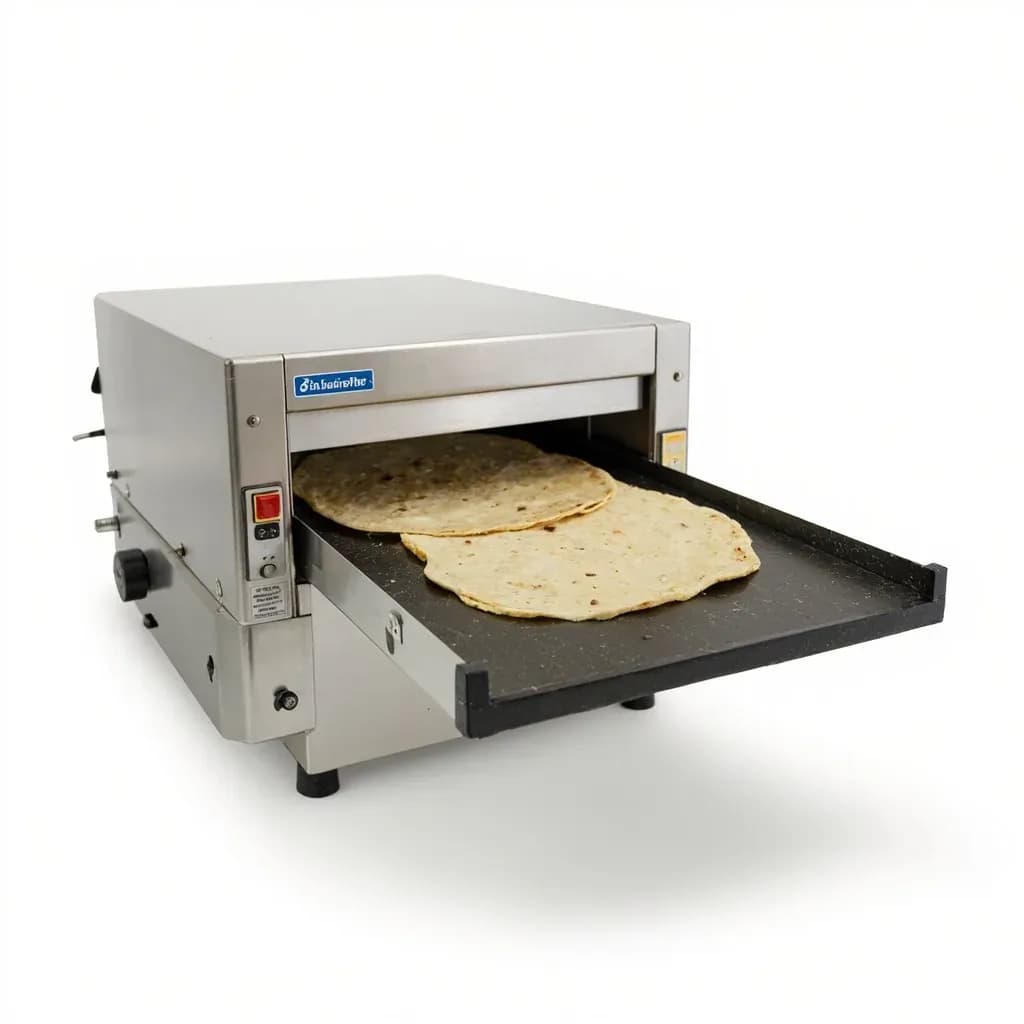
Powered press-and-griddle machine that flattens masa balls and cooks them into tortillas in a continuous run.
An automatic tortilladora is a motorized machine that takes balls or sheets of masa, presses them flat and conveys them across a heated griddle to bake both sides into finished tortillas. It is used in tortillerías, taquerías and high-volume kitchens to produce hundreds of uniform tortillas per hour. Industrial models can be tied to a masa hopper so dough is portioned, formed and cooked in one continuous line.
An automatic tortilla machine — tortilladora automática in Spanish — is the mechanical heart of any kitchen that needs fresh tortillas faster than a cook can press them by hand. Most modern machines follow one logic: a hopper feeds masa through a pair of rollers (or, on smaller semi-automatic models, into a heated press), a circular die cuts disks of fixed diameter, and a wire-mesh belt carries those disks through a tunnel-shaped griddle where both faces cook at once. Output ranges from a few hundred tortillas an hour on a countertop unit to more than ten thousand on an industrial line, and a single machine replaces two or three workers while producing a uniformity that hand-pressing cannot match.
The cooking is where the science lives. A corn tortilla puffs when steam from rapidly gelatinizing starch expands inside the disk before the surface sets — and that requires the masa to hit a surface near 180–200 °C almost on contact, with enough moisture still inside to vaporize. Machine griddles are designed for that thermal shock: thick steel or cast aluminum holds steady heat, belt dwell time is adjustable, and the roller gap sets thickness tightly enough (1.5–2.5 mm is typical) that puffing is reliable rather than hit-or-miss. Flour tortillas behave differently because wheat dough sets through a combination of starch gelatinization and protein coagulation rather than the dramatic steam expansion of corn, so flour lines run cooler (around 150–170 °C) and slower, and most add a brief toasting pass at the exit to produce the spotted, flexible sheet a burrito needs.
A machine tortilla is not, however, a hand-cooked tortilla. The continuous belt cooks evenly but rarely develops the deep, irregular spotting — la mancha — of a comal; kitchens chasing that look usually pass machine tortillas briefly over an open flame just before service. Tuning is real work too: rollers, die, belt tension, gas pressure, and the pre-heat routine all demand attention, and a small drift in any of them shows up in the first dozen tortillas off the line. Treated as equipment that needs daily cleaning and weekly calibration, a tortilladora is one of the most labor-replacing tools a Mexican-influenced kitchen can buy.
Alternatives
Types & varieties
Operator places a masa ball into a heated press that closes, cooks, and ejects one tortilla at a time. Ideal for low-volume kitchens and small taquerias.
The standard commercial design. A hopper feeds masa through rollers, a die cuts disks, and a mesh belt carries them through a tunnel griddle; 1,000–4,000 per hour.
Multi-stage system with cooling conveyor, stacker/counter, and packaging, used by large bakeries and corn-flour processors; 6,000+ per hour.
Open-flame or radiant gas burners under a thick steel comal; produces the traditional spotting and light char (mancha) preferred across much of central Mexico.
Electrically heated top and bottom plates around the belt; more temperature-stable and easier to install where gas service is restricted.
Larger dies and wider belts, usually with a toaster/burner section at the exit to add the characteristic brown spots on flour tortillas.
Same press-and-cook principle but with a thinner die and higher belt speed; produces crispy tortilla strips or rounds for chips and tostadas.
Heat, speed, and the puff
The relationship between belt speed and griddle temperature is the single most important variable on any tortilla machine. A corn tortilla needs the surface to reach starch-gelatinization temperature quickly enough that steam is trapped inside before the moisture can drive off. Run the belt too slow at a given heat and the tortilla dries out before it puffs, coming off flat and crisp-edged. Run it too fast and the interior stays gummy while the surface looks done. Most operators tune belt speed first, then nudge gas pressure or heater output to bring puffing back into the run.
The puffs themselves — those brief ballooned pockets that inflate on the belt and collapse on the cooling conveyor — are not decorative. They are evidence that the masa was correctly hydrated, the nixtamal was fresh, and the cooking surface delivered enough heat fast enough. A line producing flat tortillas all morning is almost always running too cool or too fast, not too hot. Flour lines deliberately avoid the puff; wheat dough sets through starch and protein coagulation rather than steam expansion, and a too-hot flour line dries the surface before the inside cooks through.
Daily and weekly care
The belt is the most failure-prone component on any continuous tortilladora. Dried masa on the wire mesh insulates the tortilla from the heat below and tears the sheet on the next pass; a daily scrub with a stiff brush and a food-safe alkaline detergent is non-negotiable. The cutting die and rollers want the same treatment, plus a weekly check of the roller gap with a calibrated thickness gauge — steel wears, and any drift in the gap changes the puff and the way the tortilla handles downstream.
Gas-fired machines need their burners inspected monthly for soot and proper flame pattern; an uneven flame shows up immediately as uneven browning across the width of the belt. Electric models are easier on ventilation but harder on the heating element, which scorches if spilled masa is left on it. Whichever the fuel, sanitize the hopper, rollers, and belt at the end of every shift: masa residue harbors bacteria quickly in the warm belt zone, and what smells slightly sour at closing time will smell actively off by the next pre-heat.
Common uses
Tips & pitfalls
- Hydrate the masa to the feel of soft Play-Doh — too dry and tortillas crack at the edges, too wet and they stick to the belt.
- Pre-heat the griddle section for at least 15–20 minutes before the first tortilla; uneven pre-heat causes pale centers or burned rims on the opening run.
- Adjust belt speed before temperature: too slow gives dry, crispy tortillas, too fast leaves a gummy undercooked interior.
- Keep the cutting die and rollers clean of dried masa — buildup creates rough, torn edges and tears the sheet on the next pass.
- For corn tortillas, mix a small percentage of fresh nixtamal masa into masa harina; the nixtamal proteins expand more reliably and produce a better puff.
- Watch the first dozen tortillas off the line — small thickness or temperature tweaks are easy then and impossible once the run is in full swing.
- Use a calibrated thickness gauge on the rollers weekly; wear changes the gap over time and silently ruins tortilla quality.
- For flour tortillas, let the formed sheet rest on the belt a few seconds before it enters the hot zone — this relaxes the gluten and reduces shrinkage.
- Sanitize the conveyor belt, hopper, and rollers at the end of every shift — masa residue harbors bacteria quickly in the warm belt zone.
- Gas-fired machines need proper ventilation; route combustion gases outside, not into the kitchen.
Good to know
- Origin
- Mexico, where corn tortillas are a daily staple; automated machines proliferated in the mid-20th century alongside urban demand.
- Core mechanism
- Masa is fed through rollers (or a press), a die cuts disks to a fixed size, and a mesh belt carries them through a heated griddle or tunnel oven.
- Heat source
- Gas (natural gas or LP) is most common for the cooking section; electric elements are used on smaller countertop units and where gas service is limited.
- Capacity range
- Countertop semi-automatic: ~600–1,500/hour; mid-range commercial: 2,000–4,000/hour; industrial lines: 6,000–12,000+/hour.
- Tortilla diameter
- Dies cut 10–25 cm (4–10 in); standard table tortilla ~12–13 cm, taco size ~14–15 cm, burrito/flour up to 25–30 cm.
- Thickness control
- Set by roller gap or press pressure; a standard corn tortilla is pressed to 1.5–2.5 mm.
- Pre-heat time
- 15–30 minutes to bring the cooking surface to its working range of roughly 180–200 °C (355–390 °F) for corn.
- First patent
- Louis E. Rook, 1902, for a hand-operated tortilla press; continuous automated machines followed several decades later in Mexico.
- Notable manufacturers
- Casa Herrera, Tortilla Depot, Rodriguez, and several Mexican OEMs serving both domestic and export markets.
Also called
Tortilladora · Tortilla Maker
Related

Stovetop
The everyday burners where most cooking actually happens

Oven
Enclosed dry heat for roasting, baking, and braising

Grill
Live-fire or gas grates for char, smoke, and high heat

Smoker
Low, slow heat and wood smoke for barbecue and brisket

Air Fryer
Countertop convection that crisps with little or no oil

Slow Cooker
Set-and-forget low heat for stews, beans, and braises

Pressure Cooker
Sealed steam pressure that cooks tough food in a fraction of the time

Rice Cooker
Foolproof, perfectly steamed rice every single time