Appliances & Heat
Transfer Pump
A sanitary food-grade pump that moves liquids between tanks faster and gentler than gravity siphoning.
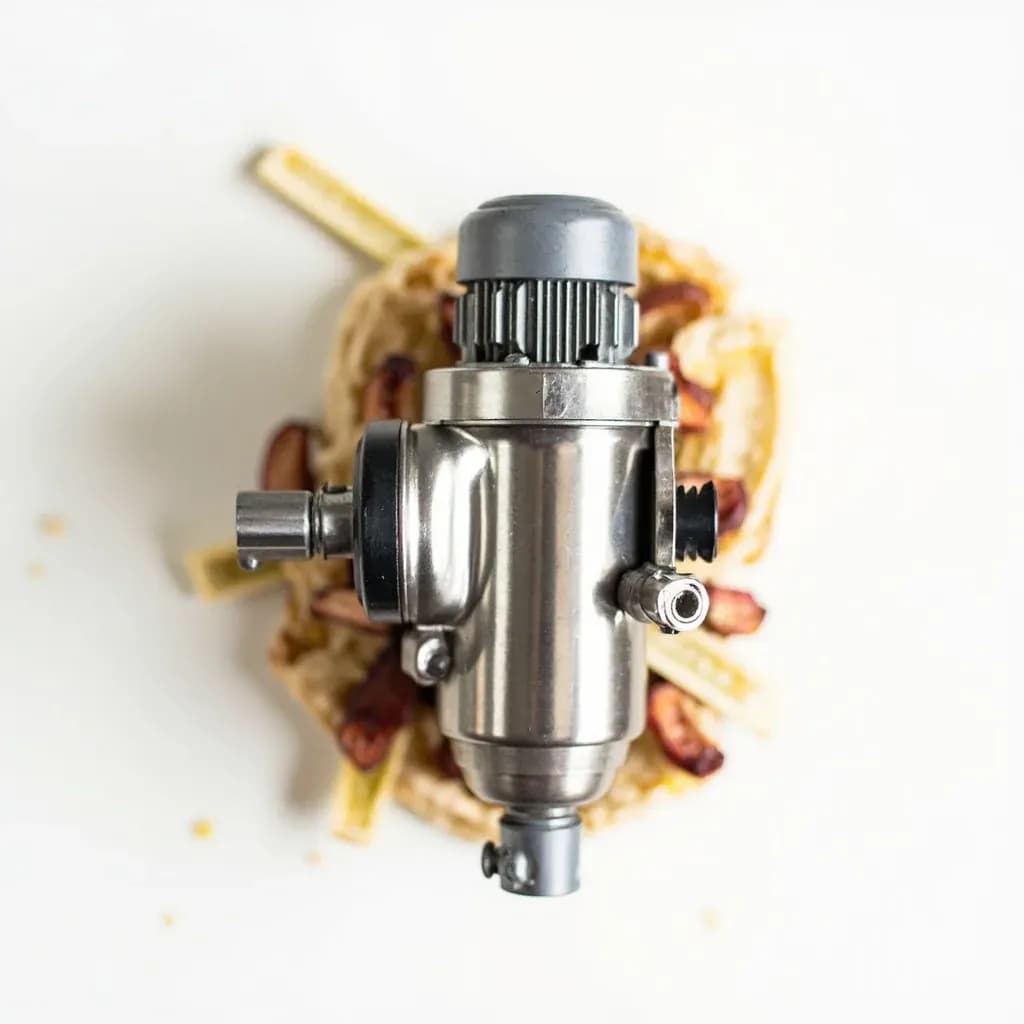
A transfer pump is a motorized sanitary pump that moves liquids such as wort, wine, or syrup between vessels without relying on gravity. It speeds racking and lets producers move liquid uphill or over distance while keeping the path closed and clean. Variable-speed and self-priming models give gentle control to avoid aerating or disturbing sediment.
A transfer pump is a sanitary, food-grade pump built to move liquids between containers — carboys, fermenters, drums, kettles, bottling tanks — under controlled conditions. Where a home cook or small producer would otherwise rely on a gravity siphon or careful pouring, a transfer pump pushes liquid under positive pressure: faster throughput, fewer air pockets, and far less splashing and oxidation. In winemaking, brewing, cider-making, kombucha, and olive-oil bottling, where oxygen exposure can bleach color, flatten aroma, or turn fruit to vinegar, that controlled, low-shear transfer is the pump's main virtue. Its second is labor — a modest electric pump can move a full carboy in a few minutes without anyone hoisting a 50-pound glass vessel up onto a counter.
Mechanically, the pump is a piece of adapted sanitary plumbing. Wetted parts are almost always 304 or 316 stainless steel with food-grade EPDM, Viton, or silicone seals, and housings are polypropylene or coated aluminum rated for direct food contact. Most units marketed to small producers are self-priming, meaning they can pull liquid upward a meter or more to start flow, and they connect to standard tri-clamp (sanitary) or barb fittings so cleaning and reconfiguration are simple. Drive styles vary widely: a hand-crank rotary pump is cheap and silent, a centrifugal electric pump moves volume fast, a peristaltic pump is gentle and ultra-sanitary, and a diaphragm pump tolerates particulates and dry running.
A pump is overkill for the occasional kitchen task — pouring or a basic auto-siphon does the work — but once volumes climb past a few gallons, or the liquid is oxygen-sensitive, foamy, or valuable, it earns its place. Commercial dairies, wineries, breweries, and oil producers scale the same principle up to CIP-capable sanitary pumps built to 3-A or EHEDG hygienic standards. Home and prosumer makers most often meet it through vacuum-fill electric pumps — typified by the Italian Enolmatic — that both transfer and bottle-fill from a carboy in one pass without oxidizing the wine or beer.
Alternatives
Types & varieties
Hand-crank paddle or vane pump fitted to a barrel or pail; classic for racking wine off sediment; slow but precise, inexpensive, and needs no power.
Small hand-operated piston pump for olive oil, syrup, or topping up bottles; not suited to large volumes.
Italian self-priming electric pump that both transfers and bottle-fills under a slight vacuum, reducing oxidation and foaming; the de facto home winemaker's reference unit.
Electric impeller pump with a sanitary head; high flow, ideal for moving large volumes of low-viscosity liquid quickly; struggles with thick or particulate-laden liquids.
Positive-displacement, gentle on solids, can run dry without damage; popular in brewing for moving yeast slurry or hop matter.
Rotor compresses food-grade tubing so only the tubing touches the liquid; extremely sanitary and gentle, common in small commercial and laboratory food settings.
Long-shaft pump (manual or electric) for 15–55 gallon drums; typical for bulk olive oil, syrups, and concentrates.
Sealless design with the motor magnetically coupled to the impeller; eliminates shaft seals and reduces leak and contamination risk.
Choosing a drive type
Match the pump to the liquid and the job, not the other way around. A home winemaker racking a carboy twice a year has very different needs from a brewery moving bright beer every week, and the wrong pump shears yeast, oxidizes wine, or clogs on the first run.
- Manual rotary: pick this for occasional, low-volume transfers where you don't want to clean an electric head or run power to the bench.
- Self-priming electric centrifugal (Enolmatic class): the all-purpose home choice — fast, gentle, and doubles as a bottle filler for wine, cider, oil, and kombucha.
- Diaphragm: choose when the liquid carries pulp, yeast, hops, or other fragile particulates you don't want to shear, or when dry-running is likely.
- Peristaltic: the most sanitary option since only the tubing touches the product; favored for laboratory, pharmaceutical, and small commercial food lines.
- Magnetic-drive centrifugal: worth the cost in commercial settings where seal leaks are unacceptable — dairy, edible oil, distilled spirits.
Sanitation and storage
A pump is one of the most common sources of cross-contamination on a small production line because residue hides in dead spaces around seals, vanes, and impeller housings. Treat it with the same rigor you give fermenters and bottling equipment.
- Disassemble the head after every use and inspect seals and vanes for wear or residue; small parts drop into the product stream unnoticed.
- Sanitize with the same no-rinse sanitizer (Star San, peracetic acid) used on the rest of the line; do not rely on a quick water flush.
- Run a final flush of clean water — or appropriate solvent for oils — through the pump before storage so sugars, salts, and acids don't sit on metal parts and pit them.
- Store dry, with seals loosened or removed to keep them from taking a compression set.
Common uses
Tips & pitfalls
- Sanitize the pump head, seals, and tubing with the same no-rinse sanitizer (e.g., Star San) you use elsewhere on the line; pumps trap residue in dead spaces and are a common source of cross-contamination.
- Prime the pump before starting flow. Running a dry centrifugal pump for long damages the seal and overheats the motor.
- Keep the suction line as short and straight as possible, and slope it gently upward toward the pump so air pockets don't break prime.
- Anchor the receiving vessel. A 1 GPM pump fills a 5-gallon bucket in under five minutes, and a jumping bucket sloshes and oxidizes the liquid.
- Position the pump outlet below the liquid level in the receiving vessel — or use a bottling wand — to prevent splashing and oxygen pickup.
- Match seal material to the liquid: EPDM for water-based liquids and many acids; Viton for oils, alcohols, and solvents; silicone for high-temperature work.
- Don't exceed the pump's rated temperature. Hot wort, syrup, or oil softens EPDM and warps plastic housings.
- For wine and beer, purge lines with CO₂ or argon before transfer to blanket the liquid and limit oxidation.
Good to know
- Purpose
- Sanitary, food-grade pump that moves liquids between tanks, barrels, carboys, or pails faster and with less oxidation than gravity siphoning.
- Typical liquids
- Wine, beer, cider, mead, kombucha, olive oil, syrups, brines, sauces, purées, and finished stocks.
- Construction
- Wetted parts usually 304 or 316 stainless steel; seals typically EPDM, Viton, or food-grade silicone; housings often polypropylene or coated aluminum.
- Drive types
- Manual hand-crank rotary, lever/piston, or electric (centrifugal, diaphragm, or peristaltic).
- Flow rate (home scale)
- Manual rotary pumps around 100–250 L/h; small electric sanitary pumps roughly 1–5 GPM (230–1,100 L/h).
- Self-priming
- Most food-marketed units are self-priming; positive-displacement designs (diaphragm, peristaltic) prime best after a dry start.
- Fittings
- Usually tri-clamp (sanitary) or barb fittings accepting 1/2", 3/4", or 1" ID food-grade tubing.
- Max temperature
- Generally rated to 60–80 °C (140–175 °F); above this, EPDM and silicone seals soften and plastic housings can warp.
- Power (electric home)
- Common 12 V DC or 110/120 V AC; benchtop models draw roughly 50–200 W.
- Sanitation
- Cleaned the same way as other food-contact equipment: CIP with PBW, B-Brite, or caustic, followed by a no-rinse sanitizer such as Star San or peracetic acid.
Also called
Wort Pump · Wine Transfer Pump · Sanitary Food-Grade Pump · racking pump
Related

Stovetop
The everyday burners where most cooking actually happens

Oven
Enclosed dry heat for roasting, baking, and braising

Grill
Live-fire or gas grates for char, smoke, and high heat

Smoker
Low, slow heat and wood smoke for barbecue and brisket

Air Fryer
Countertop convection that crisps with little or no oil

Slow Cooker
Set-and-forget low heat for stews, beans, and braises

Pressure Cooker
Sealed steam pressure that cooks tough food in a fraction of the time

Rice Cooker
Foolproof, perfectly steamed rice every single time