Appliances & Heat
Vertical Trompo Spit (Al Pastor Rotisserie)
An upright rotating spit that roasts a stacked cone of marinated meat for al pastor and shawarma.
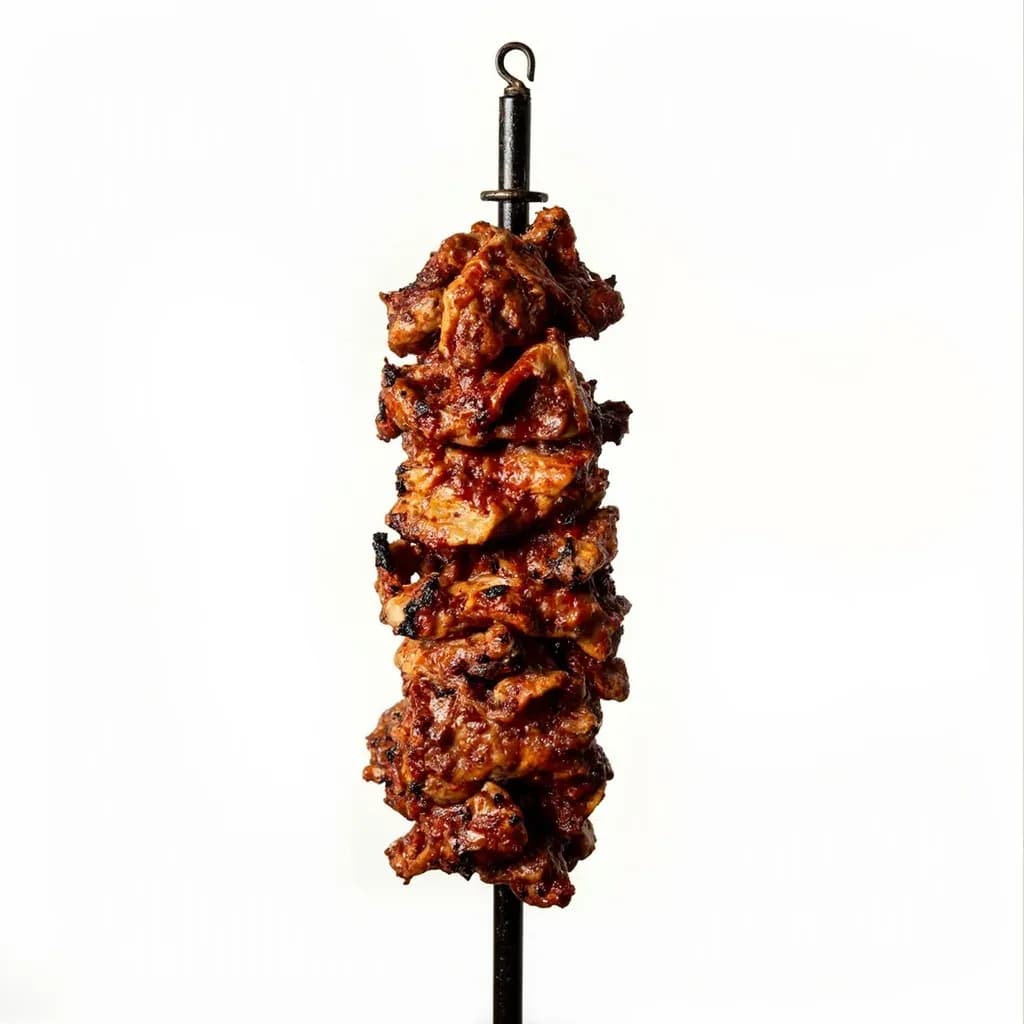
A vertical trompo spit is a standing rotisserie where seasoned meat is stacked into a tall cone and slowly turned beside a vertical heat source. As the outside roasts and chars, the cook shaves thin slices straight off the rotating cone for tacos al pastor, shawarma, and döner. The constant rotation self-bastes the stack and crisps only the exposed surface, keeping the interior juicy.
The vertical trompo is an upright rotating spit that roasts a tightly stacked cone of marinated meat against a side-mounted heat source. As the spit turns at roughly one revolution per minute, the outer surface dehydrates, Maillard-browns, and develops a crisp savory crust (the costra in Mexican kitchens) while the interior cooks gently by conduction. Because the hot face constantly rotates away from and back toward the burners, slices are shaved off in thin sheets and the cone keeps presenting a freshly seared surface to the knife.
Although the device is most familiar from Mexican taquerías serving tacos al pastor, it is fundamentally a single piece of equipment with many cultural names and slight regional differences: döner makinesi in Turkey, shawarma machine across the Levant, and gyro machine in Greece. The Mexican trompo descends from Lebanese immigrants who arrived in Puebla in the 1930s and adapted shawarma to local pork and chiles, replacing the pita and tahini with corn tortillas, pineapple, and salsa verde. A well-loaded commercial cone of 30 to 100 pounds can run for two to four hours, with the cook shaving on demand throughout service rather than finishing the cook once.
The genius of the trompo is the marriage of heat, geometry, and timing. Stacking thin slices tightly around a central rod forces rendered juices to migrate downward through the stack and self-baste the lower layers, while the rotating motion means a single burner set waist-high can brown the entire cone evenly. The cook's real job is shaping the stack, controlling the burners' height and intensity, and reading the crust as it forms.
Alternatives
Types & varieties
Most common in taquerías and shawarma shops; infrared or open-flame burners mounted beside the cone for adjustable heat
Traditional configuration favored in Turkey and some regional Mexican setups; imparts smoke and char
Compact unit with radiant electric elements; 5–15 lb capacity, suited to food trucks and home use
Larger diameter cone (60–80 cm) with 2–4 burners; standard in Turkey and German döner shops
Slimmer profile with single or double burner; common across the Levant and the Arab diaspora
Uses a compressed loaf of seasoned ground meat rather than stacked slices; different loading and carving technique
Mexican adaptation of pork shoulder layered with fresh pineapple chunks and onion between thin slices
Two cones on one frame, allowing two different meats or marinades to be served simultaneously
Anatomy of the spit
A vertical trompo has more functional parts than its simple silhouette suggests. The central rod is food-grade stainless steel, thick enough not to bow under the weight of a fully loaded cone. At the bottom sits a drip tray that catches rendered fat and juices, the foundation of consomé de trompo. The meat is held in place by a top cap and a sliding collar that the cook pushes down as the cone is consumed. Behind the cone, a burner box (or in charcoal models, a trough) provides radiant heat. The motor and gearbox sit above or behind the assembly, turning the rod through a chain or gear drive.
- Mounting plates anchor the rod to a sturdy base
- Sliding collar compresses the stack as meat is shaved
- Drip tray collects fat and juices for consomé or salsa
- Burner height is typically adjustable to shift the hot zone up or down the cone
Stacking and seasoning the cone
The cone's shape is not decorative. Tight stacking traps heat, channels fat downward, and produces a uniform cylinder that browns evenly on all sides. For al pastor, pork shoulder is sliced thin, marinated in achiote and chile, and layered with chunks of fresh pineapple and onion. For döner and shawarma, lean lamb or beef is traditionally interspersed with slabs of tail fat to keep the cone moist. Salt is held back until after carving because it draws moisture out of the stack and prevents proper adhesion.
- Slice thin enough to layer tightly and read like pages in a book
- Marinate 12–24 hours for full achiote and chile penetration
- Press the stack firmly against the rod to eliminate air pockets
- Set a pineapple crown on top so its juice runs down the cone as it cooks
Common uses
Tips & pitfalls
- Use pork shoulder (Boston butt) for al pastor — its intramuscular fat renders into the crust and keeps shaved slices juicy
- Marinate stacked layers 12–24 hours; achiote and pineapple juice both tenderize and color the meat
- Layer thin slices with chunks of fresh pineapple and white onion between them for classic al pastor
- Stack the meat tightly around the spit so it holds its cone shape — loose stacks collapse and cook unevenly
- Allow at least 30–60 minutes of rotation before the first shave so a proper outer crust (the costra) forms
- Shave thin slices from top to bottom using long smooth strokes; a dull knife tears the meat instead of slicing cleanly
- Keep the drip tray in place — collected juices are the base for consomé or salsa
- Trim large external fat caps before stacking to prevent heavy flare-ups and bitter drippings
- Avoid salting the meat before stacking; salt draws moisture and prevents adhesion — season the crust after shaving
- Position burners at the middle and lower portion of the cone to balance browning and avoid burning the top
- For döner and shawarma, mix lamb tail fat into lean stacks because pure lean meat dries out on the spit
- Never stop rotation for long during service — the outer crust thickens unevenly and slices become tough
- Clean the spit, drip tray, and burner shields daily; carbonized fat buildup creates off-flavors and is a fire hazard
- Char the pineapple crown lightly after slicing to caramelize its sugars before serving with the meat
Good to know
- Common names
- Trompo (Mexico), döner makinesi (Turkey), shawarma machine (Levant), gyro machine (Greece)
- Origin
- Ottoman-era vertical rotisserie adapted by Lebanese immigrants in Puebla, Mexico, in the 1930s to create al pastor
- Rotation speed
- Approximately 1 revolution per minute
- Surface temperature
- Outer crust reaches 450–600°F (230–315°C); interior cooks by conduction at lower temperatures
- Capacity
- Commercial cones hold 30–100 lb (14–45 kg); countertop home units hold 5–15 lb
- Heat sources
- Gas (propane or natural), charcoal, or electric radiant elements
- Construction
- Food-grade stainless steel rod with mounting plates, sliding collar, and drip tray
- Standard carving tool
- Long thin slicing knife or electric carving knife; slices shaved top-down in long smooth strokes
Also called
Vertical Rotisserie (Trompo/Shawarma Spit) · Vertical Rotisserie · Shawarma Spit · Trompo · Doner Spit
Related

Stovetop
The everyday burners where most cooking actually happens

Oven
Enclosed dry heat for roasting, baking, and braising

Grill
Live-fire or gas grates for char, smoke, and high heat

Smoker
Low, slow heat and wood smoke for barbecue and brisket

Air Fryer
Countertop convection that crisps with little or no oil

Slow Cooker
Set-and-forget low heat for stews, beans, and braises

Pressure Cooker
Sealed steam pressure that cooks tough food in a fraction of the time

Rice Cooker
Foolproof, perfectly steamed rice every single time