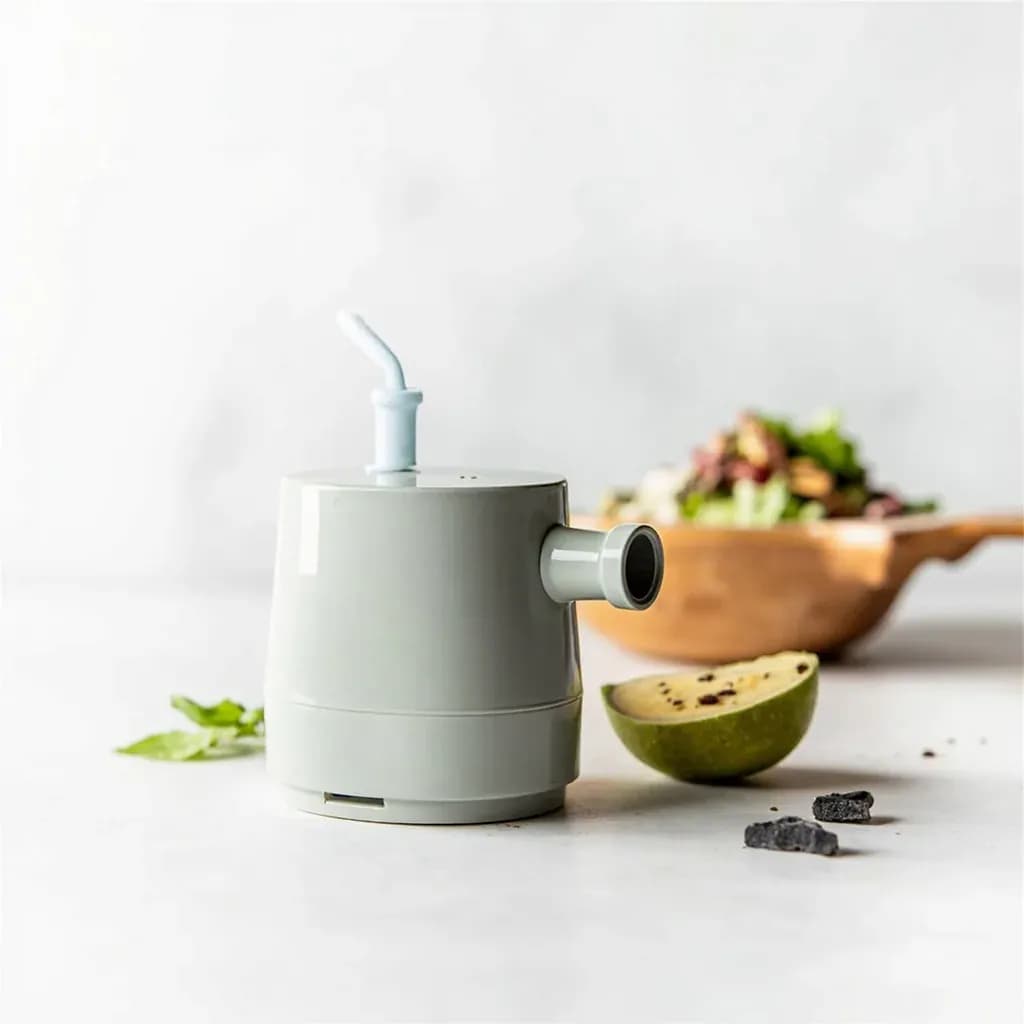
Appliances & Heat
Vacuum Pump
Pump that removes air to seal bags, degas liquids or create low-pressure cooking conditions.
A vacuum pump draws air out of a container or bag to create suction or reduced pressure. In the kitchen it powers vacuum sealers for sous vide and storage, degasses sauces and chocolate, and lowers boiling points for low-temperature reductions. Handheld and benchtop models serve everything from home meal-prep to modernist technique.
In a professional or serious home kitchen, "vacuum pump" almost never refers to a standalone appliance. It is the workhorse motor hidden inside a chamber vacuum sealer — the component that actually pulls air out of a sealed space, leaving the food pouch pressed tight against its contents. Understanding what kind of pump lives in your sealer, and what it can and cannot do, is the difference between reliably sealing a tray of marinated short ribs and watching liquid creep into the wrong side of the machine.
The key word is chamber. A chamber sealer drops the entire bag — open edge and all — into a lidded box, evacuates the air from that box, and then heat-seals the bag while it is still under low pressure. The pump never touches the food directly, which is why chamber units can handle liquids, raw marinated meats, purées, and powders that would instantly destroy an edge-style (FoodSaver-type) sealer, whose pump sucks straight from the bag. Most chamber sealers reach about 29 to 29.5 inches of mercury at sea level, roughly 99 percent of a true vacuum, which is more than enough for sous vide, compression, infusion, and degassing work.
Two pump technologies dominate culinary use. Diaphragm pumps are oil-free, quieter, lighter, and lower maintenance; rotary vane pumps, borrowed from printing and refrigeration servicing, pull a deeper vacuum faster but run on lubricating oil that must be changed regularly and run louder and heavier. Both entered restaurant kitchens in the late 1990s as sous vide moved out of research labs (Bruno Goussault, early elBulli, The Fat Duck) and into mainstream menus, and the choice between them is essentially a choice between convenience and cycle speed.
Alternatives
Types & varieties
Oil-free, lower maintenance, quieter (60–70 dB), reaches about 28–29 inHg; standard in home and light commercial chamber sealers.
Oil-lubricated, pulls deeper and faster vacuum (≈29.5 inHg), louder (75–85 dB) and heavier (50–80 lb with sealer); favored in professional kitchens running heavy, repeated cycles.
Oil-free piston mechanism used in some prosumer sealers; sits between diaphragm and rotary vane in price and performance.
Found in a few consumer chamber sealers; lower ultimate vacuum but adequate for everyday sealing and short compression work.
Built into edge-style sealers (FoodSaver-type units); not interchangeable with chamber units, cannot be used with liquids, and not what this entry covers.
How a chamber vacuum sealer actually pulls a vacuum
A chamber unit has a hinged lid and a rubber gasket that, when closed, create an airtight box around the bag and its open mouth. The pump then evacuates that whole box. Because the bag is open to the chamber, the air inside the pouch and the air outside it drop to the same pressure at the same time. Only after the target vacuum is reached does the heated seal bar fire, fusing the bag closed while everything is still under low pressure. The result is a uniform seal with no trapped bubbles and no liquid sucked up the seam. This is also why chamber bags do not need the embossed/textured face that edge-sealer bags require — the air leaves through the open mouth, not through channels in the film.
- Chamber, not bag, is what gets evacuated — the bag is open to the chamber the whole time.
- Seal bar fires only after the target pressure is reached, so the seal forms in a low-pressure environment.
- Chamber bags can be smooth on both sides; embossed edge-sealer bags are not required.
Choosing the right pump for your kitchen
Match the pump to the workload, not the spec sheet. A home cook sealing a few steaks a week is well served by a 0.5–1 HP diaphragm chamber sealer that costs under $600, weighs 15–25 lb, and runs quietly enough to live on the counter. A restaurant running continuous service — sealing stocks, portioned proteins, and marinades in volume — needs the faster cycle time and deeper vacuum of a 1.5–2 HP rotary vane unit, and should plan to locate it in a back-of-house spot where 75–85 dB of pump noise will not bother diners or line cooks. Weight, noise, and oil maintenance are as important as ultimate vacuum when deciding.
- Home, light duty: 0.5–1 HP diaphragm, oil-free, countertop, 12–16 in wide.
- Prosumer, mixed wet/dry work: 1–1.5 HP rotary vane or dry piston, expect oil changes.
- Pro, high volume: 1.5–3 HP rotary vane, plan for a dedicated, ventilated location.
- Plan oil changes and vane replacement into the operating cost, not just the purchase price.
Routine maintenance that prevents most failures
The most common chamber-sealer problems — slow cycles, weak seals, oil smoke, premature pump death — are almost always maintenance problems rather than pump problems. A few habits keep the workhorse running for years.
- Inspect the chamber gasket monthly and wipe it clean; a hardened or nicked gasket is the leading cause of poor vacuum.
- On rotary vane units, check oil level before each session and change oil every 25–50 hours of run time.
- After an oil change, run 3–5 empty cycles to flush old oil from the lines before sealing food.
- Stagger long runs: let a diaphragm pump rest 1–2 minutes between wet batches so it does not overheat.
- Listen to the pump — a rising pitch, longer cycle time, or visible oil vapor means service is overdue.
Common uses
Tips & pitfalls
- Match the pump to the sealer: chamber sealers are required for liquids, raw marinated meats, and powders; edge sealers with their inline pumps cannot handle these safely.
- Wipe the chamber gasket and inspect it monthly — a degraded gasket is the most common cause of weak vacuum and the reason pumps get overworked and burn out.
- On rotary vane units, check oil level before each session and run a few empty cycles after an oil change to flush the lines.
- Leave at least 1 in (2.5 cm) of headspace in the bag and lay the bag flat across the seal bar so air evacuates evenly from one end to the other.
- For liquid-heavy items, pre-freeze in the bag shape you want, then vacuum-seal frozen — this prevents boil-over and protects the pump from contamination.
- Do not attempt to vacuum-seal hot liquids above about 140 °F / 60 °C without chilling first; steam damages diaphragms and stretches seals.
- Stagger long vacuum runs and let a diaphragm pump rest 1–2 minutes between wet batches so it does not overheat and lose efficiency.
- Listen to the pump: a rising pitch, longer cycle time, or oil smoke are early signs that service is overdue.
Good to know
- Primary function
- Removes air from a sealed chamber (not directly from the bag) so a pouch can be heat-sealed under low pressure
- Typical ultimate vacuum
- 29–29.5 inHg at sea level (≈99% of theoretical full vacuum)
- Two main pump types
- Diaphragm (oil-free, quiet) and rotary vane (oil-lubricated, deeper and faster, louder)
- Motor sizes
- 0.5–1.5 HP for home and light commercial chamber sealers; 1.5–3 HP for prosumer and professional units
- Required sealer type
- Must be paired with a chamber vacuum sealer; edge/external sealers use a different inline pump unsuited for liquids
- Liquid compatibility
- Yes — liquids stay inside the chamber and bag rather than being drawn into the pump
- Service intervals
- Diaphragm: replace diaphragms when cycle time lengthens; rotary vane: change oil every 25–50 hours, vanes every 1,000–3,000 hours
- Cost range (sealer with pump)
- Home diaphragm units $250–600; prosumer rotary vane $1,000–3,000; commercial $3,000–10,000+
Also called
vacuum pump · food vacuum pump
Related

Stovetop
The everyday burners where most cooking actually happens

Oven
Enclosed dry heat for roasting, baking, and braising

Grill
Live-fire or gas grates for char, smoke, and high heat

Smoker
Low, slow heat and wood smoke for barbecue and brisket

Air Fryer
Countertop convection that crisps with little or no oil

Slow Cooker
Set-and-forget low heat for stews, beans, and braises

Pressure Cooker
Sealed steam pressure that cooks tough food in a fraction of the time

Rice Cooker
Foolproof, perfectly steamed rice every single time