Appliances & Heat
Vertical Water Smoker
A tall bullet-shaped smoker with a water pan that buffers heat for steady low-and-slow cooking.
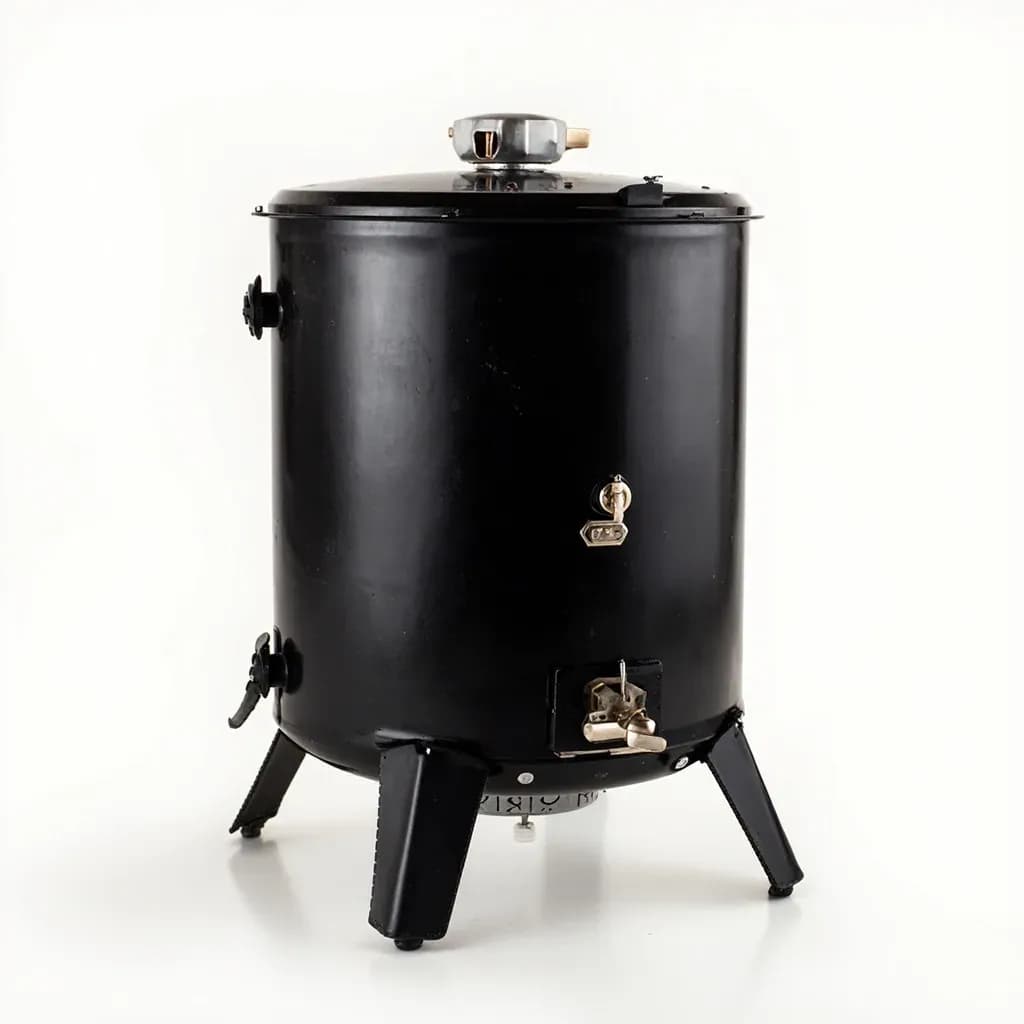
A vertical water smoker stacks a fire at the bottom, a water pan in the middle, and food racks above in a tall cylinder. The water pan absorbs and stabilizes the heat while adding humidity, making it easy to hold a low, even temperature for ribs, pork, and poultry. Its compact bullet shape and forgiving fire management make it a popular entry smoker for home cooks.
A vertical water smoker is a tall, cylindrical charcoal cooker — the silhouette cookers call the "bullet" — built around a single clever idea: a pan of water between the fire and the food. The classic stack runs fire bowl at the bottom, water pan in the middle, then two or three cooking grates topped by a vented lid. Air enters through bottom intake vents, is drawn past glowing charcoal, passes over the water pan where it picks up humidity and gives up some of its heat spikes, then flows up through the grates carrying smoke across the meat before exiting the top vent. The result is a forgiving, steady low-and-slow cooker that holds 225–275 °F for ten hours or more on a single load of charcoal, with enough moisture in the air to keep long cooks from drying out.
What separates a bullet from an offset barrel smoker is that water pan: it buffers temperature swings the way a thermal mass does, catches drips and ash so cleanup is simple, and adds humidity that protects white meat and helps bark form slowly rather than hardening into a bitter crust. The trade-off is that a vertical water smoker cannot sear — there is no direct-heat zone and no way to get the radiant blast a kettle grill delivers — and it produces a milder smoke profile than a thin-walled offset running hot. Cooks choose it precisely for what it does well: hands-off barbecue, weeknight whole chickens that stay juicy, and competition-style brisket and ribs where steady temp is the whole game.
Alternatives
Types & varieties
The benchmark charcoal bullet smoker; 14.5", 18.5", and 22.5" sizes; nickel-plated grates; dominates competition circuits.
Budget-friendly charcoal bullet smokers; double-door access; porcelain-coated body.
Early-1980s design that helped establish the format; thin steel, prone to rust, still widely available secondhand.
Plug-in version retaining the water pan; analog thermostat; offers set-and-forget temperature control without charcoal management.
Digital control panel, side wood-chip loader, retains the central water pan for moisture.
Smaller-format charcoal bullets sold primarily at big-box retailers; entry-level.
Related but distinct: vertical drum with a hanging hook and a humidity pan rather than a true water pan; included because the cook profile overlaps.
Homemade 55-gallon drum variant; often uses a water/drip pan in the same position as factory bullets.
Gas burner replaces charcoal at the base; water pan remains; cleaner startup, less smoke flavor than charcoal.
The Water Pan as Heat Buffer
The water pan is not a gimmick and it is not optional — it is the design's whole reason for existing. Water has a much higher heat capacity than air, so when a fresh batch of briquettes flares, the pan absorbs the spike before it reaches the meat. When the charcoal settles, the pan slowly releases that stored heat. The cook sees a tight temperature band rather than the 30–40 °F swings common in offset smokers. The pan also humidifies the air, which matters most on long cooks: a dry environment pulls moisture out of the surface of the meat and sets the bark early, often before the inside is done. Steam from the pan keeps the outer layer pliable so smoke and rub can keep depositing flavor as the interior climbs to temperature.
- Fill the pan with hot tap water before lighting — cold water drops chamber temp and stalls the smoke.
- A full pan holds 4–8 quarts depending on model; top up with hot water only, and only when the lid is off briefly.
- Watch for boil-over on fatty cooks (brisket, pork shoulder); leave 1" of headspace and skim rendered fat mid-cook if needed.
- Empty and rinse the pan after every cook — leftover fat and ash turn into a rancid slurry that corrodes the rim.
Mastering Vent and Fuel Control
A bullet smoker has exactly two controls — a bottom intake vent (or set of vents) and a top exhaust vent — and learning to read them is the whole skill. Air in at the bottom drives combustion and pulls draft up through the chamber; the top vent's job is to create draw, not to govern heat. The most common mistake is leaving the top vent cracked and using it to throttle temperature; that cools the smoke, slows draft, and dulls flavor. The right pattern is bottom vent in, top vent mostly open. On a Weber Smokey Mountain, leave one bottom vent fully open at the start, throttle the second to control temp, and close the top vent only about 25% to keep heat in without killing draft.
- Use the Minion Method: fill the charcoal ring with unlit briquettes, light 15–20 in a chimney starter, then dump them on top for a slow, steady climb.
- Use wood chunks (2–3" pieces), not chips — chips burn out in 20 minutes, chunks smolder for hours and match long cook times.
- Stick to hardwoods: hickory, oak, pecan, apple, cherry, mesquite (sparingly). Avoid softwoods (pine, spruce, cedar) — they produce acrid, bitter smoke.
- Don't peek. Every lid lift can add 10–15 minutes of cook time and release smoke you can't easily recover.
Common uses
Tips & pitfalls
- Place an aluminum liner or pie tin on the water pan lip to catch drips and keep the pan from seasoning into a permanent black crust.
- Season the smoker before first use: a 2-hour burn at 250 °F with oil-wiped grates burns off manufacturing residues and factory smell.
- Common mistake: lighting too much charcoal. If the water is boiling hard, you're cooking too hot and the smoke will be thin and harsh — bullets are tuned for slow burns, not sears.
- Rotate grates at the halfway point on long cooks — the upper grate near the lid runs noticeably hotter than the lower grate above the water pan.
- Trust a remote probe thermometer over the built-in lid gauge — factory lid thermometers on bullets are routinely 25–50 °F off.
- If the bark turns rubbery or creosote-black, the cooker ran too cool with the top vent choked; open the top vent fully and let draft pull clean smoke.
- Wrap the seam between the fire bowl and middle section with high-temp gasket tape if you see smoke leaking — drafts are the leading cause of hot spots.
Good to know
- Form factor
- Tall, cylindrical "bullet" smoker with stacked sections: charcoal/fire bowl at base, water pan in the middle, and a tall cooking chamber topped by a vented lid.
- Defining feature
- A water pan sits between the heat source and the food, acting as a heat buffer, humidity reservoir, and grease/ash catcher.
- Operating range
- Typically 225–275 °F (107–135 °C); can be pushed higher by opening vents and adding fuel.
- Standard sizes
- Weber Smokey Mountain comes in 14.5", 18.5", and 22.5" diameters; other makers offer similar 14–22" formats.
- Cook duration per load
- 10–14 hours on a single charcoal load (18.5" and up) using the Minion Method; smaller models run 6–10 hours.
- Construction
- Porcelain-enameled steel is the industry standard (Weber Smokey Mountain); budget units use aluminized or plain steel that may rust at seams.
- First commercial model
- Weber-Stephen introduced the Smokey Mountain Cooker in 1981, the design that popularized the category for home use.
- Cleanup
- Water pan catches most drippings and ash; the empty-and-rinse routine takes 10–15 minutes once cool.
Also called
bullet smoker · water smoker · water pan smoker
Related

Stovetop
The everyday burners where most cooking actually happens

Oven
Enclosed dry heat for roasting, baking, and braising

Grill
Live-fire or gas grates for char, smoke, and high heat

Smoker
Low, slow heat and wood smoke for barbecue and brisket

Air Fryer
Countertop convection that crisps with little or no oil

Slow Cooker
Set-and-forget low heat for stews, beans, and braises

Pressure Cooker
Sealed steam pressure that cooks tough food in a fraction of the time

Rice Cooker
Foolproof, perfectly steamed rice every single time