Appliances & Heat
Viscometer
Instrument that measures how thick or flowable a liquid is.
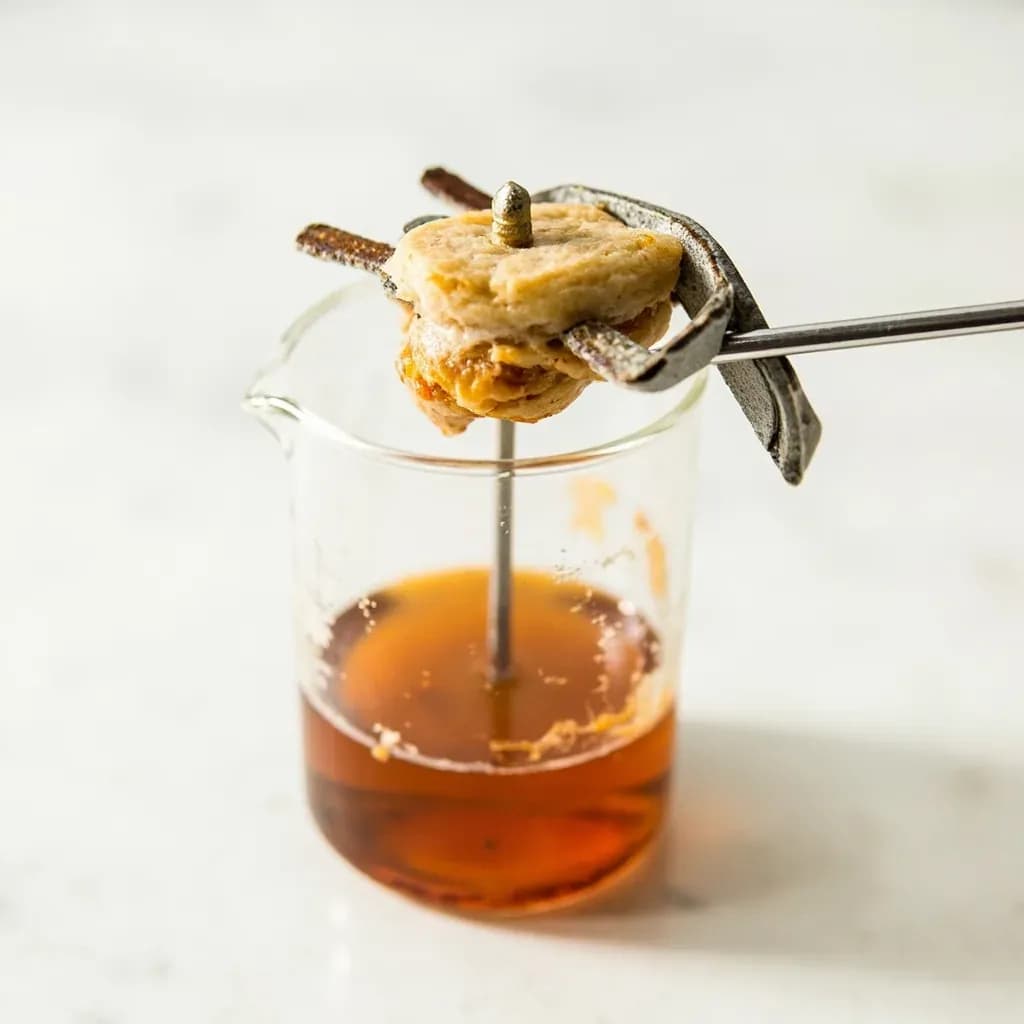
A viscometer measures viscosity, the resistance of a liquid to flow, often by timing flow through an orifice or by the drag on a rotating spindle. In food production it is used to standardize the thickness of sauces, syrups, chocolate, batters and emulsions. Consistent viscosity readings keep texture and pourability uniform across batches.
A viscometer is an instrument that quantifies a fluid's resistance to flow — its viscosity — turning the squishy, subjective judgment of "this sauce feels right" into a number a cook can repeat, log, and defend. In a working kitchen that means something concrete: a hollandaise measured at 1,200 cP at 60 °C, a chocolate at 4,500 cP at 31 °C, a ketchup that runs 6.5 cm in 30 seconds on a Bostwick. Viscosity governs how a sauce clings to a spoon, how a batter coats a piece of fish, how chocolate releases from a mold, how syrup pours at production speed, and how stable an emulsion stays on the shelf.
For home cooks, a viscometer is rarely necessary; a spoon and a tilted plate do most of the work. But for any kitchen scaling recipes, troubleshooting broken sauces, or running batch-to-batch consistency — pastry, chocolate work, brewing, condiment production, large-volume catering — a viscometer replaces guesswork with a measurable spec. Even a $30 flow cup answers the questions that frustrate a cook: why did this caramel set differently? Why is the tempura batter thin today? Why does the chocolate keep seizing?
A few rules govern every reading. Viscosity is acutely temperature-sensitive — most food fluids thin measurably with a 5–10 °C rise — so a viscosity number without its temperature is meaningless. Fluids also behave differently under stress: water, milk, and oil are Newtonian (viscosity is constant regardless of stirring), while ketchup, chocolate, and xanthan-thickened sauces are shear-thinning (they thin when stirred, pumped, or poured). A viscometer that doesn't account for that distinction will give misleading data, which is why instrument choice matters as much as the reading itself.
Alternatives
Types & varieties
Measures time for a fixed volume to flow through a narrow tube (Ostwald, Cannon-Fenske, Ubbelohde). Best for thin, Newtonian fluids like oils, syrups, and clear juices.
Spindle turns at a set speed in the sample; torque gives viscosity. Brookfield is the brand name most kitchens know. Excellent for sauces, chocolate, and batters.
A small cone rotates against a flat plate; uses tiny samples and gives shear-rate-controlled data. Favored in chocolate and polymer research.
A ball or piston drops through the fluid; travel time correlates to viscosity. Simple, robust, good for opaque or hot samples.
Calibrated cup with an orifice; dip, lift, and time the draining stream. Fast, cheap, ideal for production-floor checks of coatings, batters, and glazes.
A trough with a spring-loaded gate that releases a fixed volume; the distance the sample flows in 30 seconds is recorded. Standard for ketchup, jam, puree, and sauce consistency.
Probe vibrates at a fixed frequency; viscosity is inferred from the damping. Sanitary, in-line, used on processing tanks.
Viscosity in the kitchen: reference numbers
A viscosity reading only makes sense against a benchmark. The values below, measured at roughly 20 °C unless noted, give a cook a sense of where common ingredients and finished products sit. Non-Newtonian foods like ketchup, chocolate, and honey vary with shear rate, temperature, and formulation, so treat these as order-of-magnitude guides rather than absolutes.
- Water: ~1 cP — the universal reference.
- Whole milk: ~3 cP; heavy cream (36% fat): ~15–50 cP, climbing quickly as it cools toward fridge temperature.
- Light olive oil: ~80 cP; refined sunflower or canola: ~45–55 cP.
- Maple syrup (Grade A): ~200–500 cP depending on temperature and grade.
- Honey: ~3,000–10,000 cP, climbing as moisture drops and as the honey cools.
- Melted dark chocolate at 31 °C: ~3,000–6,000 cP; milk chocolate at 30 °C: ~4,000–8,000 cP. Working range matters more than the label number.
- Ketchup: ~50,000–100,000 cP at rest; drops sharply when pumped or squeezed (shear-thinning).
- Peanut butter: ~150,000–250,000 cP; doesn't flow without a push.
- Mayonnaise: ~1,000–5,000 cP at room temperature; broken mayo climbs past 10,000 cP and splits visibly.
Choosing the right viscometer
Match the instrument to the fluid and the question. A few rules of thumb cover most kitchen applications.
- Thin, clear, Newtonian fluids (oils, syrups, juices): a capillary tube or a Zahn #1 cup gives fast, repeatable numbers.
- Sauces, batters, chocolate, and dairy: a rotational spindle viscometer (Brookfield-style) is the workhorse — pick spindle and speed so the torque reads in the 10–100% range.
- Pastes, purees, and condiments (ketchup, jam, fruit puree): a Bostwick consistometer gives a distance value that maps directly to consumer perception of "thickness."
- Coatings and glazes on a production line: Zahn or Ford cups are quick, cheap, and don't need power.
- Research, chocolate tempering, or low-volume work: cone-and-plate gives the most accurate shear-rate data on milliliter-scale samples.
- In-tank or in-line monitoring (large sauce kettles, dairy lines): vibrational probes are sanitary and survive CIP cleaning.
Common uses
Tips & pitfalls
- Always record the temperature with the reading — viscosity without temperature is meaningless in food work.
- Match the spindle geometry and rotational speed to the expected viscosity; an under-sized spindle stalls, an over-sized one gives noisy data.
- For thixotropic or shear-thinning fluids like ketchup, xanthan sauces, and yogurt, standardize a delay (e.g., 30 seconds) after starting the spindle before reading.
- Degas or rest samples briefly to release trapped air bubbles, which cause erratic readings.
- Rinse and dry spindles between samples — even a trace of a previous sauce will throw off the next reading.
- Calibrate monthly with a certified standard fluid; temperature drift in the bath is the single biggest source of error.
- For chocolate, take readings at the working temperature (dark ~30–32 °C, milk/white ~29–30 °C) — cold chocolate is misleadingly thick.
- On a Zahn cup, hold the cup vertically, start the timer the instant it leaves the liquid, and average three dips for a usable number.
- Don't equate "thick" with "viscous" — foams, gels, and suspensions are viscoelastic and need specialized measurement.
- Keep a logbook of readings, temperatures, and batch IDs; trends catch problems before a single bad reading would.
Good to know
- What it measures
- Viscosity — a fluid's resistance to flow — typically in centipoise (cP) or millipascal-seconds (mPa·s); water at 20 °C is the reference at ~1 cP.
- Reference values at ~20 °C
- Water ~1 cP, milk ~3 cP, olive oil ~80 cP, honey ~10,000 cP, chocolate ~1,000–10,000 cP, ketchup ~50,000–100,000 cP, peanut butter ~150,000–250,000 cP.
- Common units
- Centipoise (cP), poise (P), pascal-second (Pa·s), and mPa·s (1 cP = 1 mPa·s = 0.001 Pa·s).
- Temperature dependence
- Highly sensitive; most food fluids thin measurably with a 5–10 °C rise. Always record temperature with the reading.
- Benchtop industry standard
- Brookfield rotational viscometer, in production since the 1930s; dominant in food R&D and quality control.
- Typical food-industry tools
- Rotational spindle (Brookfield), flow cup (Zahn, Ford, DIN), Bostwick consistometer for pastes, and capillary tubes for thin fluids.
- Calibration
- Verify with a certified viscosity standard (e.g., Brookfield or Cannon) at least monthly, more often in heavy use.
- Cost range
- Hand-held rotational units a few hundred USD; lab Brookfield systems $2,000–$15,000+; flow cups under $50.
Also called
viscometer · viscosity meter
Related

Stovetop
The everyday burners where most cooking actually happens

Oven
Enclosed dry heat for roasting, baking, and braising

Grill
Live-fire or gas grates for char, smoke, and high heat

Smoker
Low, slow heat and wood smoke for barbecue and brisket

Air Fryer
Countertop convection that crisps with little or no oil

Slow Cooker
Set-and-forget low heat for stews, beans, and braises

Pressure Cooker
Sealed steam pressure that cooks tough food in a fraction of the time

Rice Cooker
Foolproof, perfectly steamed rice every single time