Appliances & Heat
Walk-In Cooler
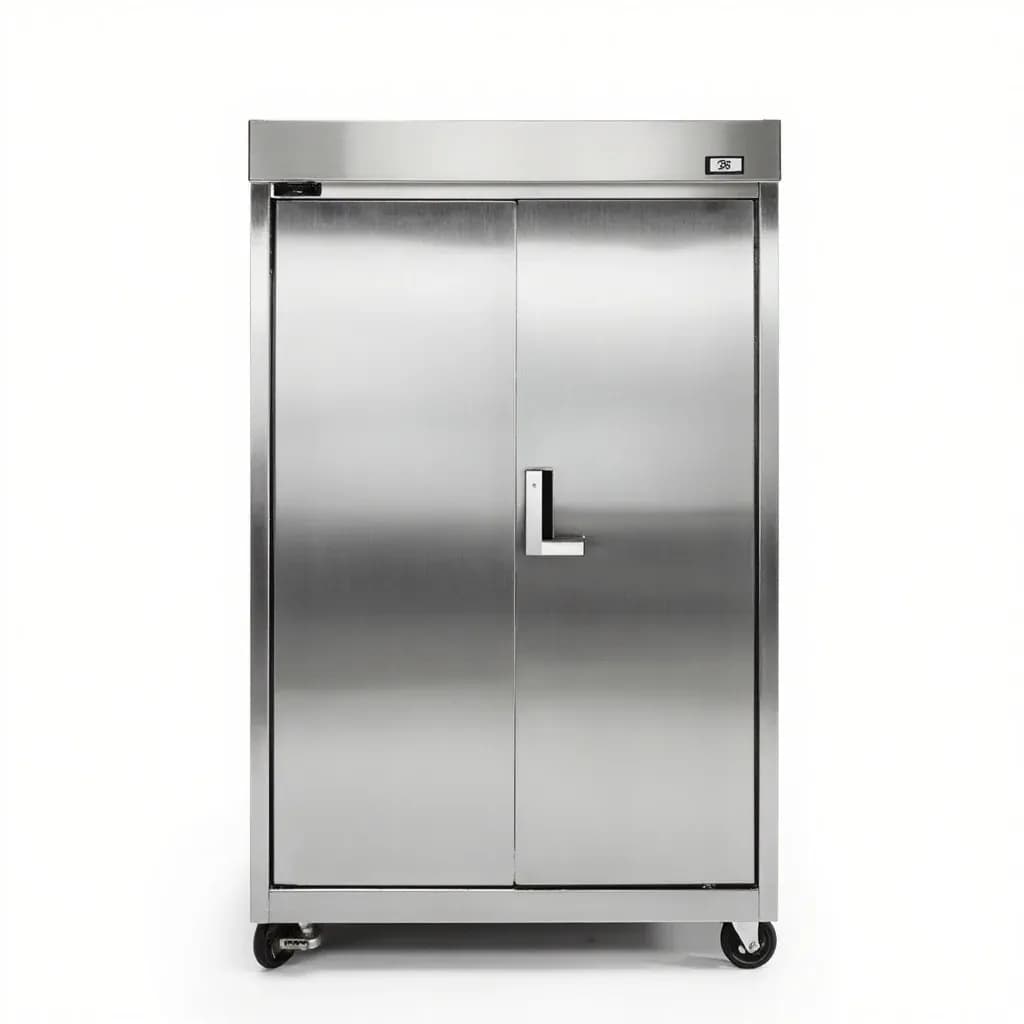
A room-sized refrigerated space for storing large volumes of perishable food in commercial kitchens.
A walk-in cooler is an insulated refrigerated room cooks step inside to store bulk produce, dairy, meat, and prepped dishes at safe temperatures. Restaurants and caterers rely on it for the storage capacity no reach-in fridge can match, organized on shelving by category and date. Keeping it consistently cold and well-stocked-but-not-overpacked is essential so airflow holds every item out of the danger zone.
A walk-in cooler is the workhorse cold-storage room of any serious commercial kitchen — a panel-built, room-sized refrigerator that holds the entire cold chain, from morning produce deliveries to finished stocks waiting to be plated. Unlike a reach-in fridge, it is essentially a small building within a building: insulated metal panels cam-locked together over a floor, sealed by a heavy gasketed door, and held at 35–40°F (1.7–4.4°C) by either a wall-mounted self-contained refrigeration unit or a remote system whose compressor sits outside the kitchen. The freezer variant is built identically and runs at -10 to -20°F (-23 to -29°C).
For a cook, the walk-in matters less as a piece of equipment than as a critical control point. Health departments treat it under HACCP, which is why NSF/ANSI 7 certification, calibrated thermometers, and strict separation of raw proteins from ready-to-eat food are non-negotiable rather than aspirational. Most temperature failures trace back to a handful of recurring causes — blocked evaporator coils, propped doors, worn gaskets, or hot food loaded in too fast — all of which a disciplined kitchen can prevent without picking up a phone.
The real skill of using a walk-in is understanding what it cannot do. It is not a quick-chill device, a freezer substitute, a dry-goods closet, or a shortcut between rooms. It holds product within a narrow temperature band; everything else — cooling speed, humidity, organization, sanitation — falls on the cook.
Alternatives
Types & varieties
Refrigerated room held at 35–40°F for fresh produce, dairy, prepared foods, and thawed proteins.
Identical panel construction, held at -10 to -20°F for long-term frozen storage.
Single box partitioned into a cooler section and a freezer section served by separate evaporators.
Doors on two opposite walls, connecting a receiving or prep area directly to the kitchen line.
Weatherproof unit installed outside the building, accessed through an exterior door; frees interior floor space.
Prefabricated insulated panels cam-locked together on site; the standard for new construction.
Refrigeration system built into the wall or ceiling; easier to install but dumps heat and noise into the kitchen.
Compressor and condenser mounted on the roof or in a mechanical room, with refrigerant lines to the evaporator inside; quieter and keeps heat out of the kitchen.
Smaller, high-velocity unit designed to rapidly drop food temperature through the danger zone, not for long-term storage — and not a substitute for a walk-in cooler.
Airflow Is Everything
A walk-in cooler is a sealed box of cold air, and cold air does not move efficiently without a fan pushing it. The evaporator coil on the wall or ceiling needs at least 1–2 inches of clearance on every side; stack cases against it and the coil ices up, the compressor labors, and temperatures drift upward long before any alarm sounds. Wire or polymer NSF shelving — never cardboard cases on the floor — keeps air circulating beneath product and lets staff see and clean spills before they become hazards. Hot loads are the other airflow killer: a stockpot of steaming liquid dumps moisture into the box, which condenses on the coil as ice and gradually chokes the system. Cool in shallow, uncovered pans outside the box, or at minimum with the door cracked and a fan pulling steam out, before transferring hot food into the walk-in.
- Maintain 1–2 in clearance around the evaporator coil at all times
- Shelve product on NSF wire or polymer racks, never on the floor
- Cool hot foods in shallow, uncovered pans outside the box before loading
- If you must load hot, prop the door open and station a fan to vent steam
Zoning the Box
A walk-in is not a closet; it is a food-safety checkpoint, and how you divide it determines whether you pass inspection and serve safe food. The cardinal rule is raw proteins on the lowest shelves, ready-to-eat items above, with no overlap and no chance of drip contamination. Beyond that, build deliberate zones: produce here, dairy there, prepped mise en place on a separate rack, allergens or dietary-restricted items (gluten-free, vegan, kosher, halal) in their own clearly marked corner. Date-mark every item on the shelf, not on the original case, and rotate so older product is in front. A walk-in that is well-zoned saves time on the line and survives a surprise health inspection without drama.
- Raw proteins always on the lowest shelf; ready-to-eat above
- Keep allergens, gluten-free, vegan, kosher, or halal items in a dedicated, labeled zone
- Date-mark every container on the shelf, not on the shipping case
- Use a first-in, first-out rotation: newer deliveries go behind older stock
- Never store cleaning chemicals, dry goods, or personal food in the same box
Reading the Problem Before You Call a Tech
When a walk-in drifts above 40°F, the impulse is to call service. Often you can solve it in five minutes. Check, in order: (1) Is the door fully closed and the gasket sealing? (2) Is the evaporator coil iced over, indicating it needs a manual defrost or has a stuck defrost timer? (3) Is the condenser filter or coil caked with dust and kitchen grease? (4) Has a breaker tripped, or has the thermostat been bumped? Most temperature excursions trace to one of these. A clipboard log of twice-daily readings tells you whether the problem is sudden (a door left open, a failed compressor) or gradual (a slowly icing coil, a degrading gasket) — and that distinction saves a service call.
- Door not latched or gasket compromised — the most common cause of drift
- Iced evaporator coil — manual defrost and check the defrost timer/heater
- Dirty condenser filter or coil — clean monthly in a working kitchen
- Sudden warm box with the fan running — check the breaker and listen for the compressor
- A twice-daily log reveals whether the problem is sudden or gradual
Common uses
Tips & pitfalls
- Keep at least 1–2 inches of clearance around the evaporator coil and never stack items against it; blocked airflow is the single most common cause of temperature failure.
- Use NSF-approved wire or polymer shelving, not the floor, so air circulates underneath and you can see and clean the floor.
- Store raw proteins on the lowest shelves to prevent drips onto ready-to-eat food — a top health-code violation.
- Cool hot foods in shallow, uncovered pans outside the box, or at minimum with the door cracked; closing a walk-in with steaming stock inside can push humidity past 95% and ice the evaporator.
- Install a clearly visible NSF-certified thermometer, log temperatures at least twice daily, and calibrate annually — the paper trail protects you during an inspection and reveals trends before failures.
- Keep door gaskets clean and inspect them monthly; a worn gasket can cost several degrees overnight and is the silent cause of most chronic temperature drift.
- Never prop the door open with a milk crate or keg — even 30 seconds in a busy service raises the box temperature and warps the hinge.
- Clean and prime the floor drain trap weekly; an unprimed trap lets sewer gas and pests into the box.
Good to know
- Typical temperature range
- 35–40°F (1.7–4.4°C) for coolers; -10 to -20°F (-23 to -29°C) for walk-in freezers
- Panel construction
- Insulated metal panels, typically 4 in thick, with polyurethane foam core between galvanized or stainless steel skins; R-30 to R-40
- Standard sizes
- Common footprints 6'×6' up to 12'×12' or larger; interior ceiling height 7'6"–8'0"
- Refrigeration options
- Self-contained (evaporator and condensing unit on the wall or ceiling) or remote (compressor/condenser on the roof or in a mechanical room)
- Floor options
- Smooth aluminum, diamond-tread plate, or floorless (set over an insulated floor built into the building)
- Door types
- Inward-swinging, outward-swinging, sliding, or pass-through doors connecting two rooms
- Governing standard
- NSF/ANSI 7 for commercial refrigeration; many jurisdictions require NSF certification for health-code compliance
- Drainage
- Most floors slope to a center drain with a trap; the trap must be primed and the drain kept clear to block sewer gas and pests
Also called
Under-Counter Refrigerator · Walk-In Fridge · Cold Room
Related

Stovetop
The everyday burners where most cooking actually happens

Oven
Enclosed dry heat for roasting, baking, and braising

Grill
Live-fire or gas grates for char, smoke, and high heat

Smoker
Low, slow heat and wood smoke for barbecue and brisket

Air Fryer
Countertop convection that crisps with little or no oil

Slow Cooker
Set-and-forget low heat for stews, beans, and braises

Pressure Cooker
Sealed steam pressure that cooks tough food in a fraction of the time

Rice Cooker
Foolproof, perfectly steamed rice every single time