Appliances & Heat
Water Filtration System
Equipment that removes impurities, minerals or chlorine from cooking and drinking water.
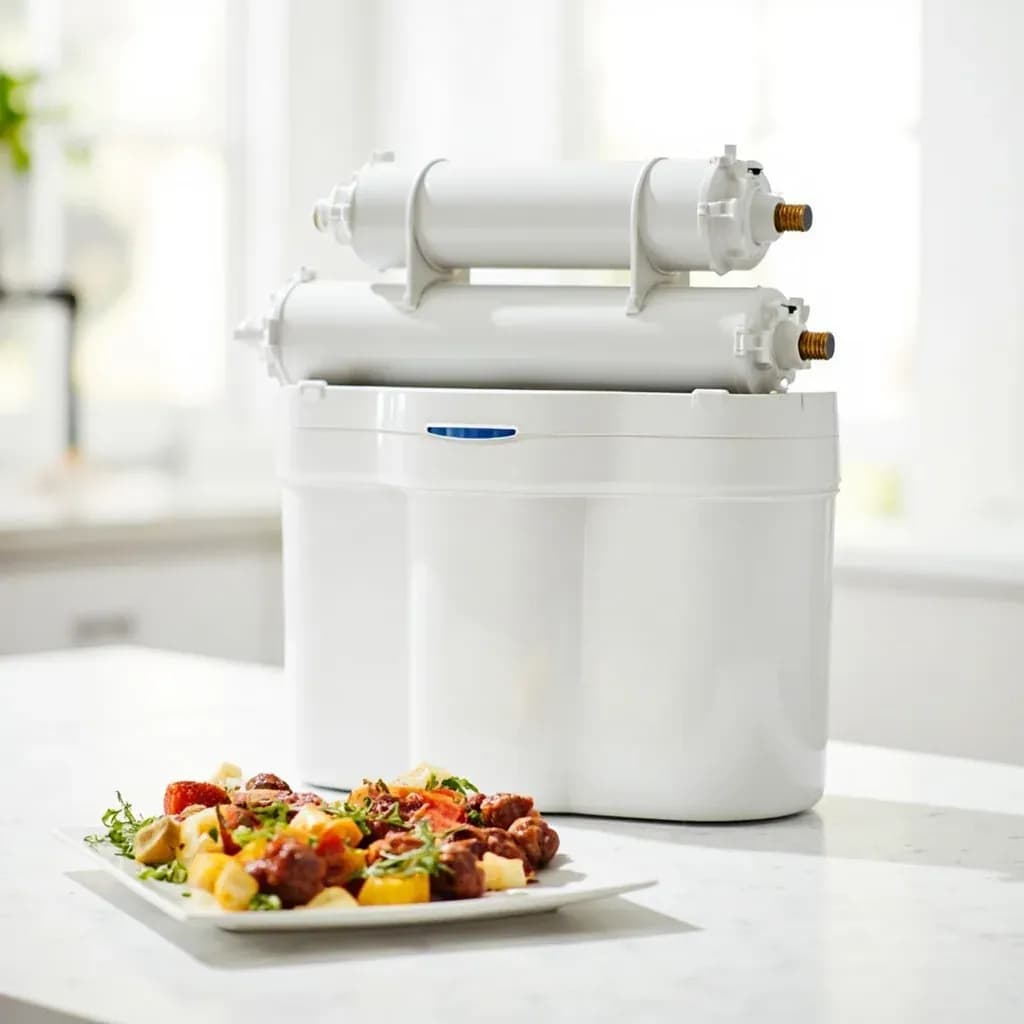
A water filtration system passes water through cartridges or membranes to remove sediment, chlorine, off-flavors and sometimes minerals before it is used. Kitchens rely on it to improve the taste of tea, coffee and stocks, protect espresso and steam equipment from scale, and ensure consistent results. Systems range from simple carbon filters to multi-stage reverse-osmosis units.
A water filtration system is the single most under-rated piece of equipment in a serious home kitchen, because the water that goes into a pot, a kettle, or a dough bowl is itself an ingredient. Tap water carries two distinct sets of problems a cook should think about separately: chemical — chlorine, chloramine, and trace organics that flatten flavor and weaken yeast — and physical, the dissolved calcium and magnesium (hardness) that scale up boilers, kettles, and espresso machines. Most home cooks first notice a difference the day they switch to filtered water for tea or bread baking, and it is almost always chlorine, not hardness, that they are tasting.
The technologies on the market behave very differently. Activated carbon adsorbs chlorine and many volatile compounds but leaves dissolved minerals untouched. Reverse osmosis pushes water through a membrane so fine it strips roughly 90–99% of everything dissolved in it, which is overkill for a soup pot but perfect for an espresso boiler. Ion-exchange softeners swap hardness ions for sodium and exist only to fight scale. UV sterilizers kill microorganisms but change nothing about taste. Matching the method to the job is the whole art of choosing one.
In practical cooking terms, a modest under-sink carbon unit covers most of what a home cook notices (better tea, livelier dough, cleaner-tasting rice and vegetables), while a dedicated hardness-balanced cartridge on an espresso machine, or a softener upstream of a combi oven, addresses the equipment side. The Specialty Coffee Association's brew-water target — 75–250 ppm total dissolved solids, 50–175 ppm hardness, 40–75 ppm alkalinity — is a useful, citable benchmark for any cooking where mineral content shapes extraction, from pour-over coffee to simmered stocks.
Alternatives
Types & varieties
Gravity-fed countertop unit (Brita, PUR, Soma). Removes chlorine and some VOCs, improves taste, leaves minerals. Slow, small capacity.
Clips onto a kitchen tap with a diverter for filtered and unfiltered streams. Good for renters; lower flow rate and limited contact time.
Plumbed into the cold line with a dedicated small faucet. Faster and higher-capacity than a pitcher; often NSF 42 + 53 certified.
Multi-stage: sediment pre-filter, carbon block, RO membrane, polishing carbon. Removes ~90–99% of dissolved solids including fluoride, lead, and arsenic. Needs a storage tank and drain line.
Salt-regenerated resin swaps calcium and magnesium for sodium. Solves scale, nothing else; not a taste filter.
Salt-free scale prevention that converts hardness minerals into inert microcrystals rather than removing them. No brine discharge, no sodium added.
Microporous ceramic candle, often silver-impregnated (Berkey, Doulton). Long life, retains beneficial minerals, removes bacteria and cysts; slow flow.
UV-C lamp in a stainless chamber kills bacteria, viruses, and protozoa. Pairs with a carbon pre-filter; does nothing for taste or hardness.
Boils and recondenses water. Near-total contaminant removal but slow, energy-hungry, and produces flat-tasting water stripped of dissolved air and minerals.
Small cartridges plumbed into refrigerators, ice machines, espresso boilers, or steam ovens (Everpure, BWT, 3M Aqua-Pure). Tuned for hardness and scale, not general drinking water.
Chlorine vs. Hardness: The Cook's Mental Model
Most home filtration mistakes come from conflating two unrelated water problems. Chlorine and chloramine are chemical disinfectants added by utilities; they smell like a pool, flatten the flavor of tea and coffee, and kill or weaken yeast in bread dough. A simple activated carbon filter is all it takes to remove chlorine. Hardness is something else entirely — dissolved calcium and magnesium that precipitate as limescale on heating elements, in kettle bottoms, inside espresso boilers, and on steam-oven sensors. Hardness affects equipment, not flavor, and demands either a softener, a TAC unit, or a hardness-balanced specialty cartridge on the appliance in question. A cook who understands this split will almost never buy the wrong filter.
- Chlorine → fixes taste, yeast activity, and odor → use carbon.
- Hardness → fixes scale on kettles, boilers, and sensors → use softener, TAC, or specialty cartridge.
- Chloramine (used by many U.S. utilities) needs a catalytic carbon rated for it; standard carbon removes it more slowly than chlorine.
- Hard water does not by itself make food taste bad; very soft or RO water makes food taste flat and washes out extraction in coffee and tea.
Standards Worth Trusting
Pitcher boxes make impressive claims, and most of them are not independently verified. The most reliable signal on a residential filter is a third-party NSF/ANSI certification printed on the carton. Knowing which standard covers which claim saves a cook from marketing nonsense and helps match the unit to the contaminant that actually matters locally.
- NSF/ANSI 42 — aesthetic effects: chlorine taste and odor, sediment. Look for this on any carbon pitcher or under-sink unit intended to improve drinking-water flavor.
- NSF/ANSI 53 — health effects: lead, mercury, cryptosporidium, and volatile organic chemicals. The one to look for if old plumbing or well-water is a concern.
- NSF/ANSI 58 — reverse osmosis systems; covers TDS reduction claims.
- NSF/ANSI 55 — UV microbiological purifiers; Class A for cysts and viruses, Class B for bacteria only.
- NSF/ANSI 44 — cation-exchange water softeners; verifies hardness reduction and capacity claims.
Common uses
Tips & pitfalls
- Match the filter to the job: carbon for chlorine and taste, RO for total mineral control, a softener or TAC only for scale, UV for biological safety — never buy one unit expecting it to do all four.
- Test your source water before buying anything — most utilities publish an annual Consumer Confidence Report for free, and a $15 TDS meter tells you within minutes whether hardness is the real problem.
- Replace cartridges on schedule; a saturated carbon block can release trapped contaminants back into the water and starts tasting faintly of a swimming pool.
- Always flush a new filter for the volume listed on the package (usually 2–5 gallons) before the first drinkable use — the first liter tastes of carbon dust and fine particulates.
- For bread baking, use carbon-filtered water rather than RO; the small residual calcium actually strengthens gluten, and pure RO water can leave dough slack and sticky.
- For coffee and tea, target the SCA brew-water range (75–250 ppm TDS, 50–175 ppm hardness) — pure RO tastes hollow, while very hard water scales the kettle and over-extracts the grounds.
- Don't run yeast cultures, fermentation starters, or houseplants through a sodium-based softener; use a carbon filter or a salt-free TAC system instead to avoid sodium buildup.
- If you own an espresso machine, install a dedicated hardness-balanced cartridge (BWT Bestmax, Everpure Claris) rather than feeding the boiler pure RO and re-mineralizing by hand — the cartridge is easier to dial in and protects the boiler.
- Reuse RO brine rather than sending it to the drain — it is fine for mopping floors, flushing toilets, and most outdoor cleaning, and a heavy user can easily recover several gallons per day.
Good to know
- Primary Purpose
- Removes chlorine, sediment, dissolved minerals, microorganisms, and/or chemical contaminants from tap water to improve taste, clarity, and suitability for cooking.
- Filtration Methods
- Activated carbon (adsorption), reverse osmosis (membrane), ion exchange (resin), ceramic (mechanical), UV (germicidal), and distillation (evaporation/condensation).
- TDS Removed by Method
- Activated carbon: 0% dissolved minerals; reverse osmosis: 90–99%; distillation: 95–99%; ion exchange: hardness only; UV and ceramic: none.
- SCA Brew-Water Target
- The Specialty Coffee Association recommends 75–250 ppm total dissolved solids, 50–175 ppm hardness (as CaCO₃), and 40–75 ppm alkalinity for brewed coffee.
- NSF/ANSI Standards
- NSF/ANSI 42 covers aesthetic effects (chlorine, taste); 53 covers health effects (lead, cryptosporidium); 58 covers reverse osmosis; 55 covers UV; 44 covers softeners.
- Filter Life
- Pitcher cartridges: 40–150 gallons or about 2 months; under-sink carbon blocks: 6–12 months; RO membranes: 2–5 years; sediment pre-filters: 3–6 months.
- RO Waste Ratio
- Standard reverse osmosis rejects roughly 3–4 gallons of brine per gallon of permeate; systems with permeate pumps approach a 1:1 ratio.
- Cost Range
- Pitchers $20–$60; under-sink carbon $100–$300; RO systems $200–$600+; whole-house systems $500–$2,000+.
Also called
water filter · water purification system · filtration system
Related

Stovetop
The everyday burners where most cooking actually happens

Oven
Enclosed dry heat for roasting, baking, and braising

Grill
Live-fire or gas grates for char, smoke, and high heat

Smoker
Low, slow heat and wood smoke for barbecue and brisket

Air Fryer
Countertop convection that crisps with little or no oil

Slow Cooker
Set-and-forget low heat for stews, beans, and braises

Pressure Cooker
Sealed steam pressure that cooks tough food in a fraction of the time

Rice Cooker
Foolproof, perfectly steamed rice every single time