Appliances & Heat
Wet Grinder
A stone-roller appliance that grinds soaked grains and lentils into smooth batter.
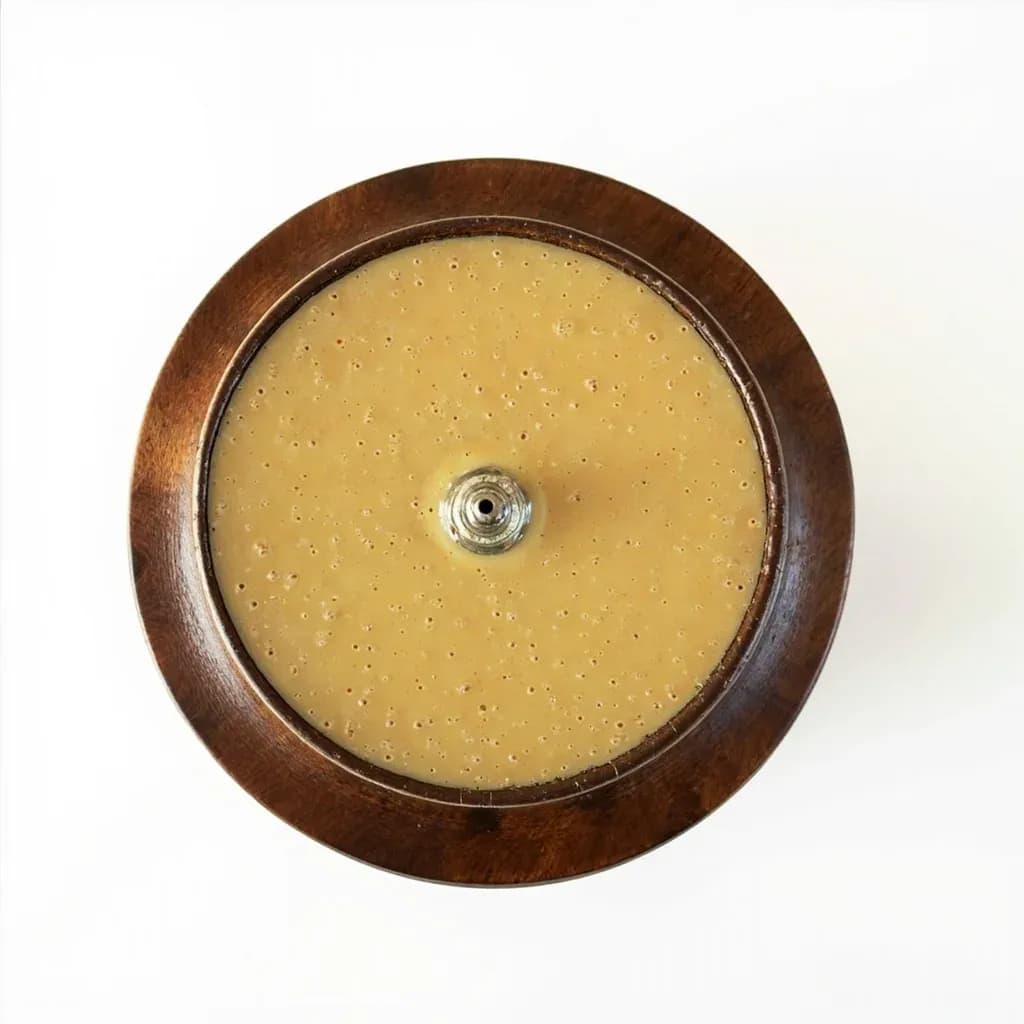
A wet grinder is a countertop appliance with heavy granite stone rollers that rotate inside a stone or steel drum to grind soaked rice and lentils into a fine, aerated batter. It is essential in South Indian kitchens for making idli and dosa batter, as the slow stone grinding avoids overheating and preserves fermentation. Tabletop tilting models are common at home, while larger commercial drums serve restaurants.
A wet grinder is a dedicated electric appliance built around two concentric granite stones that rotate against each other to crush soaked grains and lentils into a smooth, cool batter. Unlike a blender, which chops at high speed with steel blades and warms the contents as it works, a wet grinder moves slowly and stays cool, shearing starch granules open and folding micro-bubbles of air into the mixture. That specific texture and aeration are exactly what South Indian fermented batters need: idlis rise and stay springy, dosas turn crisp at the edges and tender through the middle, and vadas puff into light, honeycombed rings. Coimbatore, in Tamil Nadu, has been the manufacturing heart of the wet grinder for decades, and the basic design has barely changed because it does its job so well.
The typical home unit holds 1.25 to 2 liters in a stainless-steel drum, driven by a roughly 150 W motor that runs for 20 to 35 minutes per batch. Commercial tilting models stretch to 40 liters and pull 1 to 2 horsepower, which is what hotels, caterers, and the ubiquitous neighborhood batter shop rely on to turn out idli batter by the kilo. Using one well is mostly about judgment: dosing water in small splashes through the lid hole, watching the batter shift from slush to glossy foam, and stopping before the motor warms the mixture past the temperature at which fermentation behaves.
A wet grinder is not interchangeable with a blender or a mixer-grinder jar. The slow stone-on-grain action produces a viscosity and fermentation profile that high-speed blades cannot replicate; batters ground in a blender are noticeably denser, ferment differently, and yield heavier idlis. The traditional ancestor of the appliance, the ammi kal (a flat stone rubbed with a small stone roller), still appears in some rural homes and temple kitchens for very small batches, but for anyone serious about South Indian batters at home, the wet grinder remains the standard tool.
Alternatives
Types & varieties
Small countertop unit with a 1.25–2 L drum and non-tilting body; the most common style in urban Indian homes.
Drum hinges so it can be tipped to pour batter without lifting; reduces spillage and wrist strain in 1.5–2 L home and small-shop sizes.
Floor-standing 5–40 L drum with a heavy 1–2 HP motor, used in hotels, caterers, and dedicated batter shops.
Traditional design with two cylindrical granite stones grinding against each other; standard in most modern units.
Adds an upper stone for faster, finer grinding; found in higher-end home models and many commercial units.
Modern variant with a full stainless-steel outer shell instead of ABS plastic; more durable and easier to wipe clean.
Mid- and high-end models with an auto-cut timer and motor thermal protection to guard against overheating.
How a Wet Grinder Works
Wet grinding is essentially controlled abrasion. Two pieces of hard granite — a stationary lower stone and a rotating upper stone, or two rotating stones in a three-stone design — drag soaked grain and water between their faces. The stones do not slice; they scuff, which ruptures starch granules without gelatinizing them and folds air into the slurry as it passes. Because friction (not blade impact) does the work, the batter stays close to room temperature, and that coolness is what allows the natural yeasts and lactic acid bacteria on the urad dal to ferment the batter overnight into the light, sour, effervescent mix a good idli demands.
Choosing and Caring for a Wet Grinder
For a household of two to four, a 1.5 to 2 L tilting tabletop model with a three-stone assembly is the sweet spot. Tilting saves the heavy lift of a full drum, and a third stone noticeably cuts grind time. Stone care is the single biggest determinant of how long the unit performs: never soap the stones, never store the drum sealed while damp, and never run the grinder empty for more than a minute. A worn stone feels ridged rather than smooth to the fingertip and produces gritty, slow-to-ferment batter; most manufacturers in Coimbatore (Premier, Elgi Ultra, Sowbaghya, Lakshmi, Vidiem, Butterfly) supply replacement stones, gaskets, and drums as spare parts.
Common uses
Tips & pitfalls
- Always soak rice and dal separately and in the correct ratio (typically 3:1 or 4:1 rice to urad dal) before grinding; mixing the soak water throws off hydration and fermentation.
- Add water in small splashes through the lid hole, not all at once; a good idli batter is fluffy and just barely pourable, not thin like cream.
- Do not run the grinder empty beyond a minute or two — stone-on-stone friction can overheat the drum and crack the stones.
- For the lightest idlis, grind urad dal first to a pale, airy foam, then add the soaked rice and grind together in stages.
- Add ice-cold water when grinding in hot weather; a cool batter ferments faster and more reliably.
- Never use soap or detergent on the grinding stones; rinse with clear water and air-dry standing upright to prevent odor and cracking.
- Pour batter out of the drum immediately after grinding; leaving it sitting on the stones can give it a flat, slightly sour note from residual heat.
- Check stone wear every 2 to 3 years by running a fingertip across the grinding face — deep ridges mean the stones need replacing, not just the gasket.
Good to know
- Origin
- South India; Coimbatore in Tamil Nadu is the historic manufacturing center, often called India's 'wet grinder capital.'
- Grinding Surface
- Hard granite stones, traditionally two concentric stones, one rotating against the other.
- Typical Home Capacity
- 1.25 L to 2 L for domestic models; commercial units run from 5 L to 40 L+.
- Motor Power
- About 150 W for home models; 1–2 HP (roughly 750–1500 W) for commercial units.
- Grinding Time
- About 20–35 minutes per batch of idli/dosa batter in a 1.5–2 L home unit.
- Soak Time Required
- Rice 4–6 hours; urad dal 1–2 hours minimum, longer in cold climates.
- Cleaning
- Rinse stones under clear running water without soap and air-dry fully to prevent cracking and odor.
- Noise Level
- Roughly 70–80 dB because of stone-on-grain friction.
- Approximate Lifespan
- Stones last 5–10+ years in home use; motors and gaskets are the usual replacement parts.
Also called
Stone Grinder · Idli Grinder · Tabletop Wet Grinder
Related

Stovetop
The everyday burners where most cooking actually happens

Oven
Enclosed dry heat for roasting, baking, and braising

Grill
Live-fire or gas grates for char, smoke, and high heat

Smoker
Low, slow heat and wood smoke for barbecue and brisket

Air Fryer
Countertop convection that crisps with little or no oil

Slow Cooker
Set-and-forget low heat for stews, beans, and braises

Pressure Cooker
Sealed steam pressure that cooks tough food in a fraction of the time

Rice Cooker
Foolproof, perfectly steamed rice every single time