Appliances & Heat
Curing / Wine Fridge
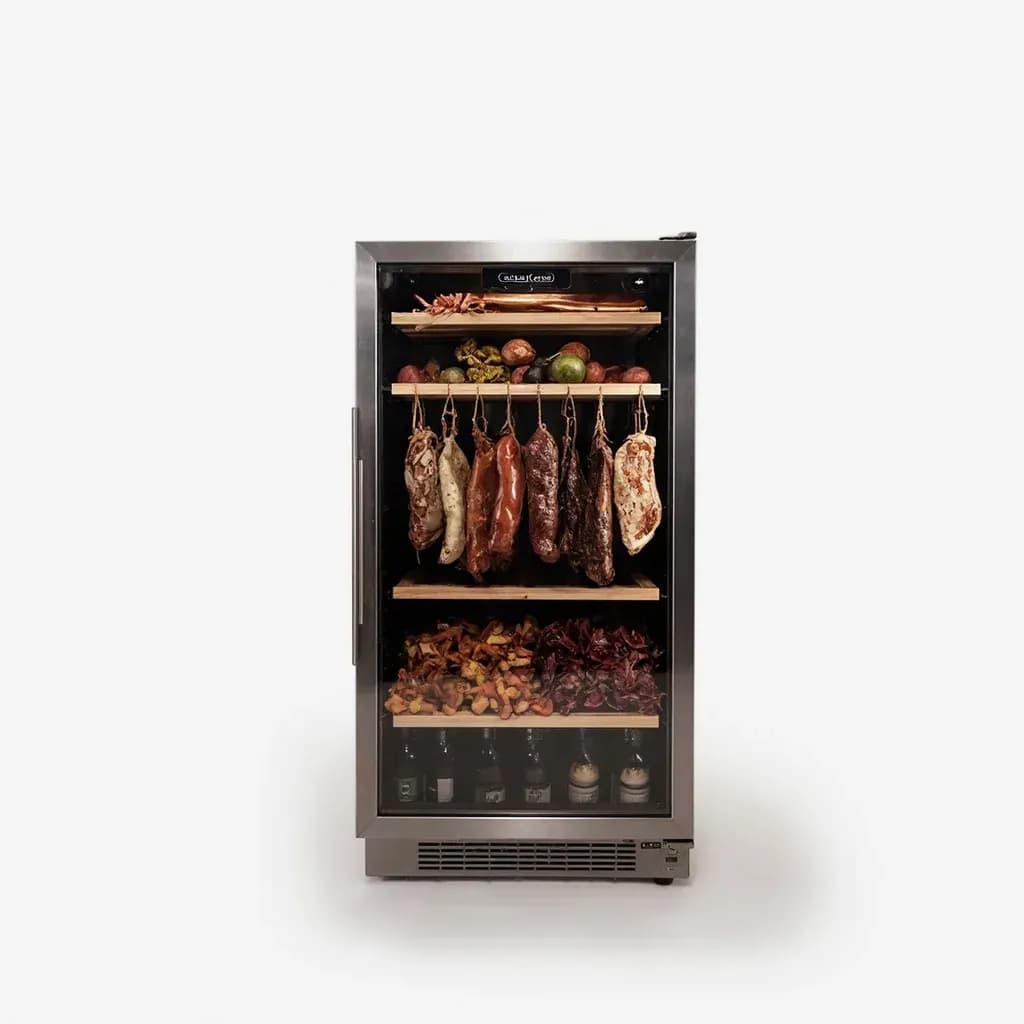
A temperature- and humidity-controlled cabinet for aging wine or dry-curing meats and cheese.
A curing or wine fridge is a compact climate-controlled cabinet that holds steadier, often cooler temperatures and gentler humidity than a kitchen refrigerator. Cooks repurpose it to dry-age and cure charcuterie, ripen cheese, or cellar wine at proper aging conditions. The stable, vibration-free environment and adjustable humidity are what set it apart from a standard fridge.
A curing and wine fridge is a purpose-built cabinet that holds a stable, adjustable temperature and a controlled humidity envelope. It descends from the wine cellar and the consumer wine cooler of the 1990s, and it differs from a standard kitchen refrigerator in four important ways: it runs warmer, it manages humidity upward rather than stripping it out, it vibrates far less, and it is built around the geometry of bottles, hanging meat, or wheels of cheese rather than leftover containers. For cooks, the practical upshot is a single piece of equipment that can age a bottle of Barolo for six months, hold a salami at 55°F and 70 percent relative humidity for three weeks, and ripen a wheel of aged Gouda in the same footprint.
The temperature and humidity envelope is the whole point. Wine stores best near 50 to 55°F with 60 to 70 percent relative humidity, because cool stable temperatures slow every reaction in the bottle and a humid cabinet keeps natural corks from shrinking and leaking. Dry-cured meats want a similar cool temperature but lean toward 60 to 75 percent humidity depending on the style: drier for hard salami, moister for a country ham that is still losing moisture. Hard cheeses ripen well at 70 to 80 percent humidity, semi-hard cheeses slightly higher; soft cheeses above 90 percent are not realistic in most stock cabinets. Good units also isolate the interior from vibration, light, and food odors, all of which are enemies of both aging wine and drying meat.
A dual-purpose unit will not match a dedicated curing chamber or a true wine cellar in performance, but for the home cook it is the most versatile piece of specialty equipment short of building out a basement. The right cabinet, set up thoughtfully, replaces several awkward workarounds: a back bedroom closet for hanging salami, a refrigerator drawer at the wrong temperature for a half-finished ferment, a countertop rack for wine that is really just decoration. Treat it as a controlled environment, not a refrigerator, and the results are immediately better.
Alternatives
Types & varieties
One temperature throughout; ideal for storing only one style, such as all reds or all whites at service temperature
Two independently controlled compartments; the standard choice for keeping reds and whites at their proper temperatures at the same time
Three zones for separate storage of reds, whites, and sparkling, or for splitting aging and service temperatures for reds
Quiet and vibration-free with no refrigerant, but limited to small and medium sizes and to rooms that stay near 70°F
Conventional refrigeration that handles large capacities, high ambient temperatures, and the lower end of the temperature range
Front-vented to fit under a standard counter inside cabinetry; almost always compressor-based
Furniture-style floor units holding 100–300+ bottles, often with dual or triple zones and compressor cooling
Marketed for charcuterie and wine, with a humidity tray or built-in humidifier, removable racks sized for hanging meat, and a temperature and humidity envelope tuned for curing
Holds 6–12 bottles, almost always thermoelectric; useful as a service-temperature unit, not for long aging
A standard fridge fitted with an aftermarket digital temperature and humidity controller (Ranco, Johnson, Inkbird); the workhorse of serious home charcuterie for precise, repeatable control
Choosing thermoelectric vs. compressor
The choice between thermoelectric and compressor cooling comes down to size, ambient room temperature, and what you intend to store. Thermoelectric Peltier modules have no moving refrigerant, no compressor cycle, and almost no vibration, which is genuinely useful for long-term wine aging. They are also very quiet. The trade-off is heat: a Peltier module cannot pull a cabinet much below about 18–20°F below the ambient room temperature, so in a warm kitchen the unit will struggle to reach proper white-wine or sparkling service temperatures. Capacity is also limited, almost always under about 50 bottles.
Compressor units behave like a normal refrigerator: more powerful, able to hold temperature in a hot room, and available in large freestanding sizes. The compressor introduces vibration, which better cabinets damp with rubber mounts, suspended shelving, and isolated condenser assemblies. For dual-purpose curing and wine work, especially anything over 30 bottles or hanging meat, a compressor-based cabinet is usually the more honest choice. For a small service-only unit in a climate-controlled kitchen, thermoelectric is often the right answer.
- Thermoelectric: quiet, vibration-free, limited capacity, struggles in warm rooms, no refrigerant
- Compressor: handles large capacity and wide temperature spans, requires vibration damping, draws more power
- For long-term wine aging in a climate-controlled room: thermoelectric is excellent
- For curing meat, large collections, or warm kitchens: choose compressor
Humidity: the make-or-break variable
Humidity is the variable that separates a wine or curing fridge from a plain refrigerator, and it is the one most home cooks get wrong. Standard refrigerators run at 15 to 30 percent relative humidity because they are designed to keep food dry, not preserve it. Wine wants 60 to 70 percent, dry-cured meat wants 60 to 75 percent depending on style, and hard cheese wants 70 to 80 percent (higher for semi-soft). A cabinet that cannot hold at least 60 percent RH is not really a curing or wine fridge, regardless of what the box says.
If the unit has no built-in humidifier, the practical tools are simple: a small open dish of water on the floor of the cabinet, a damp sponge in a shallow tray, or a passive humidity tray with a sponge reservoir. Place the dish or tray at the back where it will not drip onto bottles or meat, and refill it on a schedule. An inexpensive digital hygrometer placed inside the cabinet is worth the ten dollars; built-in sensors drift, especially on budget models. For drying-style cures, you can lower humidity by leaving the door cracked for a minute after a humid day or by placing a small open container of calcium chloride desiccant (DampRid) on a tray well away from the food.
- Aim for 60–70% RH for wine, 60–75% for cured meats, 70–80% for hard cheese (higher for semi-soft)
- Use an open water dish, damp sponge, or dedicated humidity tray if the unit has no humidifier
- Verify the readout with an independent hygrometer; built-in sensors can drift
- Lower humidity by briefly cracking the door or using a desiccant away from the food; raise it by adding water to the tray
- Keep the humidifier element away from direct contact with bottles or meat
Setting up a dual-purpose cabinet
If you intend to use one cabinet for both wine and curing, plan the interior layout before the first bottle or sausage goes in. The two activities have different airflow needs: wine benefits from full horizontal racks and minimal disturbance, while curing meat needs vertical clearance for hanging or open wire racks with air on every face. A practical compromise is a unit with removable shelving, dedicated lower racks for bottles on their side, and a top zone fitted with a wire rack or S-hooks for hanging salami, coppa, or small hams.
Run a sanitization pass between modes: wipe the interior with food-safe sanitizer, run the empty unit at its lowest temperature for 24 hours, and let it air out. Strong curing smells (garlic, pepper, smoke) will linger in the door gasket and can transfer to wine corks. If you cure often, keep a separate set of trays, hooks, and a small drip tray that lives only in the cabinet. Most dual-purpose units also benefit from being placed away from ovens, dishwashers, and direct sunlight, both to stabilize the interior climate and to keep the compressor from working harder than it needs to.
- Choose a unit with removable shelves so the interior can switch between bottle racks and curing racks
- Hang meat on S-hooks from a top rail, or rest it on a wire rack with a drip tray below
- Sanitize and air out the cabinet between wine storage and curing projects
- Store curing trays, hooks, and a small drip tray separately to avoid odor transfer
- Place the cabinet away from heat sources and follow the manufacturer's ventilation clearances
Common uses
Tips & pitfalls
- Do not store wine in a regular kitchen refrigerator; the temperature is too cold, the air is too dry, the compressor vibrates more, and food odors migrate into the cork and strip aromatic complexity from the wine.
- For long-term wine aging, set the cabinet to 50–55°F; for service only, set reds to 55–65°F and whites to 45–50°F, and put reds in the upper zone and whites in the lower zone of a dual-zone unit since warm air rises.
- Keep door openings to a minimum, especially during long cures, because every opening disrupts the carefully built temperature and humidity envelope.
- Maintain humidity with a small open dish of water, a damp sponge, or a humidity tray at the back of the unit; aim for 60–75% RH when curing meats and 70–80% when aging hard cheese.
- When curing, hang meat on S-hooks or rest it on a wire rack so air circulates on every surface; pooled liquid breeds unwanted mold and bacteria.
- Avoid overloading the cabinet; air must move between bottles and around hanging meat to prevent hot spots, uneven drying, and stagnant pockets that spoil cures.
- If you ferment vegetables like sauerkraut or kimchi in the unit, sanitize the interior thoroughly and dedicate a separate zone or a separate cabinet if possible, because strong ferment aromas persist in gaskets and can bleed into stored wine.
- Monitor with an independent hygrometer and thermometer placed inside the cabinet, since built-in sensors drift over time, particularly on budget models.
Good to know
- Wine storage temperature
- 50–55°F (10–13°C) for long-term aging; service range spans 38–45°F for sparkling to 60–65°F for full-bodied reds
- Humidity for wine
- 60–70% RH keeps corks from drying out; the broader safe range is 50–80%
- Humidity for curing meats
- 60–75% RH; the lower end yields drier, harder charcuterie, the higher end suits moist whole-muscle hams
- Humidity for cheese aging
- 70–80% RH for hard cheeses, 75–85% for semi-hard; soft cheeses need 90%+ and are not suited to most cabinets
- Cooling technology
- Thermoelectric (Peltier) units are quiet and vibration-free but limited in size and ambient tolerance; compressor units handle larger capacities and wider temperature spans
- Capacity
- Measured in standard 750 ml Bordeaux bottles, from 6-bottle countertop units to 300+ bottle freestanding cabinets
- Door and light protection
- Solid panels, tinted UV-blocking glass, or dual-pane glass to protect wine and curing surfaces from light damage
- Differences from a kitchen fridge
- Warmer set point, higher and adjustable humidity, lower vibration, no food odor transfer, and shelves sized for bottles or hanging meat
Also called
Wine Fridge · Charcuterie Fridge · Curing Chamber · Wine Cooler
Related

Stovetop
The everyday burners where most cooking actually happens

Oven
Enclosed dry heat for roasting, baking, and braising

Grill
Live-fire or gas grates for char, smoke, and high heat

Smoker
Low, slow heat and wood smoke for barbecue and brisket

Air Fryer
Countertop convection that crisps with little or no oil

Slow Cooker
Set-and-forget low heat for stews, beans, and braises

Pressure Cooker
Sealed steam pressure that cooks tough food in a fraction of the time

Rice Cooker
Foolproof, perfectly steamed rice every single time