Appliances & Heat
Wood-Fired Grill
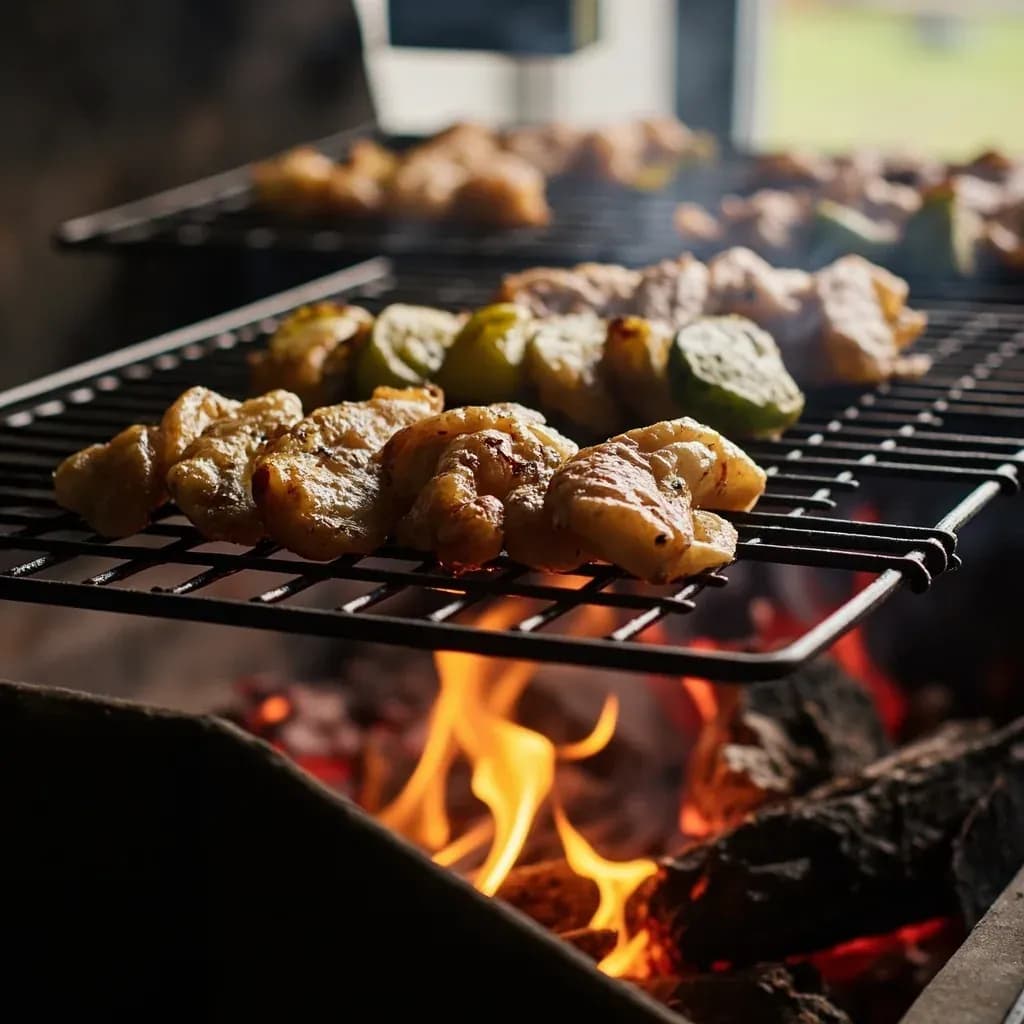
A grill fueled by burning hardwood or its embers, grilling food over live coals for smoky flavor.
A wood-fired grill cooks food over coals produced by burning hardwood logs, prized for the deep smoke and char it lends to meat, fish, and vegetables. Cooks often burn wood in a side chamber and rake the embers under an adjustable grate to manage heat. Mediterranean forms include the Catalan brasa and graella and the Italian griglia.
A wood-fired grill is any cooking setup in which hardwood, or the embers and charcoal produced by burning it, is the direct source of heat and smoke. Where gas and electric grills offer a dial and predictable temperatures, a wood-fired grill offers a fire, with all the variability and reward that implies. The cook's job is to manage the fire's stage — kindling, steady flame, deep bed of glowing coals, and eventually ash — and to position food at the right distance from it.
The appeal is twofold. First, dry hardwoods burn at high surface temperatures, producing the kind of sear and Maillard browning that open-flame cooking is famous for. Second, the pyrolysis of lignin in wood releases guaiacol, syringol, and related compounds that give real smoke its character — flavor you cannot fully replicate with a pellet smoke tube or from a gas grill's cooking chamber. The downside is that wood fires demand attention: airflow, fuel load, and timing must be read and adjusted throughout the cook.
A wood-fired grill is best treated as a category rather than a single appliance. It spans open hearths, masonry ovens with a grill deck, offset barrel cookers, adjustable parillas, kamado-style ceramic cookers running on hardwood lump, and professional combination oven-grills used in restaurants. What unites them is the use of burning seasoned hardwood as both flame and smoke.
Alternatives
Types & varieties
Stone or masonry floor with the fire built directly on the hearth and a grate set over the coals; the classic Mediterranean and Northern European form.
Horizontal barrel cooker with a side firebox; used for low-and-slow smoke-roasting and for high-heat grilling once coals are raked under the cooking chamber.
Permanent brick or stone structure that combines a wood-fired oven with a hearth, capable of grilling, roasting, and baking from the same fire.
Adjustable-height frame grate (often V-shaped) over a wood fire; the grate is cranked up and down instead of moving the food.
Wheel- or crank-operated grate over an open wood fire, originating in California ranch cooking; ideal for tri-tip and large steaks.
A vertical wood fire against which food such as bistecca alla fiorentina or whole fish is skewered and held at adjustable distance.
A long, narrow bin traditionally fired with binchotan white charcoal, sometimes supplemented with hardwood smoke for skewered meats and vegetables.
Egg-shaped ceramic vessel that holds heat like a masonry oven; can be fueled by hardwood lump charcoal and wood chunks for grilling and smoking.
An insulated firebox that slots into an outdoor kitchen counter or masonry island, delivering wood-fire grilling without a full oven build.
Enclosed steel chamber that combines a wood or charcoal fire with a convection oven; widely used in professional kitchens for grill-marked, smoke-kissed finishes.
Reading the fire
A wood fire moves through recognizable stages, and the cook's job is to cook at the stage that suits the food. Early on, the fire is flames and thin smoke — useful for kindling flavor in cold smoke applications but too volatile for direct grilling. As the wood collapses into a deep bed of glowing coals with a gray ash coating, surface temperatures peak and flames are minimal; this is the moment for high-heat searing. Later, as the coals dim and ash thickens, heat drops into the ideal smoke-roasting range of 225–275°F. Learning to read coals by color (cherry red versus dull orange), by the sound of the fire, and by the character of the smoke is more useful than any thermometer.
- Flame stage: high, licking, soot-forming — better for charring thin items briefly than for thick cuts.
- Coal stage: deep, glowing, mostly ash-covered coals — the prime grilling moment.
- Smolder stage: dim coals, thin blue smoke — best for low-and-slow smoke-roasting.
Wood selection
Hardwoods are categorized loosely by intensity. Strong woods like hickory and mesquite deliver bold, distinctive smoke — hickory sweet and bacon-like, mesquite earthy and robust — that can overwhelm fish or poultry; they suit red meat and pork. Medium woods — oak, pecan, maple — are versatile all-rounders. Light woods — alder, cherry, apple, pear — are sweet and gentle, well matched to poultry, pork, and seafood. Blending a strong wood with a milder one is a common technique for building complexity without bitterness.
- Avoid softwoods (pine, spruce, fir, cedar): resins deposit creosote and can flare.
- Aim for 12–20% moisture; wet wood is the single most common cause of bad-tasting smoke.
- Store splits off the ground, covered on top, and open to airflow on the sides.
Common uses
Tips & pitfalls
- Burn only seasoned hardwoods; softwoods like pine, spruce, fir, and cedar release resin that deposits creosote on food and can flare unpredictably.
- Let the fire burn down to a deep bed of glowing, ash-covered coals before grilling — cooking over open flame tends to char the outside before the inside is done.
- Set up two zones: a hot side directly over coals for searing and a cooler side for finishing, managing flare-ups, and resting.
- Pair wood to food — mesquite and hickory for red meat and pork; pecan, oak, and maple for poultry and general use; alder, cherry, and apple for pork, poultry, and fish.
- Manage airflow rather than fuel to control temperature: intake vents, dampers, and grate height are your real knobs.
- Do not douse a wood fire with water mid-cook; the steam and ash will coat the food. Spread or remove coals with a shovel or tongs instead.
- Avoid wrapping food in foil for long stretches on a wood fire; trapped juices and concentrated smoke can turn harsh and acrid.
- Clean the grate while it is hot with a stiff wire brush and oil it lightly after each cook to keep steel surfaces from rusting.
Good to know
- Heat source
- Seasoned hardwood logs, splits, chunks, or the embers and lump charcoal produced from them
- Grilling temperatures
- Roughly 450–700°F+ over live coals; 225–275°F for low-and-slow smoke-roasting
- Preferred fuel
- Seasoned hardwoods such as oak, hickory, mesquite, pecan, maple, alder, and fruitwoods; never softwoods like pine or fir
- Fuel moisture target
- Under 20%; well-seasoned or kiln-dried wood burns cleaner, hotter, and with thinner smoke
- Smoke profile
- Clean combustion is thin, bluish, and nearly invisible; heavy white or gray smoke deposits creosote and tastes acrid
- Flavor mechanism
- Smoke flavor comes from lignin pyrolysis (guaiacol, syringol) combined with Maillard browning at high surface heat
- Time to cook-ready
- About 30–60 minutes from a cold start to a deep bed of grilling coals, depending on wood size and airflow
- Difficulty
- Moderate to high — temperature is controlled by managing airflow, fuel, and fire stage rather than by turning a dial
Also called
Charcoal/Wood Grill · Brasa · Graella · Griglia
Related

Stovetop
The everyday burners where most cooking actually happens

Oven
Enclosed dry heat for roasting, baking, and braising

Grill
Live-fire or gas grates for char, smoke, and high heat

Smoker
Low, slow heat and wood smoke for barbecue and brisket

Air Fryer
Countertop convection that crisps with little or no oil

Slow Cooker
Set-and-forget low heat for stews, beans, and braises

Pressure Cooker
Sealed steam pressure that cooks tough food in a fraction of the time

Rice Cooker
Foolproof, perfectly steamed rice every single time