Appliances & Heat
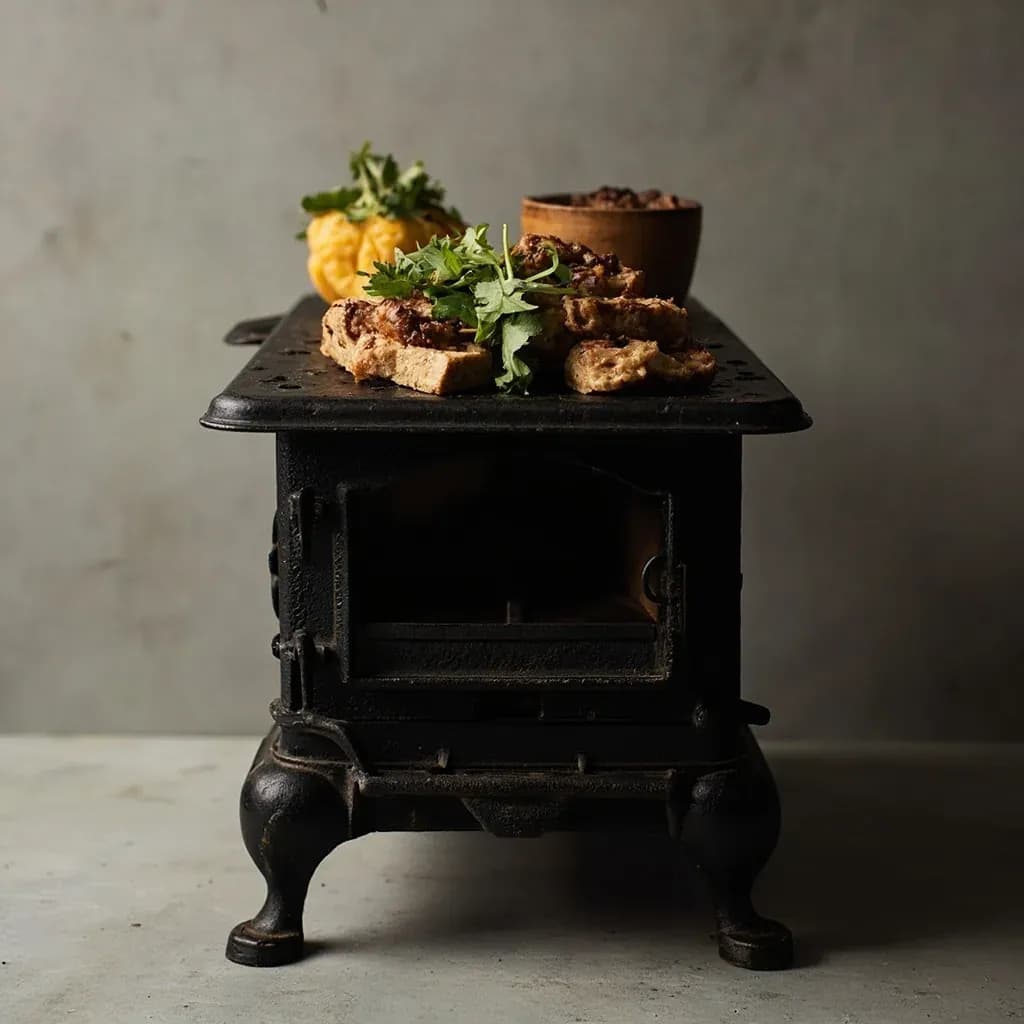
Wood-Burning Stove
An enclosed cast-iron or masonry stove that burns wood (or dung) for cooking and heating.
A wood-burning stove is a closed firebox, usually iron or tiled masonry, with a flat top that doubles as a cooktop and an oven or warming chamber. Enclosing the fire makes it burn more efficiently and safely than an open hearth while heating the room. Regional forms include the European kachelofen, the Himalayan bukhari, and yak-dung-fueled stoves on the high plateau.
A wood-burning cookstove is a contained firebox of cast iron, welded steel, soapstone, or masonry that turns a pile of logs into controlled cooking heat — the missing link between the open hearth and the gas range, and the tool that dominated rural kitchens across much of North America and Europe from the mid-1800s through the 1930s. What defines it is thermal mass: heavy iron or stone that soaks up heat from the fire and releases it slowly into food and room. That property is why a wood stove takes 30 to 60 minutes to come up to cooking temperature, why it holds steady for hours after you bank the coals, and why a cold pot set on a cold plate can take surprisingly long to boil. The cooking surface is a set of removable iron rings or hinged lids over the firebox; the oven, when present, is a baffled chamber of hot air surrounding or running alongside the firebox, read by a thermometer in the door.
Cooking on one is really managing three things at once — fuel moisture, draft through the damper and ash pan, and the body of iron or stone that holds and gives back heat. Move a pot from the front (hottest, directly over the firebox) toward the back, and you have just dialed in a lower temperature without touching the fire. Bank the fire with a log laid end-to-end and a partial ash cover, and you can hold 200°F in the oven for breakfast bread the next morning. The cost of all that thermal forgiveness is real: chimney creosote, indoor air-quality concerns, the daily need for dry split wood, and a cooktop whose thermometers routinely read 25°F or more off from actual.
Two parallel traditions are worth keeping straight. The American cast-iron kitchen range — Glenwood, Kitchen Queen, Monarch, and many others — is a freestanding appliance with lift-off cooktop lids, an integral oven, and usually a water reservoir, dominant from roughly 1880 to 1930. The European and Alpine masonry tradition — Kachelofen, Finnish soapstone stoves, the Russian pech — builds the stove into the house itself, with long flue paths running through tile or brick and food cooked in or on the masonry body. The rocket stove is the deliberate outlier: a small, simple, high-efficiency design that reshaped both the development-cooking world and the home-stove market.
Alternatives
Types & varieties
Benjamin Franklin's 1742 enclosed iron fireplace, ancestor of the cast-iron parlor and cookstove; uses splayed plates to radiate more heat into the room.
The classic American wood cookstove: lift-up cooktop lids over a firebox, integral baffled oven, often a water reservoir; makers included Glenwood, Kitchen Queen, and Monarch in the early 20th century.
Wood stove clad in or built of soapstone; prized for slow, even radiant heat and long retention. Tulikivi of Finland is the best-known modern maker.
Small, insulated vertical-combustion-chamber design using an insulated riser; reaches 60–85% efficiency and is easy to build. Popularized in the 1980s by Dr. Larry Winiarski at the Aprovecho Research Center.
Site-built or pre-cast thermal-mass stove of firebrick and fieldstone; common in Alpine and Scandinavian homes, with multiple burner hatches over long internal flue paths.
German and Austrian tiled masonry stove, primarily a space heater but traditionally fitted with cooktops and baking chambers.
Massive whitewashed brick stove with a large firing chamber, sleeping platform on top, and a chamber mouth used for bread and slow-cooked one-pot dishes.
Wood-pellet-fed variant with a hopper and electric auger; easier to regulate temperature, but requires electricity to run.
Managing heat on the cooktop
A wood cookstove gives you two big dials and a free third one. The two dials are the damper, which controls how fast hot gases leave through the chimney, and the fire size, which is how much wood is burning. The free one is position on the cooktop: the front plates sit directly over the firebox and run hottest; the back plates are downstream of the fire and noticeably cooler. Most cast-iron ranges show a working temperature swing of roughly 75–150°F between front and back plates, depending on fire intensity.
- Boil a gallon of water at the front over a brisk fire; move pots of stock, beans, or braise back to simmer.
- Use the hinged lids to convert hot plates into a flat griddle for pancakes or comal-style tortillas.
- The thermometer in the oven door is not a room thermometer and not a cooktop thermometer — trust it for oven work, not for surface work.
- To bake, preheat 45–60 minutes (longer than a gas oven), slide in a baking stone, and accept that recovery time after opening the door is measured in minutes, not seconds.
Banking the fire
Banking is the technique of partially covering a hot fire with ash and a fresh log so it smolders slowly for hours without going out. It is how a wood cookstove cooks breakfast the morning after dinner, and it is also how you keep a room warm through a winter night without feeding the fire every hour.
- Rake coals to the front of the firebox and leave 1–2 inches of ash on the grate.
- Lay one or two large logs end-to-end along the coals, then cover with a thin layer of ash.
- Close the damper most of the way, but never all the way on a still-active fire — CO and creosote build quickly.
- Top-down lighting (big logs on the bottom, kindling on top) gives a cleaner overnight burn than the conventional teepee start.
Wood, creosote, and chimney care
Almost every wood-stove problem traces back to fuel moisture and draft. Seasoned hardwood — split, stacked, and sheltered for 6 to 12 months — burns hotter and cleaner than anything sold as 'firewood' at a roadside stand in winter. A moisture meter is the single most useful $20 tool a new wood cook ever buys. Creosote is the dark, tar-like condensate that builds up inside a cool or slow-burning chimney; once it reaches about 1/8 inch, the next fire should be treated as urgent maintenance.
Common uses
Tips & pitfalls
- Burn only seasoned hardwood at 20% moisture or less — wet wood wastes heat, glazes the chimney with creosote, and blackens the cookware.
- Light top-down for cleaner combustion and a longer-lasting fire: large logs on the bottom, smaller splits on top, kindling on the very top.
- Use the hot-spot / cold-spot trick — move pots between the front (hottest) and back (cooler) plates instead of constantly lifting lids to check.
- Do not overfire. Long, very hot fires warp cast-iron cooktop lids and crack firebrick; respect the manufacturer's BTU rating.
- Never close the damper fully on a live fire — CO and creosote accumulate fast. Crack it open even on an overnight bank.
- Inspect and clean the chimney at least once a year; once you see 1/8 inch of creosote, treat the next fire as urgent maintenance.
- Season a cast-iron cooktop before first use with a thin coat of flaxseed or vegetable oil, brought up gradually through several low fires to polymerize the oil.
- Trust the oven thermometer in the door, but verify with an independent oven thermometer for the first dozen bakes — built-ins routinely read 25°F off.
Good to know
- Also called
- Wood cookstove, wood range, wood-fired cookstove, solid-fuel cookstove
- Primary materials
- Cast iron, welded steel, soapstone, firebrick, and fieldstone masonry
- Typical fuel
- Seasoned hardwood at 20% moisture or less; pellets, softwoods, and dry dung in some regions
- Cooktop surface temperature
- Roughly 300–600°F on the plates; 1,000–1,500°F inside the firebox
- Heat-up time from cold
- 30–60 minutes to reach useful cooking temperature
- Thermal efficiency
- Open hearth 10–15%; enclosed cookstove 25–40%; rocket and well-built masonry stoves 60–85%
- Oven temperature range
- About 225–450°F on most cast-iron ranges, regulated by the damper and fire intensity
- Chimney and safety
- Code-compliant Class A insulated chimney or masonry flue; 1/8 inch of creosote buildup is the recognized danger threshold for chimney fire
Also called
Wood-Fired Stove · Bukhari · Soba · Agungi · Kachelofen · Tiled Stove · Yak-Dung Stove
Related

Stovetop
The everyday burners where most cooking actually happens

Oven
Enclosed dry heat for roasting, baking, and braising

Grill
Live-fire or gas grates for char, smoke, and high heat

Smoker
Low, slow heat and wood smoke for barbecue and brisket

Air Fryer
Countertop convection that crisps with little or no oil

Slow Cooker
Set-and-forget low heat for stews, beans, and braises

Pressure Cooker
Sealed steam pressure that cooks tough food in a fraction of the time

Rice Cooker
Foolproof, perfectly steamed rice every single time