Appliances & Heat
Yogurt Maker
Countertop appliance that holds milk at a steady warm temperature to culture yogurt.
A yogurt maker gently warms inoculated milk and maintains it at the ideal incubation temperature, usually around 40-45°C, for several hours while live cultures thicken it into yogurt. Many models include individual jars for portioned servings. It removes the guesswork of holding a stable temperature compared with an oven light or cooler method.
A yogurt maker is a small countertop appliance whose only job is to hold milk at a steady 110–115°F (43–46°C) for several hours — the narrow temperature window in which Lactobacillus bulgaricus and Streptococcus thermophilus, the two workhorse cultures of yogurt, convert lactose into lactic acid and build a gel. Unlike an oven, slow cooker, or heating pad, a dedicated maker is built to maintain that band without fluctuation, often holding it within a degree or two for 8–12 hours without attention. That repeatability is the real reason cooks own one: once you dial in a milk and starter you like, every subsequent batch sets the same way.
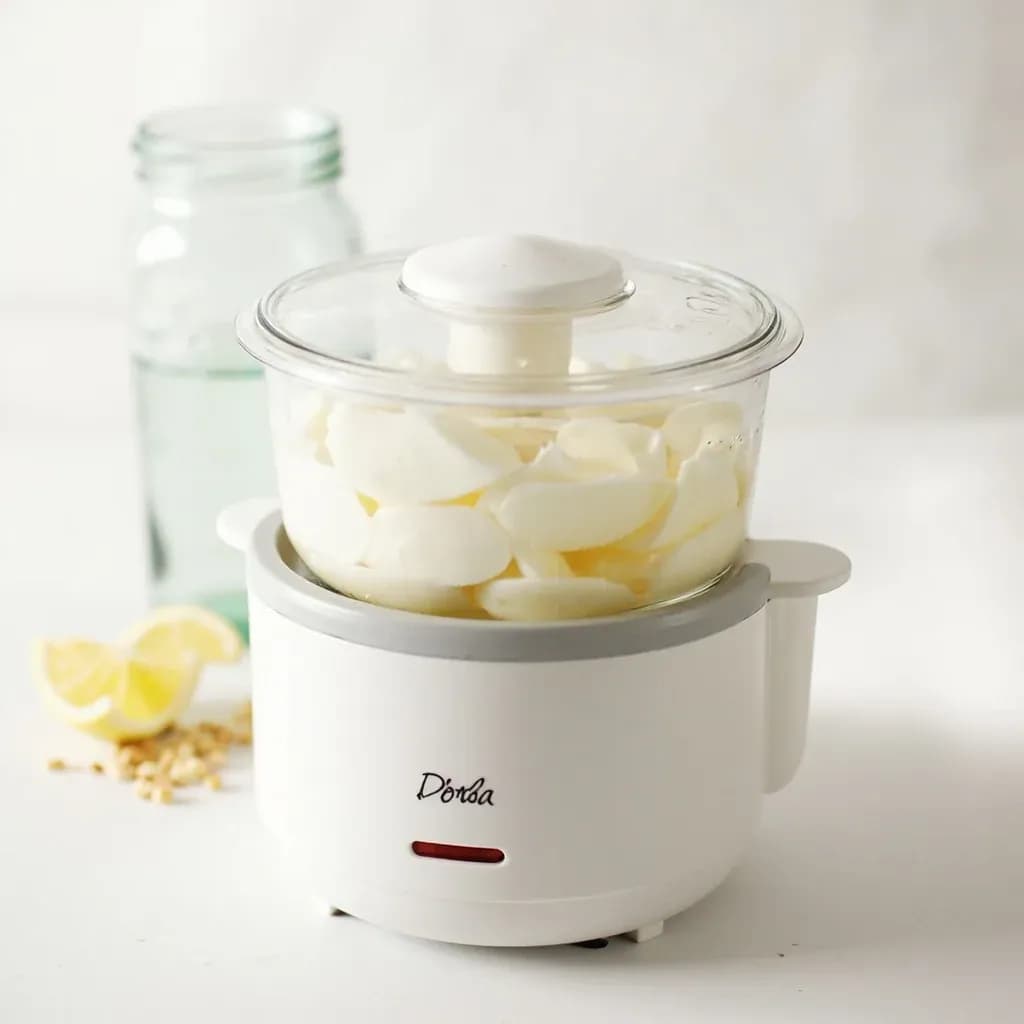
The appliance itself is simple. A heated base warms either individual glass jars or a single bowl nested in a wrap-around heat sleeve; culturing happens in the containers, not the base. Most units are plastic with glass inserts, draw 12–20 watts, and essentially become warm bricks during incubation. The work that determines final texture — heating the milk to denature its proteins, cooling it precisely, whisking in a healthy starter, and chilling the set curd to stop fermentation — all happens around the maker rather than inside it.
For cooks who already own a multi-function cooker or sous-vide circulator, a dedicated yogurt maker can feel redundant, since the yogurt setting on an Instant Pot or an immersion circulator in a pot will hold 110°F just as well. Where dedicated makers still earn their place is in the dry, undisturbed heat they provide, the convenience of pre-portioned glass jars, and the ability to run a batch without tying up a larger appliance.
Alternatives
Types & varieties
Heated base with 4–8 individual glass jars; popular examples include Cuisinart YM-400, Hamilton Beach 33005, and Euro Cuisine YM80. Good for staggered batches and portioning.
One larger 1–2 quart container nested in a heated wrap-around base; one batch at a time, useful for Greek straining or large families.
Pre-heated container that holds 110°F passively for 4–6 hours using thermal mass. No power needed, but less precise.
A pre-warmed wide-mouth thermos cultures a small batch using only retained heat. Lowest-tech option, suited to small yields.
Pressure cookers such as the Instant Pot and sous-vide circulators both have yogurt modes that hold 110°F steadily, making a dedicated unit optional in many kitchens.
A fine-mesh or cloth strainer that nests in or over the maker's bowl to drain whey after incubation, producing thick, spoonable Greek yogurt.
A seedling heat mat or wrapped towel inside a picnic cooler used as an improvised incubator — a low-cost workaround, not a commercial unit.
How it actually works
Yogurt is the result of two specific thermophilic bacteria consuming lactose and producing lactic acid. The acid drops the milk's pH, which causes casein proteins to unfold and link into a three-dimensional gel — that gel is the set. The maker's only job is to keep the milk warm enough that the bacteria stay active but cool enough that they don't die, and to hold that temperature without cycling up and down. Sharp swings during incubation — especially across the 100°F or 120°F thresholds — can stress the culture and give you a thin, weeping curd, which is why a dedicated unit outperforms a turned-on oven light or a drafty windowsill.
- Bacteria: Lactobacillus bulgaricus and Streptococcus thermophilus work in symbiosis; bulgaricus produces peptides that feed thermophilus, and thermophilus produces formic acid that feeds bulgaricus back.
- Acid build: pH drops from ~6.7 to ~4.5 over 6–10 hours. Below 4.0, the cultures begin to die off and acidity becomes harsh.
- Texture drivers: protein content, fat level, the 180°F pre-heat, and the addition of powdered milk all push toward a thicker set; the culture strain itself has a smaller effect than most recipes imply.
Choosing between a maker and a multi-function cooker
If you already own an Instant Pot, a sous-vide circulator, or even a well-regulated slow cooker with a 'warm' setting, you can produce essentially identical yogurt without buying a dedicated machine. The case for buying one anyway comes down to convenience and capacity: pre-portioned glass jars go straight from maker to fridge, the dry air of a heated base is gentler on long ferments than a water bath, and a maker can be left running overnight without tying up a larger multi-cooker.
From set yogurt to Greek, labneh, and skyr
The maker's job is finished once the milk has gelled. The texture of Greek, labneh, and skyr is created afterward by draining whey. Line a fine-mesh strainer, a nut-milk bag, or a coffee filter-lined colander with cheesecloth, ladle in the set yogurt, and refrigerate 2–6 hours. The longer it drains, the thicker and more concentrated the result becomes — and the more the tang concentrates with it.
- Greek-style: 2–4 hours of draining for thick spoonable yogurt; about half the original volume remains.
- Labneh: 12–24 hours, often finished with a pinch of salt; spreadable, like a very soft cream cheese.
- Skyr-style: start with a higher-protein milk or add nonfat dry milk, then drain longer for an extra-dense result.
Common uses
Tips & pitfalls
- Heat milk to 180–185°F before cooling and inoculating. Skipping the hot hold is the single biggest reason for thin, store-bought-looking yogurt that never sets firmly.
- Cool the milk to 110°F before adding starter, and verify with an instant-read thermometer. Anything above 120°F will kill the culture; below 100°F will slow fermentation significantly.
- Temper the starter by whisking it into a small ladle of warm milk first, then whisk back into the pot. Dropping freeze-dried culture or a spoonful of yogurt directly into the full volume often leaves clumps of unincorporated culture on the bottom.
- Don't peek, stir, or move the maker during incubation. Settling undisturbed gives a cleaner gel; disturbing it mid-set can break the curd and produce a looser, weeping texture.
- Pull the batch at 6–8 hours for mild, slightly sweet yogurt, or 10–12 hours for a tangy profile. Going past 14 hours usually crosses into harsh, almost vinegar-like acidity.
- Chill the set jars in the refrigerator for at least 4 hours before eating. Cold sets the final texture and halts fermentation; warm yogurt continues to acidify and will taste sharper than it should.
- Avoid UHT/shelf-stable milk for the thickest set — its proteins don't coagulate as well. If you must use it, add 2–3 tablespoons of nonfat dry milk per quart to compensate.
- Sterilize jars and lids in boiling water or a hot dishwasher cycle before each batch. A single wild yeast or mold spore can ruin a 12-hour incubation.
Good to know
- Optimal incubation temperature
- 110–115°F (43–46°C); most electric units target ~110°F
- Typical fermentation time
- 4–12 hours; longer = tangier, more acidic
- Bacterial cultures
- Lactobacillus delbrueckii subsp. bulgaricus and Streptococcus thermophilus (standard); heirloom and multi-strain starters also widely used
- Milk prep temperature
- Heat to 180–185°F (82–85°C) before culturing, then cool to 110°F — the hot hold denatures whey proteins and dramatically improves thickness
- Typical capacity
- 4–8 individual jars of 6–8 oz, or 1–2 quart single containers; 1-quart mini models also exist
- Power draw
- Roughly 12–20 W during incubation — very modest compared to an oven or slow cooker
- Yield and straining
- About 1 quart of milk yields ~1 quart of yogurt; draining for Greek-style cuts volume by roughly half
- Origin
- Electric home yogurt makers became popular in North America and Europe in the 1980s; Yogourmet (Canada) was an early mainstream brand
Also called
Yogurtnitsa · yoghurt maker · yogurt incubator
Related

Stovetop
The everyday burners where most cooking actually happens

Oven
Enclosed dry heat for roasting, baking, and braising

Grill
Live-fire or gas grates for char, smoke, and high heat

Smoker
Low, slow heat and wood smoke for barbecue and brisket

Air Fryer
Countertop convection that crisps with little or no oil

Slow Cooker
Set-and-forget low heat for stews, beans, and braises

Pressure Cooker
Sealed steam pressure that cooks tough food in a fraction of the time

Rice Cooker
Foolproof, perfectly steamed rice every single time