Knife Skills
Cleaver Mincing
Using a heavy cleaver to chop meat or aromatics into fine mince.
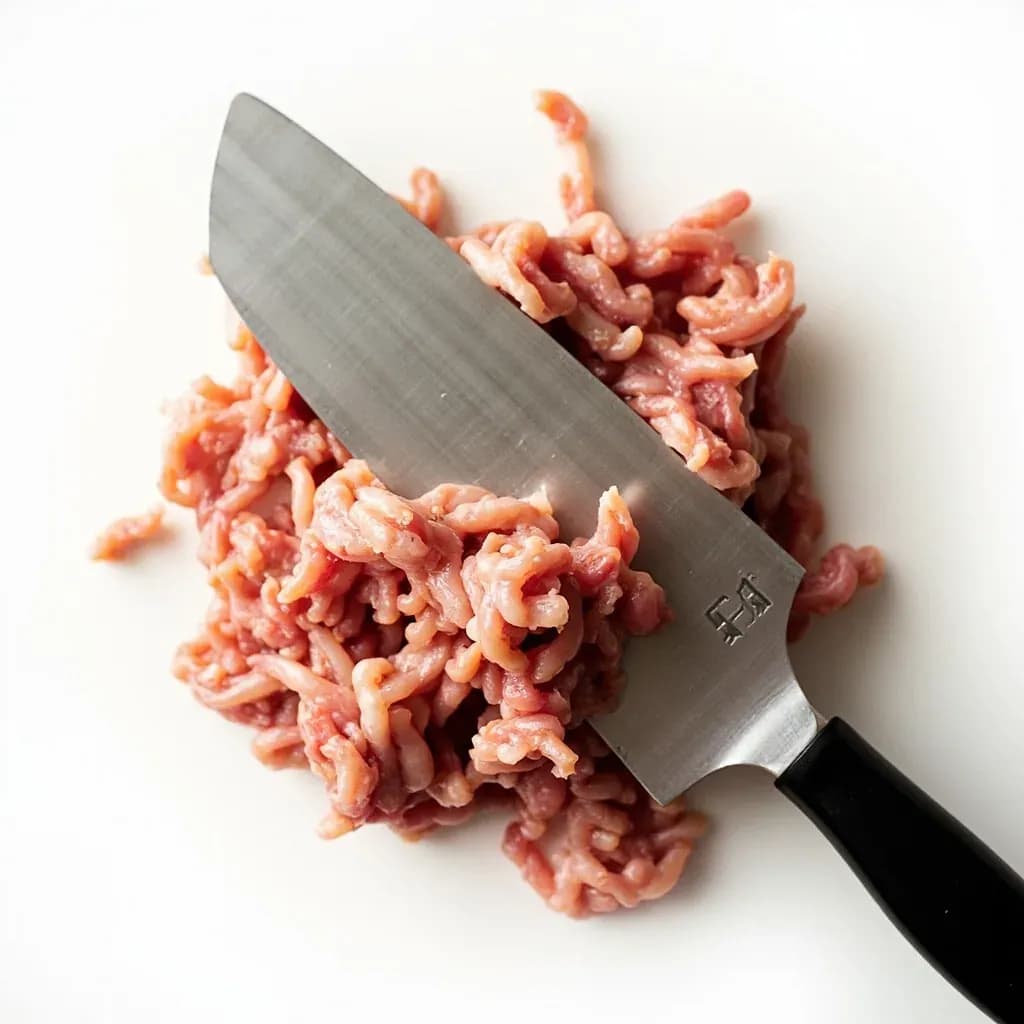
Cleaver mincing rocks and chops with a broad Chinese cleaver to reduce meat or aromatics to a fine, even mince, the 剁 technique. The cleaver's weight does much of the work, letting cooks power through cartilage and tougher cuts quickly. It produces the loose, hand-cut texture prized in Chinese dumpling fillings and meatballs, and the flat blade doubles as a scoop.
Cleaver mincing is the workhorse chopping technique of the Chinese kitchen, in which a heavy rectangular càidāo (Chinese cleaver) is driven through meat or aromatics in a rapid, two-handed rocking motion while the blade stays in continuous contact with the board. The cook's off-hand rides flat across the top of the blade, adding downward pressure so that the cleaver's weight — not arm strength — does the cutting. This grip and the cleaver's broad, flat geometry let the cook produce anything from a coarse 5–8 mm chop to a true, sticky meat paste (ròu mí) in under two minutes, using a single tool that also scoops and scrapes as it works.
The method is most closely associated with northern Chinese cooking — Shandong, Beijing, and the northeast — where dumpling fillings, lion's head meatballs, and pork-based stuffings are daily work. But it is the default mince in nearly every Chinese restaurant prep line because it is faster, more uniform, and less tiring than a chef's knife rock-chop on a large batch. The cleaver's heft and the fact that the off-hand literally rides the steel also make it safer than it looks: the fingers are kept away from the edge, and the stroke is short and controlled.
- Difficulty
- Medium
Types & varieties
The classic two-handed rock for meat pastes; blade never leaves the board, used for dumpling, wonton, and meatball fillings.
Same grip but fewer, slower strokes; yields 5–8 mm pieces suitable for stir-fries and stuffings.
Garlic, ginger, and scallion whites are first smashed flat with the blade side, then minced in place to release juices.
Blade lifted and brought straight down; used for hard, dense items like dried beans or when precise evenness matters more than speed.
Off-hand only stabilizes the food; useful for softer ingredients and small batches where a two-handed stroke is overkill.
How to do it
- 1
Prepare the ingredient
Trim sinew and silver skin from meat. For raw meat, chill uncovered in the freezer for 20–30 minutes until firm but not frozen solid. Slice across the grain into 1–2 cm slabs or 2 cm dice so the cleaver can move through layers instead of bouncing off a thick block. For aromatics, peel garlic and ginger and lightly smash with the flat side of the blade to break the fibers before mincing.
- 2
Set up the board and grip
Lay a thick wooden or HDPE board on a damp cloth so it does not slide. Grip the cleaver handle with your dominant hand. Place the palm of your off-hand flat across the top of the blade near the tip or middle, fingers extended and tucked into a soft claw so the blade can ride along your knuckles to set the cut thickness.
- 3
Anchor the blade
Set the middle of the cleaver edge on the food with the blade face flat against the board. The blade should remain in continuous contact with the board for the entire mince; lifting it costs both speed and control.
- 4
Rock and smacking stroke
Drive the blade forward and down with a short, firm stroke powered from the elbow and shoulder, then pull it back along the board into the next bit of food. The off-hand pushes straight down to add pressure. Settle into a rapid, even rhythm — about two strokes per second once warmed up.
- 5
Work in rows and re-pile
Begin at the far edge of the food and work backward in overlapping rows. Every 6–8 strokes, use the blade to scrape the mince back into a pile, spread it out flat, and continue. This prevents a coarse center ringed by an overworked edge and keeps the particle size uniform.
- 6
Bind into a paste (optional)
For dumpling, wonton, or meatball fillings, sprinkle 1–2 tsp of cold liquid (water, stock, or shaoxing wine) over the mince partway through and keep chopping. The liquid and continued mincing develop myosin in the meat, turning the mince sticky, elastic, and cohesive — the proper state for shàng jìn.
- 7
Check and finish
Stop at the desired fineness: coarse for stir-fry, medium for most fillings, or a smooth, glossy paste for meatballs. Use the cleaver blade itself to scoop the mince into a bowl — the flat face is the tool's own scraper.
Why the cleaver works differently from a chef's knife
A Chinese cleaver is not a heavy butcher's axe; the blade is thin (roughly 2–3 mm) but tall and broad, and most of the weight sits forward of the handle. That mass, combined with the off-hand pressing on the spine, turns each stroke into a controlled percussive cut. The wide, flat face also keeps the mince contained on the board and acts as its own scraper and scoop, so a cook can work a kilo of pork with a cleaver and a board and nothing else.
- Heft + downward palm pressure = cutting done by gravity, not by muscle.
- Tall blade walls keep the mince from flying off the board.
- Flat face replaces the need for a bench scraper or bowl scraper.
- Continuous contact with the board gives a more even particle size than a lifted chop.
Reading texture as you go
The cook's senses — sight, sound, and feel — are the only timing cues. The mince is judged by how the blade moves through it: a coarse chop resists and crunches, a medium mince gives way with a soft, wet hiss, and a finished paste grabs the blade and pulls back on the hand.
Common uses
Tips & pitfalls
- Let the cleaver's weight do the work; arm strength only causes fatigue and ragged cuts.
- Partially freeze meat for 20–30 minutes so fibers shear cleanly instead of smearing under the blade.
- Pre-slice meat into 1–2 cm slabs so the cleaver has something to bite into rather than a thick block.
- Keep the off-hand in a soft claw and let the flat of the blade ride your knuckles to set the chop thickness — this protects your fingertips and standardizes the cut.
- Keep the blade face flat on the board between strokes; a chopping arc kills both speed and uniformity.
- For a true paste, sprinkle cold water or stock over the mince mid-chop so the fibers bind into a sticky mass.
- Use the cleaver as its own scraper and scoop; reaching for a second tool slows you down and adds cleanup.
- Common mistake: working on a thin plastic board that bounces and chews the edge — use a thick wooden or HDPE board.
- Common mistake: leading with the tip. The tip is thin and weak, and you lose leverage. Use the middle to heel of the edge.
- Common mistake: a wide wrist arc. The stroke should come from the elbow and shoulder in a short, tight path; a flapping wrist is slow and dangerous.
Good to know
- Origin
- Chinese culinary tradition, refined in northern Chinese home and restaurant kitchens
- Knife used
- Chinese cleaver (càidāo), typically 18–22 cm blade, 0.5–1 kg
- Grip
- Dominant hand on the handle; off-hand palm presses flat across the top of the blade near the tip or middle
- Motion
- Short, repeated rock-and-smack stroke; the blade stays in contact with the board and is rarely lifted
- Working edge
- Middle and heel of the blade; the tip is avoided because it is thin and weak
- Fineness range
- Coarse 5–8 mm pieces through a smooth, sticky paste (ròu mí)
- Speed
- An experienced cook can produce a fine pork paste in under 90 seconds from 250 g of meat
- Difficulty
- Moderate; safe once the rhythm is learned, but requires practice to protect fingertips and keep the cadence even
Also called
Cleaver Mincing (剁) · Cleaver Chopping
Related

Chop
Cut into rough, irregular pieces — the everyday workhorse cut

Dice
Cut into uniform cubes for even cooking and a tidy look

Mince
Cut as fine as possible so flavor melts evenly into the dish

Slice
Cut into even, flat pieces for consistent cooking and presentation

Julienne
Cut into thin matchsticks for fast cooking and elegant garnish

Brunoise
Cut into tiny, precise cubes — the finest dice in the kitchen

Chiffonade
Roll and slice leafy greens into delicate ribbons

Batonnet
Cut into tidy sticks, thicker than julienne — think classic fries