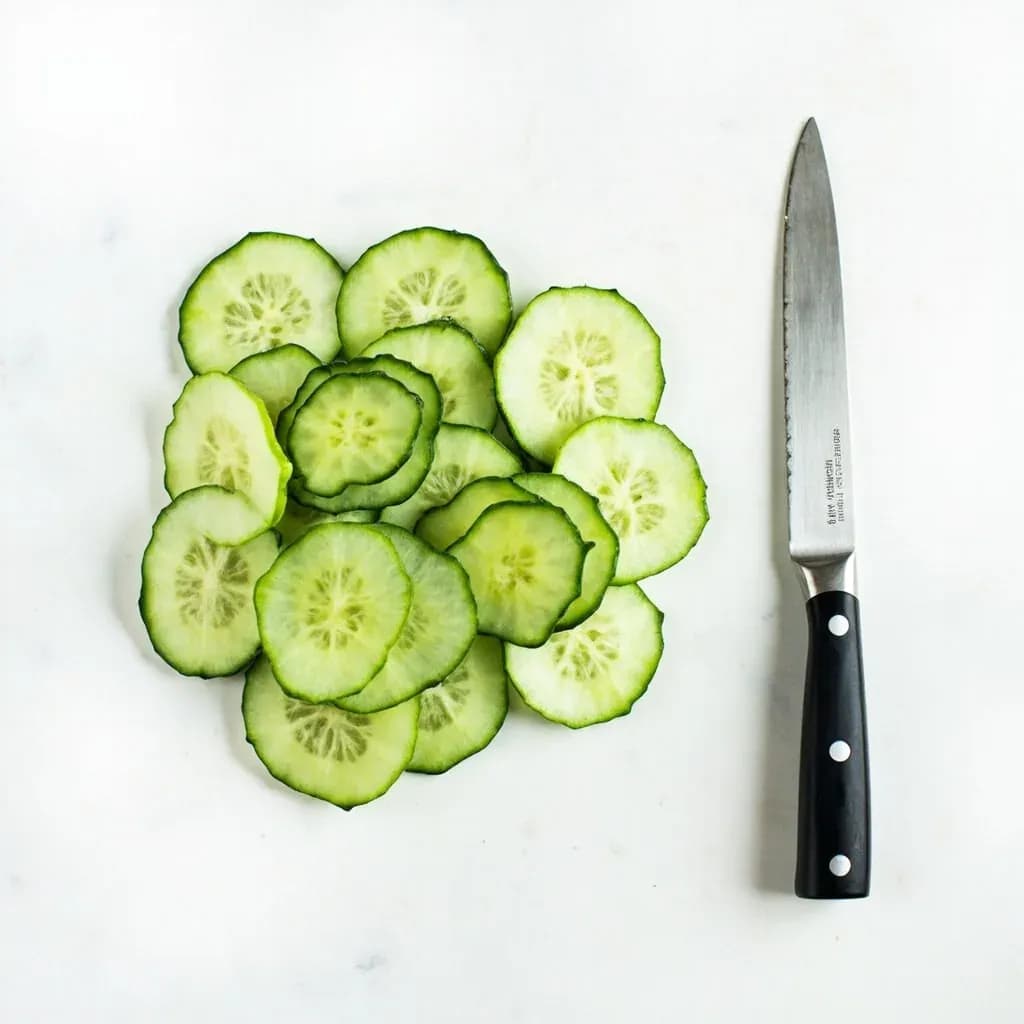
Knife Skills
Crescent Slicing (Half-Moon Cut)
Halving a round vegetable lengthwise, then slicing each half into half-moon crescents.
Crescent slicing, or the half-moon cut, takes a cylindrical vegetable such as a cucumber, zucchini, or onion, splits it lengthwise, and then cuts the flat-faced halves crosswise into curved semicircles. The shape gives more surface area and a more interesting bite than plain rounds, and is common in stir-fries, salads, and pickles. In Japanese cooking it is known as hangetsu-giri.
Crescent slicing — also called the half-moon cut — produces pieces with one flat face and one curved edge, a geometry that does more than look tidy. The flat side sits flush against the board, so the vegetable refuses to roll under the knife, and once it hits a hot pan that same face lays down for full contact with the metal, which means better browning and more even caramelization than a rondelle cut from the un-halved vegetable.
The cut earns its place in the foundational knife-skill set because it solves two problems at once. Stability and surface area. Cylindrical produce — carrots, zucchini, cucumbers, radishes, parsnips, plantains, sweet potatoes, baby turnips — is awkward to slice while round, and the curved skin side of a rondelle repels oil and seasoning, so browning concentrates on the cut edges. Halving gives you a flat working base and doubles the cut-edge area that can absorb salt, oil, and marinade.
It is also the gateway cut to more advanced techniques. The same halve-and-lay-flat logic underpins the oblique (roll) cut used on tapered roots and the quarter-moon variant for thinner sauté pieces, so mastering the basic crescent pays dividends as your knife work progresses.
- Difficulty
- Easy
Types & varieties
Vegetable halved along its long axis, then sliced crosswise; the standard and most common form.
Vegetable halved across its short axis, then sliced; used on shorter rounds like radishes and baby turnips.
Vegetable quartered lengthwise, then sliced; yields thinner crescents ideal for sautés and stir-fries.
Knife held at a sharp angle to the vegetable for elongated, decorative crescents — the bridge to the roll cut.
How to do it
- 1
Trim and stabilize
Slice a thin sliver off one long side of the vegetable so it has a flat face, then set that flat face down on the board. For very short rounds like radishes, trim the root and stem ends instead and halve crosswise.
- 2
Halve lengthwise
With the vegetable flat-side down, cut straight down through the center lengthwise to make two long halves. On shorter vegetables, halve crosswise to keep the crescents bite-sized.
- 3
Lay flat for control
Place each half cut-side down. The flat surface anchors the piece against rolling, and the curved upper edge acts as a built-in thickness guide.
- 4
Slice crosswise into crescents
Working from one end to the other, cut across the half at your chosen thickness. Keep the knife tip on the board and use a steady rocking or draw stroke; let the previous slice guide the next one.
- 5
Adjust for taper and check uniformity
On tapered vegetables, rotate the half a few degrees between cuts near the thin end so the crescents stay close in size. Toss the trimmings into the pan or save them for stock.
Crescents versus other basic cuts
Crescent slicing sits in the same family as the rondelle, the oblique cut, and the paysanne, but each has a different job. A rondelle is a straight crosswise slice through the whole vegetable: fast, but the cylinder rolls and the skin side resists browning. The oblique cut (also called the roll cut) is essentially a crescent sliced on a bias from a long, tapered root — it produces more pieces per inch of vegetable and looks more refined on the plate. The paysanne is a thin, half-moon-shaped slice about 1/8 inch thick used for quick-cooking garnishes in soups and sautés. Reach for the basic crescent when you want pieces substantial enough to roast, braise, or hold their shape in a stew; switch to the oblique when presentation and maximum yield from long roots matter; pick the paysanne when the pieces are meant to disappear into a sauce or cook in under a minute.
Matching thickness to the cooking method
Thickness is the single biggest variable in how crescent pieces behave in the pan, and it should be chosen before you start cutting, not after. The general rule: the longer the cooking time, the thicker the slice. Thinner pieces cook faster, lose more moisture, and scorch at the edges; thicker pieces stand up to long braises and develop a crusty exterior without turning to mush. Use the ranges below as a starting point, then adjust to your knife, your heat, and the specific vegetable.
- 1/8 inch (3 mm): quick sautés, stir-fries, pickles, raw salads and slaws where you want delicate, almost translucent pieces.
- 3/16 inch (4–5 mm): pan-frying, sheet-pan roasting at high heat, gratins where pieces should soften but not dissolve.
- 1/4 inch (6 mm) and up: long braises, stews, roasted root medleys where a caramelized crust and a tender-but-firm interior are the goal.
Common uses
Tips & pitfalls
- Trim a thin slice from one side of the round vegetable first so it sits flat before halving — never try to halve a rolling cylinder on a bare board.
- After halving, lay the cut side flat; this gives you a stable base and a visible guide for even thickness.
- Curl your fingertips into a claw grip and let the knife tip rest on the board; use a smooth rocking or straight downward stroke and don't lift the blade fully between cuts.
- Aim for consistent thickness: uneven crescents cook unevenly, with thin edges scorching before thick centers softening.
- Keep the knife sharp; a dull blade crushes cell walls and leaves ragged, moisture-losing edges.
- For long vegetables like carrots or zucchini, halve again lengthwise to get quarter-moons that are easier to manage and cook faster.
Good to know
- Also known as
- Half-moon cut, half-moon slice
- Category
- Basic knife skill / vegetable preparation
- Primary tools
- Chef's knife (8–10 in) or santoku; stable cutting board
- Typical thickness
- 1/8 to 1/4 inch (3–6 mm), depending on application
- Best for
- Cylindrical or slightly tapered round vegetables
- Yield
- Nearly 100% of usable flesh; minimal trim required
- Difficulty
- Beginner
- Key benefit
- Flat side prevents rolling and exposes more surface area for browning and seasoning
Also called
Crescent Slicing (Half-Moon Cut) · Half-Moon Cut · Half-Moon Slicing · Hangetsu-giri
Related

Chop
Cut into rough, irregular pieces — the everyday workhorse cut

Dice
Cut into uniform cubes for even cooking and a tidy look

Mince
Cut as fine as possible so flavor melts evenly into the dish

Slice
Cut into even, flat pieces for consistent cooking and presentation

Julienne
Cut into thin matchsticks for fast cooking and elegant garnish

Brunoise
Cut into tiny, precise cubes — the finest dice in the kitchen

Chiffonade
Roll and slice leafy greens into delicate ribbons

Batonnet
Cut into tidy sticks, thicker than julienne — think classic fries