Prep & Assembly
Frothing Chocolate
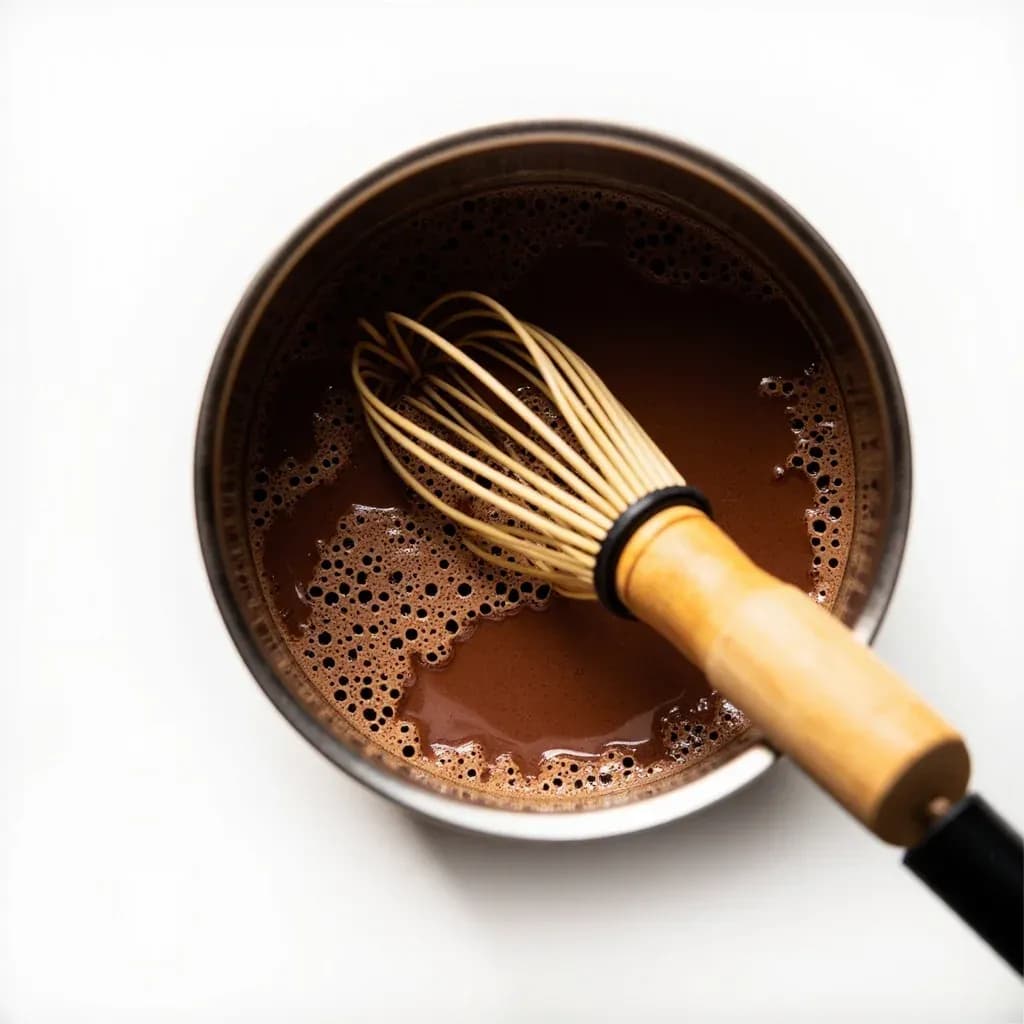
Spinning a molinillo whisk to raise a thick foam on hot drinking chocolate.
Frothing chocolate is the Mexican technique of rolling a carved wooden molinillo between the palms inside a pot of hot chocolate to aerate it into a thick, foamy crown. It both mixes in the dissolving chocolate and tablets and incorporates air for the prized froth. The same motion can be done with a whisk, but the molinillo is traditional for atole and champurrado as well.
Frothing chocolate is the old-world practice of whipping hot drinking chocolate by hand until it develops a thick, pale crema that floats on the surface of the cup. It is most often associated with the molinillo, a turned wooden whisk with a long handle and a knobbed, ring-stacked head that is rolled briskly between the palms to agitate the liquid. Far from a finishing flourish, the frothing is the technique that defines the drink: it dissolves the last grains of table chocolate, melds the fat into the liquid, and beats in just enough air to give the finished cup a layer of mousse-like foam that holds its shape from the pot to the table.
The practice predates European contact, originating in Mesoamerica where the Aztecs and Maya frothed xocolātl in clay vessels for ceremonial and everyday use. When drinking chocolate crossed the Atlantic in the 16th and 17th centuries, the molinillo and its rolling motion came with it, taking root in Spain as chocolate a la taza and later spreading across the Hispanic world. What the technique demands is simple but specific: a coarse-ground table chocolate (not chips or couverture), a fatty liquid such as whole milk, gentle heat that stays just below a simmer, and two to five minutes of sustained agitation. Get any of those wrong and the crema either never forms or collapses back into the cup.
- Difficulty
- Easy
Types & varieties
The classic technique: spinning a wooden molinillo between the palms in a clay or metal pot.
Iberian adaptation using a thicker, sweeter drinking chocolate; same molinillo motion, often in a chocolatera.
Frothed chocolate thickened with masa harina; the masa stabilizes an especially velvety foam.
A wire whisk or wooden baton used in the same rolling motion when a molinillo is unavailable.
Hand-held milk frother, immersion blender, or French press used to replicate the foam without a molinillo.
How to do it
- 1
Heat the liquid
Pour whole milk (or milk-and-water, or water alone) into a clay cazuela, small saucepan, or chocolatera and warm over medium heat until it steams and small bubbles form at the edge — about 170°F / 77°C. Do not let it boil.
- 2
Add the chocolate
Grate or finely chop Mexican table chocolate (about 1 oz / 28 g per cup) and stir it in. Reduce heat to low and stir gently until every grain has melted and the surface is glossy.
- 3
Insert the molinillo
Place the molinillo in the center of the pot, resting its base on the bottom. Hold the handle vertically between your open palms.
- 4
Roll between the palms
Pressing palms together and releasing in quick succession, spin the molinillo between them. Aim for a rapid, sustained rotation — a clear vortex should form in the liquid.
- 5
Build the foam
Continue rolling for 2–5 minutes. The surface will go from glossy to bubbly to a thick, pale crema. If the liquid cools too much, return it briefly to a low heat.
- 6
Serve with the crema intact
Lift the molinillo straight up (tap it on the rim so foam falls back into the pot). Pour the chocolate into cups, then spoon the crema on top so it sits in a distinct layer.
How the molinillo works
A molinillo is deceptively simple: a slender wooden handle, a bulbous head with concentric rings, and a small finial at the bottom. When the handle is rolled between the palms, the rings spin through the liquid and act like the cage of a manual mixer, drawing chocolate up from the bottom of the pot and beating it into a vortex. The motion is fast and rhythmic, more like playing a drumstick than stirring. As the chocolate circulates, the rings incorporate small amounts of air, the fat emulsifies with the milk or water, and the surface gradually changes from glossy to frothy to a thick, pale foam. The tool doubles as a thermometer of sorts: a properly rolling molinillo hums in the hands, and the vortex it creates is the visual cue that the foam is building.
Why the foam holds
The stability of the crema comes from a combination of fat, cocoa solids, and starch. Whole milk supplies milk fat; table chocolate supplies cocoa butter and finely ground cocoa solids; champurrado adds masa harina, whose starches act as a foam stabilizer. Together they trap air bubbles in a network that resists collapse for several minutes — long enough to carry the cup to the table. This is also why couverture chips and most bar chocolate fail at the job: their added emulsifiers (soy lecithin, PGPR) tighten the chocolate and inhibit the kind of loose, fat-rich structure a crema needs. Coarse, minimally processed table chocolate, with its cinnamon, sugar, and sometimes almond or vanilla, is the right raw material for the technique.
Common uses
Tips & pitfalls
- Use whole milk — or add 1–2 tsp melted butter to water-based chocolate. Fat is what holds the foam.
- Melt the chocolate fully before frothing; grated or finely chopped chocolate incorporates faster and prevents grainy pockets.
- Keep the heat low once the chocolate is melted. A hard boil collapses the crema and can scorch the milk.
- Roll the molinillo fast enough to create a visible vortex in the pot; the rings do the actual whipping, not your arms.
- Tap the molinillo on the rim of the pot before lifting it out so excess foam falls back in instead of clinging to the wood.
- A pinch of fine sea salt sharpens the chocolate flavor without affecting foam stability.
- When using a modern frother, hold the head just below the surface and move it up and down to layer air rather than blasting the surface.
- Skip the chocolate chips — the added stabilizers (soy lecithin, PGPR) prevent a true crema from forming. Reach for Mexican table chocolate instead.
Good to know
- Origin
- Mesoamerica; used by the Aztecs and Maya to prepare xocolātl long before Spanish contact
- Traditional tool
- Molinillo — a turned wooden whisk carved from a single piece of hardwood
- Motion
- Rolled briskly between the palms (entre las palmas), spinning the rings to agitate the liquid
- Target temperature
- Just below a simmer, roughly 170–180°F / 77–82°C — hot enough to melt the chocolate but not boiling
- Typical frothing time
- 2–5 minutes of continuous rolling to build a thick, stable foam
- Chocolate used
- Mexican table chocolate — coarse-ground disks or tablets (e.g. Abuelita, Ibarra, Mayordomo, Taza) flavored with cinnamon and sometimes almonds
- Liquid base
- Whole milk, water, or a mix; champurrado adds masa harina for body
- Resulting texture
- A light, mousse-like crema that sits in a distinct layer on top of the drink
- Cultural spread
- Brought to Spain in the 16th–17th centuries; still used for chocolate a la taza
Also called
Frothing Chocolate with Molinillo · Molinillo Frothing
Dishes that rely on it
Related

Whisk
Beat ingredients smooth and aerated with a looping wire motion

Sift
Pass dry ingredients through mesh to aerate and remove lumps

Strain
Pour through mesh to separate solids from liquid for a smooth result

Filter
Pass liquid through fine material to clarify out the smallest particles

Rice
Press cooked potatoes through small holes for fluffy, lump-free texture

Mash
Crush soft cooked food into a rustic, creamy purée

Grind
Crush food into a coarse to fine texture, from spices to meat

Grate
Shred food into fine bits against a sharp-toothed surface