Transform & Preserve
Gravity Reading
Measuring a liquid's specific gravity to track sugar content and fermentation.
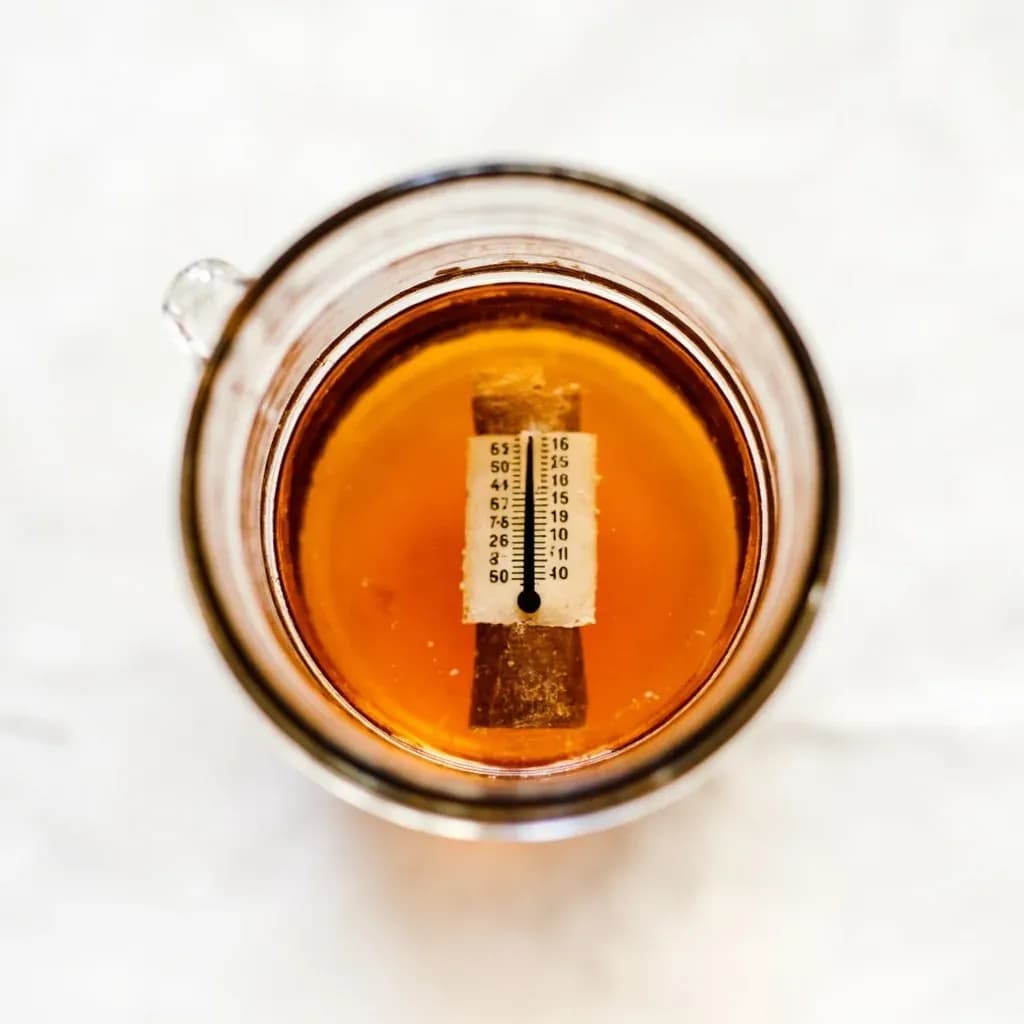
Gravity reading uses a hydrometer or refractometer to measure the density of a liquid relative to water, indicating dissolved sugar. Brewers, winemakers, and fermenters compare original and final gravity to gauge how much sugar has converted to alcohol and to estimate strength. Consistent readings signal that fermentation is complete.
A gravity reading is the workhorse measurement of every fermentation craft — beer, wine, cider, mead, and distilling wash all use it to convert the invisible work of yeast into numbers a cook can act on. The principle is simple: dissolve sugar in water and the liquid gets denser, so a calibrated float (or beam of light) sunk into wort, must, or wash will sink less. Read that depth and you have a snapshot of dissolved solids, which before fermentation tells you potential alcohol and recipe strength, and after fermentation tells you how much sugar the yeast has actually converted.
What makes the reading genuinely useful is that you can take it at any point in the process and compare it to the previous one. A drop of 20–30 points between pitch and the third day is consistent with healthy fermentation; a stuck reading at the same gravity a week or more in suggests a sluggish or stuck fermentation. Two identical readings 48 hours apart confirm the batch is done. The craft lies in getting the number right: temperature, bubbles, parallax, and (for refractometers) the presence of ethanol each conspire to mislead the unwary.
The technique is deceptively old — John Richardson's 1785 saccharometer let British brewers quantify mash strength a generation before yeast was understood as a living organism — and the same physics still drives the inexpensive glass hydrometer on a home brewer's shelf. Get the sample, the meniscus, and the temperature right, and a basic instrument will outperform any digital gadget for routine work.
- Difficulty
- Medium
Types & varieties
Calibrated 0.990–1.120 SG; the standard, inexpensive tool in home brewing.
Calibrated 0–25 °P; standard in professional brewing; expresses fermentables directly as a percentage.
Handheld, uses only a few drops of sample; ideal for small or precious volumes, but raw readings must be alcohol-corrected once fermentation begins.
Oscillating U-tube sensor with automatic temperature compensation; high precision and repeatable, but expensive and overkill for most small batches.
Tilted floating wireless hydrometer that logs gravity and temperature throughout fermentation; useful for tracking curves rather than spot readings.
How to do it
- 1
Sanitize all equipment
Soak the hydrometer, test jar, and any sampling tool in a no-rinse sanitizer such as Star San at roughly 1 oz per gallon. Drain; do not rinse. A splash of untreated tap water can contaminate the fermenter with chlorine or wild microbes.
- 2
Draw a representative sample
For an OG reading, cool wort in a sanitized pitcher to 20 °C or below before measuring; hot samples give a falsely low SG. For mid- and post-fermentation readings, draw from a well-mixed, settled fermenter through a sample port or wine thief, taking care to minimize splashing and headspace exposure.
- 3
Fill the test jar
Pour about 200 mL of sample into the test jar. The liquid should be deep enough that the hydrometer floats freely without touching the bottom or the walls.
- 4
Lower the hydrometer
Gently spin and release the hydrometer into the sample. Never push it down — forcing it wets the stem above the true reading and makes the value appear too low.
- 5
Pop bubbles and settle
Tap the jar lightly or blow across the surface to dislodge clinging CO₂ bubbles; trapped gas buoys the hydrometer and gives a falsely low SG. Wait 30–60 seconds for oscillation to stop.
- 6
Read at the meniscus
Crouch so your eye is level with the liquid surface and read the scale at the bottom of the meniscus to two decimal places (for example, 1.054). Reading from above or below introduces parallax error of a point or more.
- 7
Measure temperature and correct
Check the sample with a sanitized thermometer. If it differs from the hydrometer's calibration temperature, add roughly 0.001 SG per 3 °C (5 °F) warmer (or subtract if cooler) and record the corrected value.
- 8
Log the reading
Record date, time, corrected SG (or °P/°Bx), and sample temperature on the batch sheet. A reading without its temperature cannot be reinterpreted later if the equipment is questioned.
- 9
Return or discard the sample
If sanitation permits, pour the sample back into the fermenter to avoid waste. Otherwise discard, rinse the jar with cool water, and store the hydrometer vertically in its tube so the weighted paper inside does not shift and miscalibrate the scale.
- 10
Confirm terminal gravity and calculate ABV
When two readings 48 hours apart are identical, the batch is at terminal gravity. Calculate ABV ≈ (OG − FG) × 131.25, or use the Daniels or Cutaia formula for worts above 1.070 OG where the simple multiplier drifts high.
Scales and when to use them
Three scales coexist because they answer slightly different questions. Specific Gravity is dimensionless and tied to the cheapest instruments, which is why it dominates home brewing and the simple ABV formula. Plato and Brix both express dissolved solids as a percentage by weight, which is closer to the way malt bills and chaptalization tables are written — a 12 °P wort contains 12 g of extract per 100 g of liquid, full stop. A hydrometer calibrated in one scale can be read in the others with a conversion table; a refractometer is usually sold as a Brix or Plato model. Pick one scale per batch sheet and stay in it; conversions at the edge of the scale are where rounding errors hide.
Reading temperature and alcohol
Two corrections account for almost every bad number a brewer or vintner ever logged. First, a hydrometer floats higher in warm liquid and lower in cold liquid because the liquid's density changes with temperature — a sample that reads 1.050 at 25 °C is closer to 1.054 once cooled to 20 °C. Second, ethanol is less dense than water and less refractive than sugar solution, so a refractometer's raw Brix reading drops as fermentation proceeds even though sugar is being converted, not disappearing. The widely used Sean Terrill correction (SG ≈ 1.0000 + 0.0038·Brix − 0.000016·Brix²) brings refractometer readings of finished beer back in line with a hydrometer. Skip the correction and you will under-read FG and overstate ABV by a point or more.
Common uses
Tips & pitfalls
- Always sanitize the hydrometer, test jar, and sampling tool — a single splash of unsanitary equipment can ruin a batch.
- Take the OG reading at room temperature, ideally after chilling the wort in a sanitized pitcher; hot samples read falsely low.
- Read at the bottom of the meniscus with your eye level with the liquid; parallax from above or below easily introduces a full point of error.
- Tap the hydrometer gently to dislodge clinging bubbles; CO₂ clinging to the stem reads as a lower gravity than the wort actually has.
- Apply a temperature correction of roughly ±0.001 SG per 3 °C (5 °F) when the sample is off the hydrometer's calibration temperature, and log the temperature alongside the reading.
- If using a refractometer on finished or partially fermented beer, apply the Sean Terrill correction — ethanol skews the refractive index and the raw Brix reading will understate true SG by several points.
- Avoid opening the fermenter just to take a reading; use a sample valve or a closed-system thief to keep oxygen and contaminants out.
- Rinse the hydrometer with cool water immediately after use; dried wort residue coats the glass and skews future readings.
Good to know
- Primary purpose
- Measures the density of wort, must, or wash relative to water to quantify dissolved sugars and track fermentation progress.
- Common instruments
- Glass float hydrometer, digital density meter (oscillating U-tube), and optical refractometer.
- Units used
- Specific Gravity (SG, water = 1.000), degrees Plato (°P), and Brix (°Bx); 1 °P ≈ 4 SG points.
- ABV estimate
- ABV ≈ (OG − FG) × 131.25. Daniels and Cutaia formulas are more accurate above ~1.070 OG.
- Calibration check
- Pure water at the hydrometer's reference temperature should read 1.000 SG, 0.0 °P, or 0.0 °Bx.
- Reference temperature
- Most hydrometers are calibrated to 15.6 °C (60 °F) or 20 °C (68 °F); correct readings when the sample differs.
- Sample size
- Roughly 200 mL in a test jar, enough to float a standard 12-inch hydrometer freely.
- Typical ranges
- Beer OG 1.040–1.075 (FG 1.005–1.015 for dry styles), wine OG 1.090–1.115 (FG 0.990–1.005), mead OG 1.090–1.140.
Also called
Specific Gravity Reading
Related

Confit
Cook slowly submerged in fat for silky tenderness and keeping

Cure
Draw out moisture with salt and time to preserve and concentrate

Pickle
Steep in acidic brine for bright, tangy, crunchy preservation

Ferment
Let friendly microbes transform food into tangy, complex flavor

Marinate
Soak in a seasoned mix to flavor and tenderize before cooking

Brine
Soak in salt water so meat stays juicy and seasoned throughout

Dehydrate
Slowly dry out moisture to concentrate flavor and extend shelf life

Cold-Smoke
Perfume cured food with smoke without cooking it through