Transform & Preserve
Priming
Adding sugar at bottling so fermentation carbonates the drink in the container.
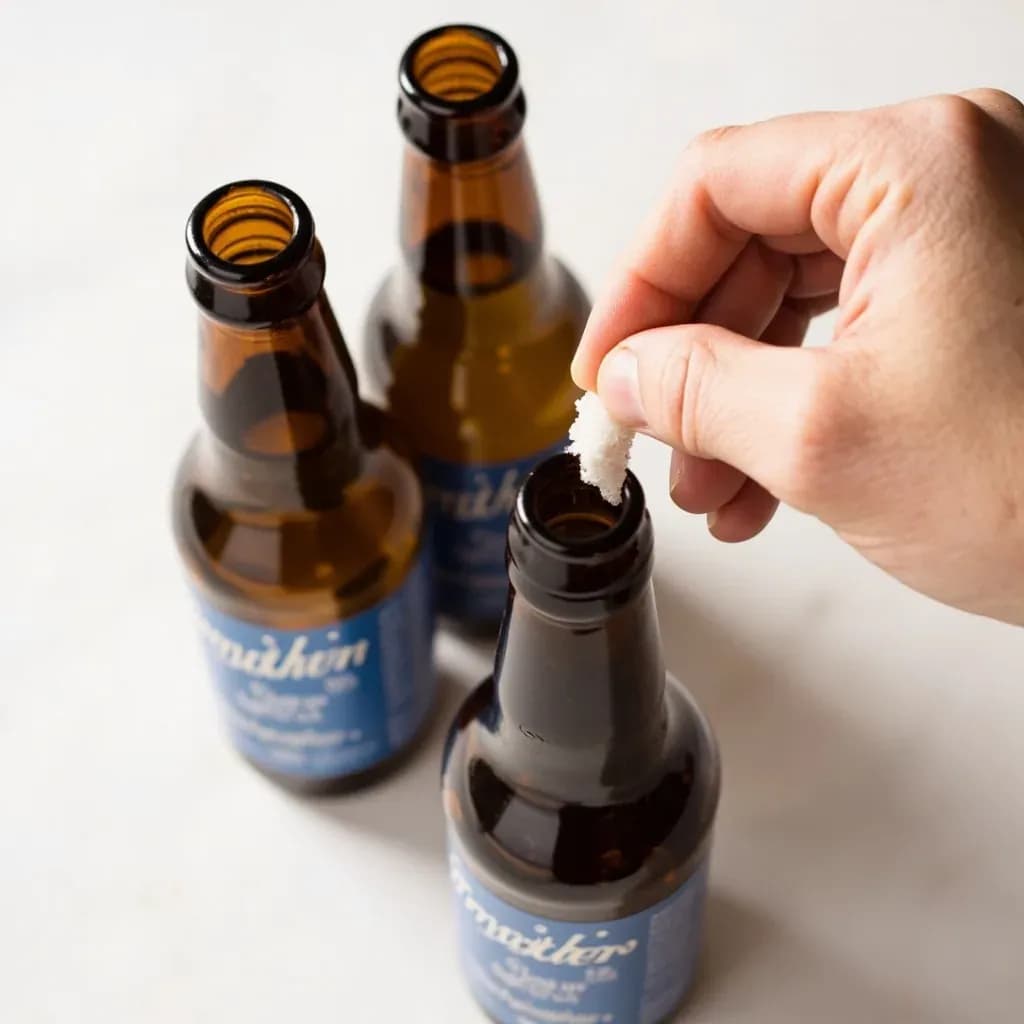
Priming adds a measured dose of sugar to beer, cider, or kombucha at bottling, giving the remaining yeast or culture a final feed that produces CO2 trapped in the sealed bottle. This bottle conditioning creates natural carbonation without force-carbonating. The sugar amount must be precise, as too much risks dangerous over-pressurization.
Priming is the brewer's quiet trick for putting fizz into a finished beverage. After primary fermentation has run its course and the gravity has settled, a measured dose of fermentable sugar is added at packaging. The residual yeast in suspension eats that sugar and exhales CO2 — which, with nowhere to escape in a sealed bottle, dissolves into the liquid under pressure. The result is natural carbonation with a softer, finer bubble structure than what comes from a CO2 tank, plus the gentle maturation that bottle-conditioning brings over the following weeks.
The technique matters because most styles of beer, cider, mead, and homemade soda are defined in part by their level of carbonation. A cask-style bitter at 1.0–1.5 volumes feels entirely different from a Belgian strong ale at 3.5, even if the underlying liquid were the same. Priming also lets the brewer dial in style-appropriate fizz without owning a kegging setup, and it produces a level of bottle integration that force carbonation rarely matches in the first weeks of conditioning.
Modern priming is a 20th-century homebrewing adaptation of an older British practice. Victorian brewers added a small measure of fresh, actively fermenting wort to aged stock ales to bring them back to life and lightly carbonate them in cask. Today's brewers skip the wort and dose straight sugar, though the name stuck.
- Difficulty
- Medium
Types & varieties
Brewers' standard; ferments cleanly and contributes no flavor of its own.
Widely available and neutral; slightly less efficient than dextrose, so use a touch more for the same carbonation.
Light or amber DME adds a touch of malt character that suits English-style ales.
Used in mead and braggot; about 25% less fermentable by weight than dextrose and contributes floral notes.
Light or dark; adds subtle caramel or fruit notes alongside carbonation.
Adds a distinct maple character; reduce the dose by ~25% versus corn sugar to avoid overcarbonation.
Imparts dark, rum-raisin notes; use sparingly in strong ales and stouts.
Traditional for hard cider and sparkling perry; carbonates while adding fruit sugar.
Fully fermentable; the traditional choice for British cask ales.
How to do it
- 1
Calculate the priming sugar
Determine the target volumes of CO2 for your style — roughly 1.0–1.5 vol for a cask-style bitter, 1.5–2.0 vol for an English bitter, 2.5–2.8 vol for an American pale ale, 2.0–2.5 vol for a witbier, 2.5–3.5 vol for a hefeweizen, and 3.0–4.0 vol for a Belgian strong ale. Use a priming calculator that accounts for beer temperature and the type of sugar being used, then weigh the sugar precisely in grams.
- 2
Sanitize and prepare equipment
Clean and sanitize the bottling bucket, racking tube, siphon, bottle filler, and caps. Have clean, sanitized bottles ready — swing-tops, crown-cap glass, or PET — and inspect each one for cracks, chips, or stress marks that could fail under pressure.
- 3
Make the priming solution
Boil the weighed priming sugar in 200–300 ml (about 1 cup) of water for 5 minutes to dissolve it and sanitize the syrup. Skim any hot-break or debris, then cool the solution to room temperature (20 °C / 68 °F or below) before use — adding hot or warm syrup to finished beer drives off CO2 and causes excessive foaming.
- 4
Confirm fermentation is complete
Take a hydrometer reading and another 24–48 hours later. Fermentation is finished when gravity has been stable for at least two consecutive readings. A small amount of viable yeast must still be in suspension; do not bottle beer that has been racked off a yeast cake and left to settle for months without rousing.
- 5
Add priming solution to the bottling vessel
Pour the cooled priming syrup into the sanitized bottling bucket first, or directly into the fermentor if it has a spigot. The goal is to have the priming solution on the bottom so the beer racked on top naturally mixes it in as the bucket fills.
- 6
Rack the beer onto the priming sugar
Siphon the beer gently from the fermentor onto the priming solution, splashing as little as possible to avoid oxygen pickup. If the bucket is not full enough to mix naturally, give it one gentle stir with a sanitized paddle — slow and even, not vigorous.
- 7
Fill and seal the bottles
Using a bottle filler attached to the siphon, fill each bottle to within about 2.5 cm (1 inch) of the top. Cap immediately with sanitized crown caps or seal swing-top bottles firmly. Consistency in fill level helps every bottle carbonate evenly.
- 8
Condition at room temperature
Store bottles upright at a stable 18–24 °C (65–75 °F) for 7–14 days. Do not refrigerate during conditioning — the yeast need warmth to work, and cold bottles will carbonate slowly or not at all.
- 9
Verify and age
After one week, chill a single test bottle in the refrigerator for 48 hours, then open it to assess carbonation. If flat, leave the rest another week and test again. Once fully carbonated, move bottles to cold storage to drop yeast and improve clarity, then age according to the style — many bottle-conditioned ales improve noticeably over 4–8 weeks.
Safety and bottle bombs
Glass bottles under pressure fail catastrophically. Over-priming — adding even 20–30% more sugar than a style calls for — can push a bottle past the working pressure of a standard crown cap, and the result is broken glass, lost beer, and potential injury. Treat every calculation as a starting point and verify with a chilled test bottle before opening the rest of the batch. The two most reliable safeguards are weighing sugar in grams (not tablespoons) and using a calculator that accounts for residual CO2 already in the beer at bottling temperature.
- Always use a calculator that factors in beer temperature, style, and target volumes — warmer beer holds less residual CO2 and needs slightly more priming sugar.
- Weigh sugar in grams; volumetric measurements are unreliable because crystal size and compaction vary.
- Use PET plastic bottles alongside glass for one batch as a pressure check — a bulging plastic bottle warns of an over-primed glass batch before it explodes.
- For very high-gravity beers above 1.080 OG, use champagne-style bottles or strong swing-tops rated for higher pressure.
- Reduce priming sugar by 10–15% when bottling at altitude, since lower atmospheric pressure raises effective carbonation.
Priming vs. force carbonation vs. krausening
Priming is one of three common ways to carbonate a fermented beverage, and the choice shapes the final character. Priming uses residual yeast to ferment fresh sugar in package, producing natural CO2 alongside weeks of bottle aging. Force carbonation injects CO2 from a tank under pressure — fast, repeatable, and flavor-neutral, but it skips the maturation that bottle-conditioning provides. Krausening adds a small portion of actively fermenting wort to finished beer, restarting fermentation with vigorous young yeast; it is the classic technique for German weissbier and many Czech lagers and produces the famously fine, creamy head associated with those styles.
Common uses
Tips & pitfalls
- Always run your numbers through a priming calculator that factors in beer temperature, style, and target volumes of CO2 — warmer beer holds less residual CO2 and needs slightly more priming sugar for the same fizz.
- Boil the priming sugar in 200–300 ml of water for 5 minutes to dissolve and sanitize, then cool to room temperature before adding; warm syrup drives off CO2 and causes foaming on transfer.
- Add the priming solution to the bottling bucket before racking the beer on top of it — the incoming flow naturally mixes the syrup in and avoids uneven carbonation bottle to bottle.
- Confirm fermentation is truly finished (stable gravity for 2–3 days) before priming; without enough residual yeast the priming sugar will not ferment and the bottles will go flat.
- Weigh sugar in grams rather than measuring by volume — crystal size and compaction make volumetric measurements unreliable.
- Leave at least 2.5 cm (1 inch) of headspace in each bottle to allow for foam during filling and pressure buildup during conditioning.
- Chill a single test bottle for 48 hours after the conditioning window to verify carbonation before opening the rest of the batch.
- Bottle one or two PET plastic bottles alongside the glass as a pressure check; a bulging plastic bottle warns of an over-primed glass batch before it becomes dangerous.
Good to know
- Also called
- Bottle conditioning, cask priming
- Most common priming agent
- Corn sugar (dextrose) — clean ferment, neutral flavor
- Typical priming rate
- ~4 g/L (about 2/3 cup per 19 L / 5 US gal) for moderate carbonation
- Target carbonation range
- 1.0–4.0 volumes of CO2 depending on style
- Conditioning time
- 7–14 days at 18–24 °C (65–75 °F); longer for high-gravity or high-carbonation beers
- Storage temperature
- Stable room temperature; warmth speeds carbonation, cold slows it
- Risk
- Over-priming causes overcarbonation and bottle bombs — never use unverified amounts in glass
- Origin
- British 18th–19th century practice of adding fresh wort or sugar to aged cask ale to restart fermentation
Related

Confit
Cook slowly submerged in fat for silky tenderness and keeping

Cure
Draw out moisture with salt and time to preserve and concentrate

Pickle
Steep in acidic brine for bright, tangy, crunchy preservation

Ferment
Let friendly microbes transform food into tangy, complex flavor

Marinate
Soak in a seasoned mix to flavor and tenderize before cooking

Brine
Soak in salt water so meat stays juicy and seasoned throughout

Dehydrate
Slowly dry out moisture to concentrate flavor and extend shelf life

Cold-Smoke
Perfume cured food with smoke without cooking it through