Transform & Preserve
Foaming (Espuma)
Aerating flavored liquids into light foams or espumas using gas, lecithin, or whipping.
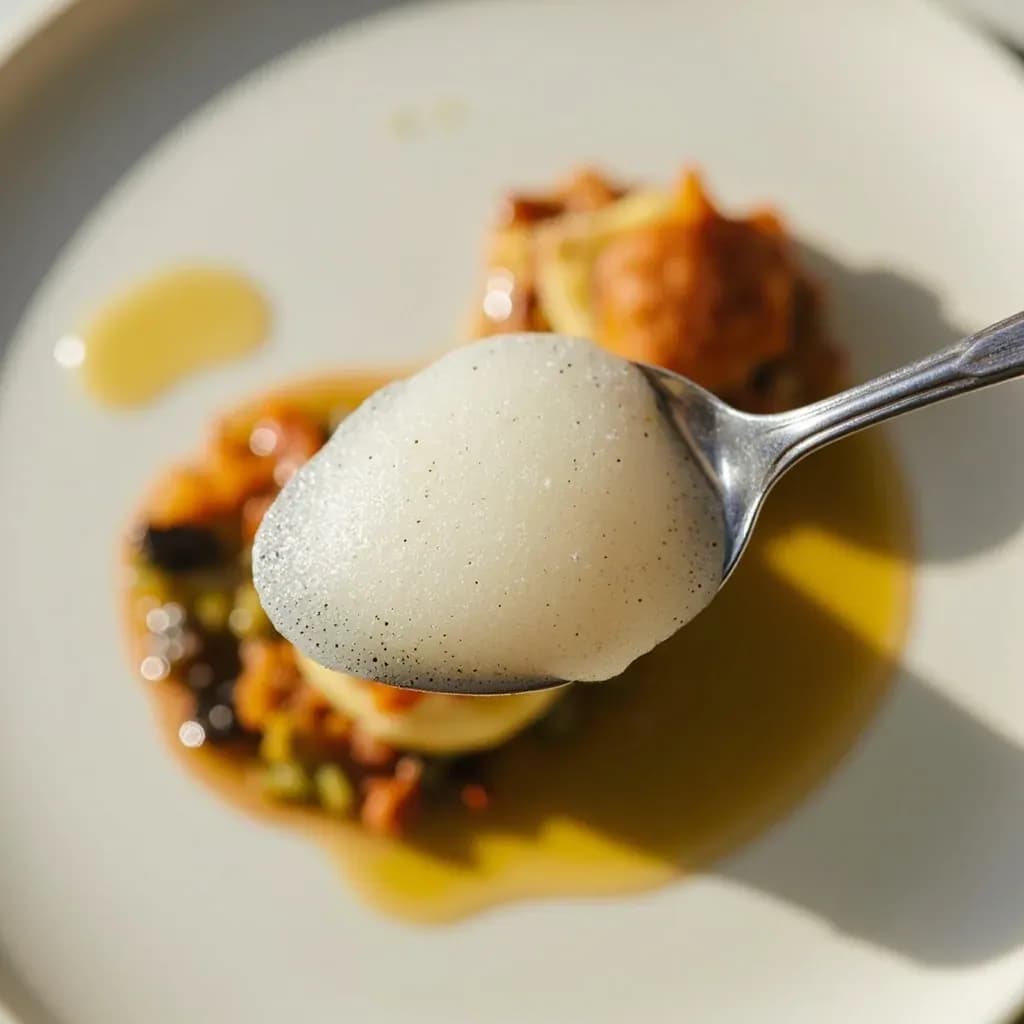
Foaming turns a flavored liquid into a light, airy foam, often called an espuma in modern cuisine. It can be achieved by charging a stabilized base in a whipping siphon with nitrous oxide, by blending in lecithin, or by simple agitation. The technique delivers concentrated flavor in a weightless texture, used to garnish dishes or add aroma without heaviness.
Foaming — often called by its Spanish name, espuma — is the technique of incorporating air or a dissolved gas into a flavored liquid so it holds the shape of a foam, mousse, or cloud. The foam carries pure, intense flavor in a form that dissolves almost instantly on the tongue, which is why modernists use it to finish a plate: a spoonful of parmesan espuma delivers the full dairy hit of a sauce in a texture that weighs almost nothing. The technique spans a surprising range, from a classic whipped-cream siphon charged with nitrous oxide to a humble bowl of warm lecithin-laced stock beaten with an immersion blender.
The underlying trick is the same as a meringue or a whipped cream: you need surface-active molecules (proteins, lecithin, gums) to stabilize bubbles of gas in a water-based liquid. The modernist variants give a cook more control over stability, temperature, and mouthfeel than the old egg-white-and-cream toolkit, and they let you foam things that would never hold air on their own — a clarified consommé, a citrus juice, a thin vegetable stock. The two branches to keep straight are the siphon method (powered by dissolved N2O — stable, repeatable, service-friendly) and the no-siphon methods (lecithin, agar, gellan, or xanthan — more fragile, but needing nothing beyond a stick blender).
- Difficulty
- Medium
Types & varieties
The classic Adrià technique: a flavored liquid charged in a whipped-cream siphon with nitrous oxide. Stable, repeatable, scalable for service, works hot or cold.
Air whisked or blended into a liquid stabilized with soy or sunflower lecithin. Delicate, melts on the tongue; collapses within 10–20 minutes.
A very weak agar set (~0.1–0.2%) blended to a mousse-like foam. Holds longer than lecithin and tolerates warm applications better.
Low-acyl gellan used like agar but at lower dosage; gives a cleaner, less gelatinous mouthfeel.
Xanthan gum at ~0.1–0.3% stabilizes air whipped in with a whisk or immersion blender; useful for sour or acidic bases where lecithin struggles.
Same siphon method, with the canister held in a bain-marie at 60–75 °C; common for purées, stocks, and warm sauces.
Standard service for fruit purées, cocktails, dairy, and chilled savory bases.
Old-school alternative: egg white or cream whipped into a flavored base. Technically a foam even though it predates the modernist vocabulary.
How to do it
- 1
Build a clean, flavorful base
Cook, infuse, or blend the flavor you want to carry (purée, consommé, dairy, stock, juice). Season, adjust acidity and salt, then pass through a fine chinois. The base should be fluid — about the consistency of single cream — and free of fibers, seeds, and skin.
- 2
Adjust the body and stabilizer
For a siphon espuma the base can usually be used as is; for thin or acidic bases add 0.1–0.2% xanthan or a touch of lecithin. For a lecithin foam, whisk 0.3–1% soy or sunflower lecithin into the warm (35–45 °C) liquid. For an agar foam, set 0.1–0.2% agar into a weak gel, chill, then crumble.
- 3
Load the siphon (siphon method)
Pour the base into the siphon, filling no more than about half the canister (room for gas and expansion). Screw the head on tightly. For cold bases insert one N2O charger; for hot or viscous bases use two.
- 4
Charge and dissolve the gas
After each charge, shake the siphon vigorously for 10–15 seconds, then let it rest 1–2 minutes so the gas fully dissolves. Refrigerate (or hold in a bain-marie at 60–75 °C) until needed.
- 5
Dispense and serve
Hold the siphon upright, vent briefly, and discard the first small burst. Dispense onto the plate or into a glass; the foam should hold its shape for at least 1–2 minutes.
- 6
Build a lecithin foam (no siphon)
With the lecithin-laden warm liquid in a wide bowl, hold an immersion blender just under the surface and run it on medium for 20–40 seconds until a thick cap of foam forms. Let it sit 30 seconds, then scoop the foam off with a spoon — don't stir it back in.
- 7
Build an agar or gellan foam
Blend the set gel on high until it becomes a smooth, aerated purée, about 30–60 seconds. Pass through a fine sieve for a cleaner texture if desired. Use immediately; the foam will begin weeping within 20–30 minutes.
- 8
Service and holding
Siphon espumas keep 2–4 hours in the dispenser; re-shake before each round of service. Lecithin and agar foams are made to order. Always taste before plating — bases change as they sit and may need a final salt or acid adjustment.
Siphon vs. no-siphon methods
The siphon branch is the workhorse of restaurant service: you build your flavored base, pour it in, charge with N2O, shake, and dispense foam on demand across a two-to-four-hour service. N2O dissolves under pressure into the liquid and, when the nozzle is opened, expands into a stable foam that holds its shape on the plate. The no-siphon branch uses food-grade emulsifiers and gums to trap room-air bubbles, either by blending, whisking, or processing a weak gel. These are more fragile and are typically made to order, but they need only an immersion blender and a bowl — useful for home cooks, for plating à la minute, or for any base that doesn't behave well in a siphon.
When foaming fails
Most foam disasters come down to one of three causes: the base is too thin and the gas slips out, the base is too thick and the nozzle clogs, or the stabilizer is wrong for the pH. Worth keeping in mind:
- Very low-protein liquids (water, clarified consommé, dilute stocks) need a stabilizer — a pinch of xanthan or lecithin — or the foam will weep within seconds.
- Acidic bases below about pH 3.5 break lecithin; switch to xanthan or gellan for citrus-heavy foams.
- High-sugar or high-alcohol bases (above ~20% ABV) resist foaming because they dry out bubble walls; dilute, or add a little lecithin/xanthan.
- Pure fats and very fatty liquids (above ~15% fat) will not hold a stable foam; build the foam from the water phase and incorporate fat as a garnish instead.
- If the foam is thin and wet, the gas didn't fully dissolve — you didn't shake hard enough or long enough after charging.
Common uses
Tips & pitfalls
- Strain the base through a fine chinois before loading the siphon; fibers and pulp clog the nozzle and burst bubbles.
- For lecithin foams, hold the immersion blender just under the surface so it pulls air down — fully submerging the head barely aerates.
- Soy lecithin can taste beany or soapy above about 1%; sunflower lecithin is more neutral and the better choice for delicate desserts.
- Charge the siphon, then shake hard for 10–15 seconds; the gas won't fully dissolve into a still canister and the foam will be thin and wet.
- Always test-dispense and discard the first burst after charging — it carries un-dissolved gas and uneven texture.
- Bases with high sugar or high alcohol (above ~20% ABV) resist foaming; dilute or add a little lecithin/xanthan to compensate.
- Don't try to foam clarified consommés or very low-protein liquids with a siphon alone — they leak gas; a small amount of lecithin or xanthan helps.
- Lecithin foams should be scooped, not poured — the layer beneath the foam is defatted, depleted liquid and is not the same texture.
- Keep the siphon upright and warm in a bain-marie for hot espumas; tilting vents the charge.
- Label and date the siphon if you hold it longer than one service — espumas pick up metallic notes after several hours.
- For very acidic bases (pH below ~3.5), lecithin performs poorly; switch to xanthan or a gellan-stabilized foam.
Good to know
- Origin
- Popularized by Ferran Adrià at elBulli (Roses, Spain) from the late 1990s, building on the molecular-gastronomy work of Hervé This and Nicholas Kurti.
- Spanish term
- Espuma means 'foam' in Spanish; 'espuma' specifically refers to siphon-charged foams, while 'aire' (air) and 'nubes' (clouds) are related elBulli vocabulary for lecithin- or agar-based foams.
- Driving gas
- Nitrous oxide (N2O) is used in siphons because it dissolves into the liquid without acidifying it or leaving carbonation; CO2 would make the foam fizzy and sour.
- Equipment
- ISI Whip or similar 0.5 L / 1 L siphon charged with N2O chargers; for hot applications a heat-rated siphon or a bain-marie hold is used.
- Yield (siphon)
- A 0.5 L siphon typically yields roughly 1.5–2.5 L of foam depending on the base and number of charges.
- Lecithin dosage
- Soy or sunflower lecithin is typically used at 0.3–1% of the weight of the base; savory foams sit at the lower end, intense or fatty bases at the higher end.
- Agar/gellan dosage
- Agar at roughly 0.1–0.2% sets a very weak gel that can be blended into a stable foam; low-acyl gellan works at even lower concentrations, around 0.05–0.1%.
- Cartridge count
- One N2O charge for cold liquids, two for hot or thicker bases; shake the siphon vigorously for 10–15 seconds after each charge.
- Hold time
- Siphon espumas keep 2–4 hours in the dispenser; lecithin foams collapse within 10–20 minutes and should be made to order.
- Base temperature
- Cold espumas dispense at 2–5 °C; hot espumas are held at 60–75 °C — above roughly 80 °C most siphons are not rated.
- Fat tolerance
- Pure fats and very fatty liquids will not foam well; bases with up to about 10–15% fat can be coaxed into a foam if the rest of the matrix is water- and protein-rich.
- Difficulty
- Beginner-friendly with a siphon; lecithin and agar foams require more practice to balance stabilizer load and air incorporation.
Also called
Espuma · Air
Dishes that rely on it
Related

Confit
Cook slowly submerged in fat for silky tenderness and keeping

Cure
Draw out moisture with salt and time to preserve and concentrate

Pickle
Steep in acidic brine for bright, tangy, crunchy preservation

Ferment
Let friendly microbes transform food into tangy, complex flavor

Marinate
Soak in a seasoned mix to flavor and tenderize before cooking

Brine
Soak in salt water so meat stays juicy and seasoned throughout

Dehydrate
Slowly dry out moisture to concentrate flavor and extend shelf life

Cold-Smoke
Perfume cured food with smoke without cooking it through