Prep & Assembly
Hand-Pulling Noodles
Repeatedly stretching and folding dough by hand to draw out thin noodle strands.
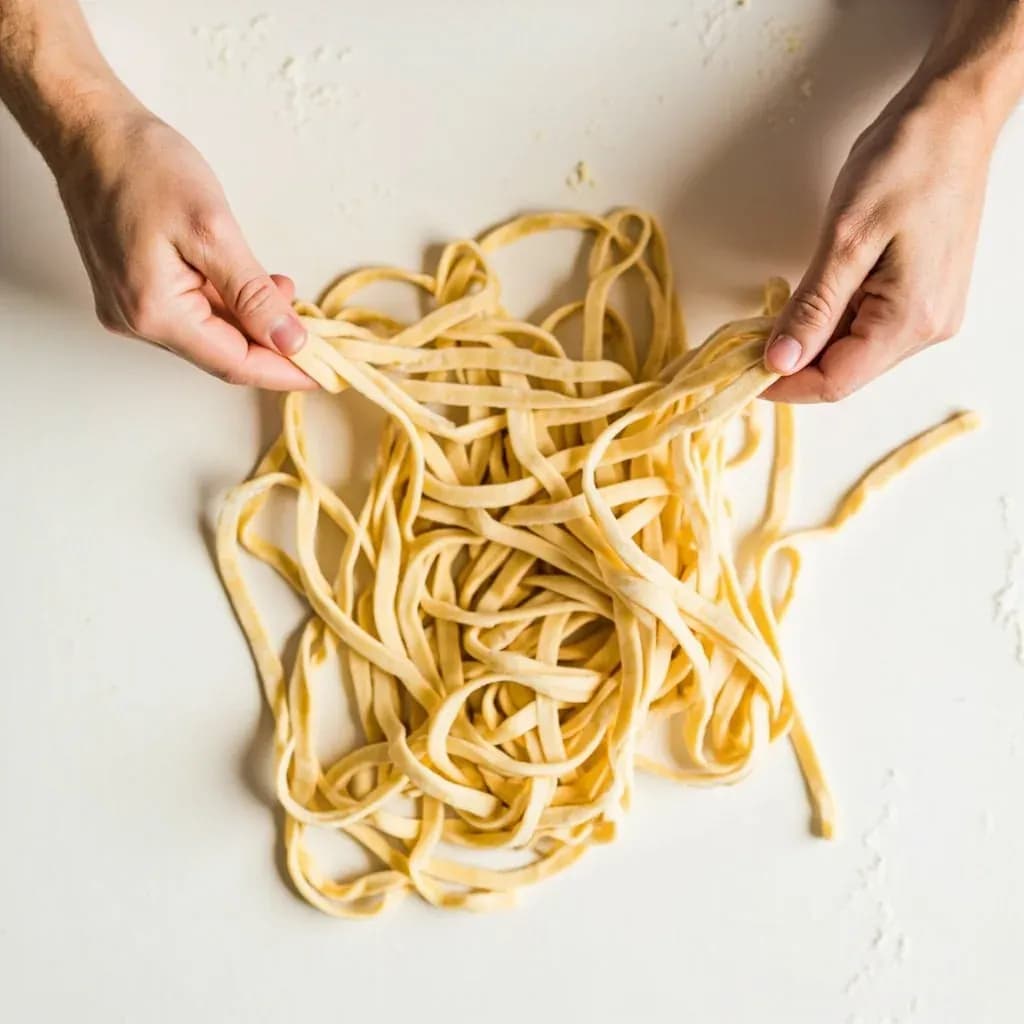
Hand-pulling is the lamian technique of stretching a well-developed wheat dough, then repeatedly folding and pulling it to double the strands each pass. Alkaline salt and rest give the dough the extensibility needed to draw many thin, even noodles without breaking. The pulled noodles are cooked immediately and prized for their springy, chewy bite.
Hand-pulling is a Chinese noodle technique in which a stiff, well-developed wheat dough is repeatedly stretched, folded, and twisted in the hands to align its gluten into long, even strands. Each fold doubles the number of strands while the cumulative stretch draws them thinner, allowing a single portion of dough to become many meters of finished noodle without a rolling pin, knife, or extruder in sight. The result is a noodle with a uniquely springy, slightly chewy bite and a rough, hand-formed surface that grips broth and sauce better than machine-cut or extruded pasta.
The technique is most strongly associated with Lanzhou in Gansu province, where Hui Muslim noodle masters turned it into a defining regional cuisine, but related styles exist across northwestern China and into Central Asia. What separates hand-pulling from neighboring stretched-noodle traditions — such as Shaanxi's biang biang or Shanxi's knife-shaved dao xiao mian — is the combination of even two-handed tension, repeated folding, and a notably dry, alkaline dough that holds its shape during aggressive manipulation. The alkaline agent, traditionally the lye-rich ash water called penghui, tightens the dough, deepens its yellow color, and contributes the slightly firm, springy texture that distinguishes a properly pulled noodle from ordinary fresh wheat noodles.
For the home cook, hand-pulling is less about flash and more about feel: a tight, well-rested dough, oiled hands and surface, and a steady, even pull. The reward is a noodle with snap, fragrance, and the visual theater of being made to order at the table.
- Difficulty
- Hard
Types & varieties
'Hair-thin,' the finest width at about 1 mm; made by many folds and twists, cooks in under a minute
Standard thin round strand, roughly 2 mm — the everyday choice for Lanzhou beef noodle soup
'Second thin,' slightly thicker than xìmiàn with a chewier bite
'Third thin,' round and firmer, with a feel close to spaghetti
'Chive-leaf,' a flat strand about the width of a chive leaf
'Buckwheat edge,' a triangular cross-section with a ridged, springy texture
Wide flat noodle, roughly 1–2 cm across
'Extra wide,' stretched into broad ribbons; the classic choice to serve under dà pán jī (big plate chicken)
How to do it
- 1
Mix the dough
Combine about 500 g high-gluten flour with 5–8 g salt and the alkaline agent of choice (1–2 g potassium carbonate or roughly ¼ tsp baking soda). Add 200–220 g cool water in two additions, stirring with chopsticks until shaggy. The dough should feel quite stiff and dry — not tacky like bread dough.
- 2
Knead to develop gluten
Turn out and knead vigorously for 10–15 minutes, folding and pushing, until the dough is smooth, firm, and springs back when poked. It should feel tight and elastic, like firm modeling clay. Resist adding flour; you want a tight dough for pulling.
- 3
Rest the dough
Shape into a ball, coat lightly with oil, place under a bowl or in a sealed container, and rest at cool room temperature for at least 1 hour, ideally 2–4 hours. Overnight in the refrigerator works well and often gives the most relaxed, pullable dough.
- 4
Oil and portion
Brush the rested dough with neutral oil, then cut into thick strips about 8–10 cm long. Roll each strip between oiled palms into a uniform 2–3 cm round log, coat with oil, and let them sit another 10–15 minutes so the gluten fully relaxes.
- 5
Pull the noodles
Take one oiled log and hold an end in each hand. Stretch gently and bounce the dough against the work surface to lengthen it, then fold in half and let the strands twist around each other. Stretch again, fold, twist — each fold doubles the number of strands. Stop when you reach the desired thinness: more folds for máowèi, fewer for kuān.
- 6
Cook immediately
Slip the finished strands onto an oiled or floured tray without letting them tangle, then drop straight into a large pot of vigorously boiling water. Hair-thin strands cook in 30–45 seconds; wider strands need 1.5–2 minutes. Drain, rinse briefly if serving cold, and toss into broth or sauce.
The role of the alkaline agent
Alkali is what gives hand-pulled noodles their signature color, aroma, and firm bite. Traditional penghui is a lye-rich water made by soaking the ashes of burned desert plants, and it raises the dough's pH enough to strengthen the gluten network, deepen the yellow hue, and contribute a faintly mineral, almost alkaline fragrance. In a modern kitchen, 1–2 g of food-grade potassium carbonate (or kansui powder) per 500 g of flour is a faithful substitute. A pinch of baking soda plus a small amount of salt can be used in a pinch, though the flavor is milder and the color less pronounced. Skipping alkali entirely produces a workable dough, but the resulting noodles will be paler, softer, and lack the characteristic snap.
How the pull actually works
Pulling is a controlled alignment of gluten. A well-kneaded and rested dough is essentially a tight web of gluten strands pointing in every direction; the first stretch lines them up along the axis of the pull. Folding the dough in half and stretching again doubles the number of strands while continuing to align and thin them. Each cycle of stretch, fold, and twist doubles strand count and halves thickness, so a thick 3 cm log pulled through eight cycles becomes a 256-strand bundle approaching 1.5 mm per strand — about the count and fineness of a proper máowèi. The hand motion is a smooth, even tug — never a jerk — and any uneven tension snaps the weakest strand and starts a tear. The traditional bounce against the work surface between pulls is not for show: it redistributes gluten along the length of the dough and relaxes the strand you are about to stretch.
Common uses
Tips & pitfalls
- Use a high-protein flour (bread flour or 12–14% protein all-purpose) — too little gluten and the strands snap mid-pull.
- Do not skip the resting period; gluten must relax or the dough will fight you and tear at the first stretch.
- Coat rested dough generously with neutral oil so strands slip against the table and against each other rather than sticking.
- Keep tension even on both hands while pulling — an uneven pull is the single most common cause of broken strands.
- Pull only what you will cook right away; once stretched, noodles should hit boiling water within minutes to stay springy.
- If the dough resists stretching, rest it another 15–20 minutes rather than forcing it — fighting tight dough guarantees tears.
- In dry climates, tent the resting dough with a damp cloth to prevent a skin from forming on the surface.
- Slap the rested dough firmly against the work surface a few times before pulling — this redistributes gluten along the length of the strand and relaxes it for a cleaner stretch.
Good to know
- Origin
- Northwestern China, most strongly associated with Lanzhou, Gansu, and the Hui Muslim noodle tradition
- Chinese name
- Lāmiàn (拉面), literally 'pulled noodles'
- Flour
- High-gluten (high-protein) wheat flour, ideally 12–14% protein; bread flour is a good stand-in
- Hydration
- Roughly 40–45% water-to-flour by weight — notably drier than pasta or bread dough so strands hold their shape while stretched
- Alkaline agent
- Traditional penghui (蓬灰) ash water; modern substitutes include food-grade potassium carbonate, kansui powder, or a small amount of baking soda
- Resting time
- Minimum 1 hour at room temperature, ideally 2–4 hours; overnight refrigeration also works well
- Tools required
- Hands only — no rolling pin, knife, or extruder; an oiled work surface or tray for holding finished strands
- Cook time
- 30 seconds to 2 minutes in vigorously boiling water, depending on strand thickness
- Yield reference
- About 500 g of flour yields 3–4 generous portions of fresh noodles
Also called
Lamian Pulling · Pulled Noodles
Dishes that rely on it
Related

Whisk
Beat ingredients smooth and aerated with a looping wire motion

Sift
Pass dry ingredients through mesh to aerate and remove lumps

Strain
Pour through mesh to separate solids from liquid for a smooth result

Filter
Pass liquid through fine material to clarify out the smallest particles

Rice
Press cooked potatoes through small holes for fluffy, lump-free texture

Mash
Crush soft cooked food into a rustic, creamy purée

Grind
Crush food into a coarse to fine texture, from spices to meat

Grate
Shred food into fine bits against a sharp-toothed surface