Prep & Assembly
Hand-Stretching Dough
Coaxing dough into shape by hand stretching rather than rolling, as for pizza and bagels.
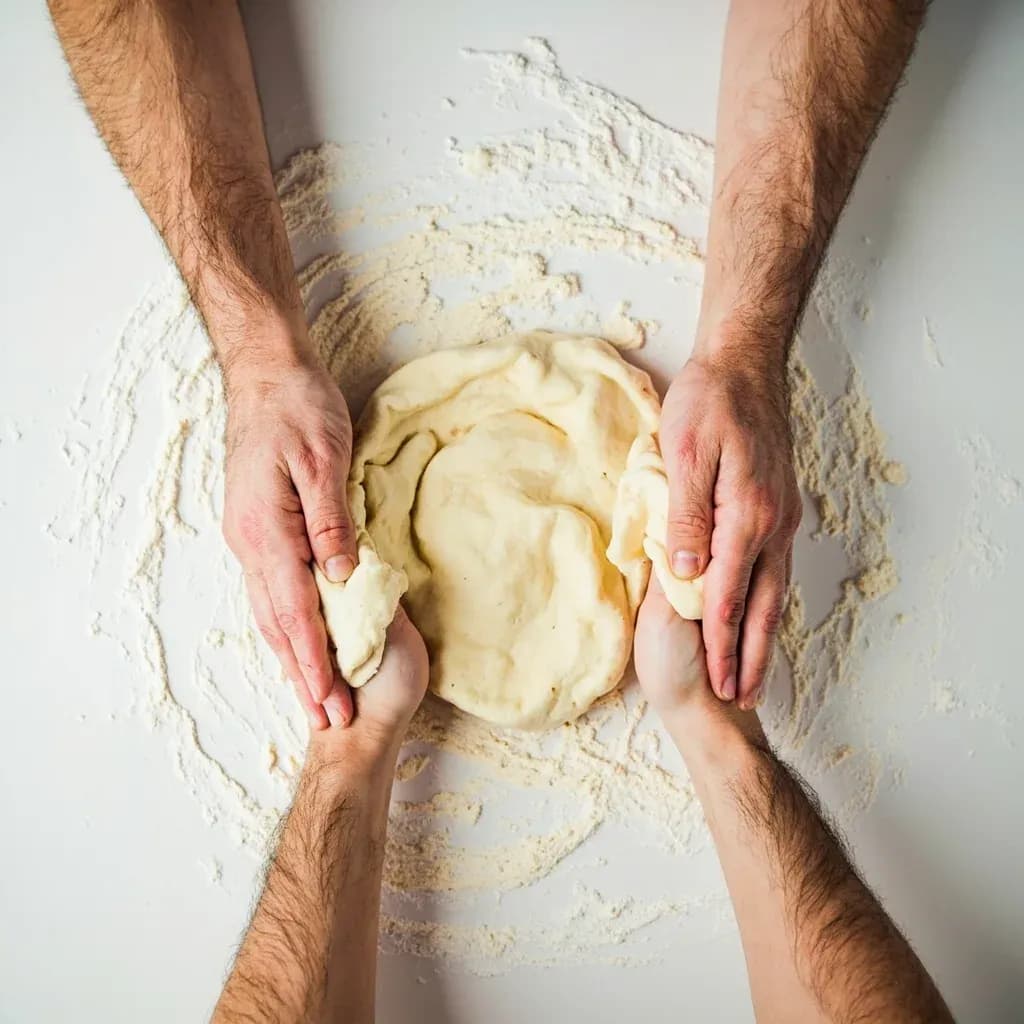
Hand-stretching shapes leavened dough by gently pulling and slapping it outward with the hands, preserving the gas bubbles that a rolling pin would press out. It produces the open, airy rim of Neapolitan pizza and shapes breads like bagels, relying on the dough's elasticity and the baker's feel. The slap-and-stretch motion also develops gluten in wet doughs during mixing.
Hand-stretching is the workhorse shaping method for any dough whose final texture depends on the gas network built during fermentation. By coaxing the dough outward with gravity, knuckles, and the flat of the hand rather than compressing it with a rolling pin, the baker preserves the alveoli that give pizza its open crumb, bagels their dense chew, and flatbreads their tender, blistered interior. The trade-off is sensitivity: dough temperature, hydration, and handling time all matter more than they do with a pin, and the technique rewards a light, patient touch over force.
The reason rolling pins are avoided in styles like Neapolitan pizza is mechanical. A pin flattens dough from the top down, squeezing carbon dioxide out of the cells that a long cold ferment spent hours building. It also aligns the gluten strands into a tough, sheet-like structure that resists the quick, violent expansion of oven spring. Hand-stretching works the dough from the center outward, leaving the interior loosely structured and the cornicione — for pizza, at least — visibly puffy. Whether the goal is a 30 cm Neapolitan disc, a taut bagel ring, or a thin pocket of pita, the principle is the same: read the dough, work fast, and let gravity do the heavy lifting.
- Difficulty
- Medium
Types & varieties
Dough draped over both fists; gravity and gentle rotation pull it outward, leaving a puffy cornicione. Considered the gold standard.
Flatten with fingertips on a floured bench, then pull outward from the edges. Common for New York–style and home cooks.
Dough laid across the backs of both hands, rotated and allowed to sag; used for large thin-crust styles.
Specific motion: roll into a rope, wrap around the hand, and seam the ends through the palm to form the ring; preserves the dense, chewy interior.
Brief, controlled lift-and-settle motion used for naan and some pita styles to encourage thinness without tearing.
How to do it
- 1
Temper the dough
Remove the dough from the fridge and let it sit, covered, until pliable — typically 1–2 hours for a cold-fermented ball, or until it holds a finger dent without snapping back.
- 2
Prepare the surface and hands
Lightly dust the bench with '00', semolina, or bread flour. Coat your hands with a thin layer of flour or a little olive oil. Avoid heavy flour on the dough's face.
- 3
Form an initial disc
Turn the dough out seam-side down. Using flat fingertips or the heels of your hands, gently press outward from the center to flatten into a rough 12–15 cm disc, leaving a slightly thicker rim.
- 4
Knuckle-stretch (pizza)
Lift the disc and drape it over the knuckles of both fists. Let gravity pull it downward while you rotate your hands. Work from the center outward, never touching the edge ring, until the disc reaches 25–35 cm.
- 5
Counter stretch (alternative)
Lay the disc on the bench. Pick it up by the edge, let the weight pull it down slightly, rotate a quarter turn, and lay it back down. Repeat, then gently pull the edge outward with the backs of your hands.
- 6
Rest if it resists
If the dough snaps back or feels tight, set it on a floured surface, cover, and rest 5–10 minutes so the gluten relaxes before continuing.
- 7
Check thickness
Hold the stretched dough up to the light; the center should be translucent in thin spots but uniform. The cornicione should remain visibly thicker — about 1–2 cm tall and un-stretched.
- 8
Transfer and top immediately
Drape the dough onto a floured peel (or a semolina-dusted tray for pan styles), dock any large bubbles with a quick poke, and add toppings. Bake without delay to preserve the open crumb.
- 9
For bagels: roll and thread
Divide rested dough into equal pieces (typically 85–115 g). Roll each into a 20 cm rope with tapered ends. Drape the rope around your fingers, overlap the ends on the palm, then roll the seam under your hand on the bench to seal and form an even ring.
Reading the Dough
A successful stretch is a conversation with the dough, not an act of force. Three signals tell you almost everything you need to know. Temperature is the first: a ball pulled from the fridge at 4°C will feel rubbery and snap back the moment you press it; a ball left out at 24°C for too long will feel slack, sticky, and prone to tearing. The sweet spot is 18–22°C, when the dough yields to the hand but still has structure. Spring-back is the second signal: if the dough resists your stretch and tightens, the gluten is tense and needs a 5–10 minute rest under a cloth, not more force. Pushing against resistance is the single most common mistake in home stretching, and it almost always leads to a tear. Translucency is the third: when you hold a stretched disc up to the light, you should see an even, slightly translucent field in the center with a noticeably thicker, opaque rim. Thin spots that read as bright or hole-prone need one more pass; a uniformly bright disc means the cornicione has been overworked.
Troubleshooting
Even with good technique, things go wrong. A small tear in pizza dough is recoverable: pinch the edges together firmly, lay the dough seam-down on the peel, and proceed — most pinches disappear in the oven. A large blowout usually means the dough was overworked, under-tempered, or stretched too thin at the edges; patch it by folding the torn edge underneath, or set the dough aside to rest. A dough that sticks to the bench can be released with a bench scraper dusted in semolina; never try to peel it with your fingers, which stretch and tear the gluten. If the bottom of the disc picks up too much flour during transfer, give the peel a quick shake before launching — a layer of loose flour will smoke and burn bitter on the oven floor.
Common uses
Tips & pitfalls
- Temper cold-fermented dough on the counter for 1–2 hours before shaping — cold gluten snaps and tears, and most stretching failures start here.
- Flour the surface and your hands lightly, but never the face of the dough; over-flouring toughens the crust and burns bitter in the oven.
- Press with flat fingertips or the heels of the hands, not pointed fingers, which punch through and create holes that are hard to patch.
- If the dough resists and springs back, cover it and rest 5–10 minutes — pushing against tight gluten is the most common cause of blowouts.
- For pizza, aim to handle the dough in under 90 seconds; every extra minute risks degassing and undoing the work of fermentation.
- Rotate the disc as you stretch so thickness stays even; check by holding it up to the light for thin spots before topping.
- Drape the stretched dough over lightly floured knuckles or the back of a fist; never squeeze the rim with your fingertips, which kills the cornicione.
- Keep a bench scraper nearby to release dough that sticks to the bench without tearing the gluten.
- For bagels, weigh each piece before rolling so rings bake evenly and don't dome unevenly in the oven.
Good to know
- Purpose
- Shape dough while preserving internal gas bubbles (alveoli) developed during fermentation, yielding an airier crumb and better oven spring than rolling.
- Dough Temperature Range
- Best worked at roughly 18–22°C (65–72°F); cold dough resists and tears, warm dough sticks and deflates.
- Hydration Range (Pizza)
- Typically 60–75% hydration; lower hydration doughs are easier to handle but produce a tighter crumb.
- AVPN Rule
- The Associazione Verace Pizza Napoletana requires shaping without a rolling pin or mechanical press.
- Neapolitan Targets
- Final disc about 25–35 cm (10–14 in) wide, center 3–4 mm thick, edge (cornicione) 1–2 cm tall.
- Rest Between Stretches
- If dough springs back, rest 5–10 minutes under a cloth to relax the gluten before continuing.
- Key Tool Avoided
- Rolling pin — compression deflates the dough's gas network and toughens the crust.
- Difficulty
- Beginner-friendly for flatbreads; intermediate for thin-crust pizza; bagel threading takes a few attempts.
Also called
Hand-Shaping Bagel Dough · Slap-and-Stretch (Schiaffo) · Stretching Dough
Dishes that rely on it
Related

Whisk
Beat ingredients smooth and aerated with a looping wire motion

Sift
Pass dry ingredients through mesh to aerate and remove lumps

Strain
Pour through mesh to separate solids from liquid for a smooth result

Filter
Pass liquid through fine material to clarify out the smallest particles

Rice
Press cooked potatoes through small holes for fluffy, lump-free texture

Mash
Crush soft cooked food into a rustic, creamy purée

Grind
Crush food into a coarse to fine texture, from spices to meat

Grate
Shred food into fine bits against a sharp-toothed surface